In 1945, brothers Alfred and Andrew Collier donated 146 Oregon acres to the state as a memorial to their parents; today, Collier Memorial State Park spans 536 acres and preserves the regionâs logging history
US News: Explore the rich history of Collier Memorial State Park, a tribute to the Collier brothers' parents, showcasing over 150 years of logging heritage and serving 350,000 annual visitors in Oregon.
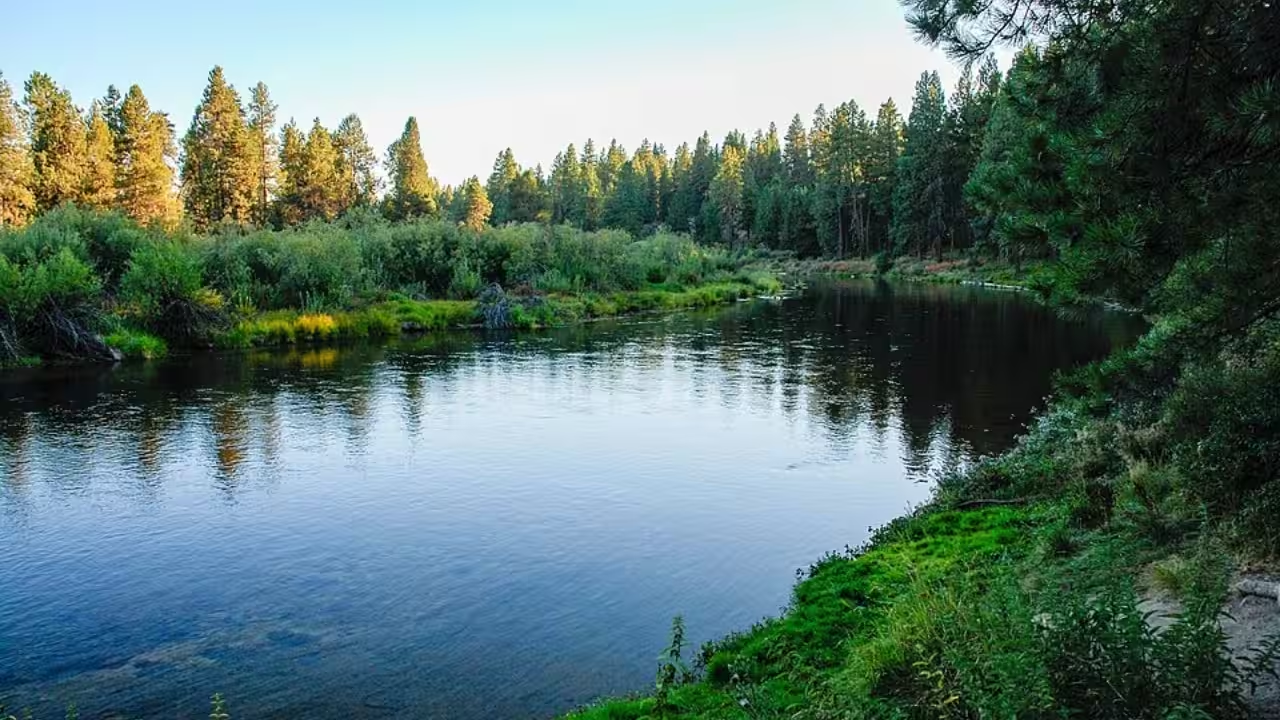
In 1945, brothers Alfred D. and Andrew Collier of Klamath Falls donated 146 acres of what would become Collier Memorial State Park to the state of Oregon as a memorial to their parents, Charles Morse Collier and Janet McCormack Collier. The initial 146 acres were only the beginning: over the next four decades, Oregon slowly acquired additional land, thus expanding the park to its present 536 acres. Today, the Oregon Parks and Recreation Department says that the park serves more than 350,000 visitors every year, combining outdoor recreation with one of the countryâs notable collections of historic logging equipment.A family memorial turns into a state parkThe Collier familyâs connection with the property went beyond the memorial donation. The brothers, Alfred D. and Andrew Collier, were involved with Klamath Falls business interests, including the Swan Lake Moulding Company, and their ventures left them with a significant collection of antique logging and lumbering equipment. According to Oregon State Parks, the idea of a logging museum was conceived by the brothers from the beginning, making the preservation of the regionâs timber history part of the parkâs purpose from its early years.In 1947, the brothers donated the first machines that would eventually become part of the Collier Logging Museum. Notably, the collection did not stay limited to those original pieces: donations continued over subsequent decades, while Alfred Collier reportedly continued finding new equipment for the museum until his death in 1988. Through these continuous acquisitions, the collection grew to encompass nearly 150 years of industrial timber history, chronicling the evolution of logging technology from the late 19th century onward.While the outdoor logging museum currently covers an expansive 146-acre footprint, matching the exact total acreage of the brothers' initial 1945 deed, the surrounding park footprint did not remain static. Instead, the state strategically acquired adjacent timber tracts over the years, absorbing the museum into a much larger 536-acre recreational ecosystem.The parkâs expansion from 146 acres to 536 acresThe park expanded over decades rather than in a single acquisition, with the Collier brothers helping acquire additional land through 1962, according to Oregon State Parks. In 1981, the final tract was obtained from the US Forest Service, completing the major additions that brought the park to its current size.Furthermore, the parkâs location helped shape what it became, with the Williamson River and Spring Creek converging within the property and the surrounding landscape connecting the park with broader forests and recreational areas of south-central Oregon. The Williamson River is regionally known for its trout fishery, while Spring Creek is a clear spring-fed stream flowing through the park. Today, visitors can camp, fish, explore trails and visit the outdoor logging museum.Meanwhile, the logging museum remains the parkâs defining historical feature, and its outdoor collection includes rare and antique equipment dating to the 1880s, alongside machinery from later periods. The exhibit underscores how timber harvesting changed as railroads, engines and mechanised equipment transformed the industry. Additionally, the museum contains a cabin village made up of buildings constructed between 1880 and 1920, which were originally sourced from a 100-mile radius across the pine-forested high plains of south-central and eastern Oregon and relocated to the park grounds.Transformation from private tribute to major public destinationThe state organisation reported that donations for the museum continued to grow long after the brothersâ initial contributions. They noted that donations for the museum continued to grow long after the brothersâ initial contributions, rolling in over nearly eight decades to establish a highly comprehensive regional archive.The park itself survived several changes that significantly affected its historic landscape, including the Two Four Two wildfire in September 2020 that burned through part of Collier Memorial State Park and damaged portions of the logging museum. The stateâs Park and Recreation agency reported that most of the museumâs roughly 10,000 artefacts survived, although two major pieces of historic equipment, one of its buildings and areas of the surrounding ponderosa-pine forest were damaged. Despite those changes, the original purpose of the property remains visible through the state-initiated intensive multi-year ecological restoration projects, hazardous tree mitigation, and historical structure rebuilds following the disaster. Thanks to these comprehensive recovery efforts, the park successfully reopened its gates in phases.Today, the parcel given to the state as a family memorial has become a public park that attracts hundreds of thousands of visitors annually, according to the state brochure. Within it, the museum preserves the history of the stateâs logging industry, while Williamson River, Spring Creek, the forest and the campground support recreation.Catch the latest World News and Live updates. Download the TOI app.
Topics in this story
Gathered from external sources. Rights to this text belong to whoever originally published it.