OpenAI's Sam Altman criticises Anthropic’s push to explore AI consciousness and religion
OpenAI CEO Sam Altman has criticised efforts to give artificial intelligence a religious or spiritual dimension, in what appeared to be a pointed response
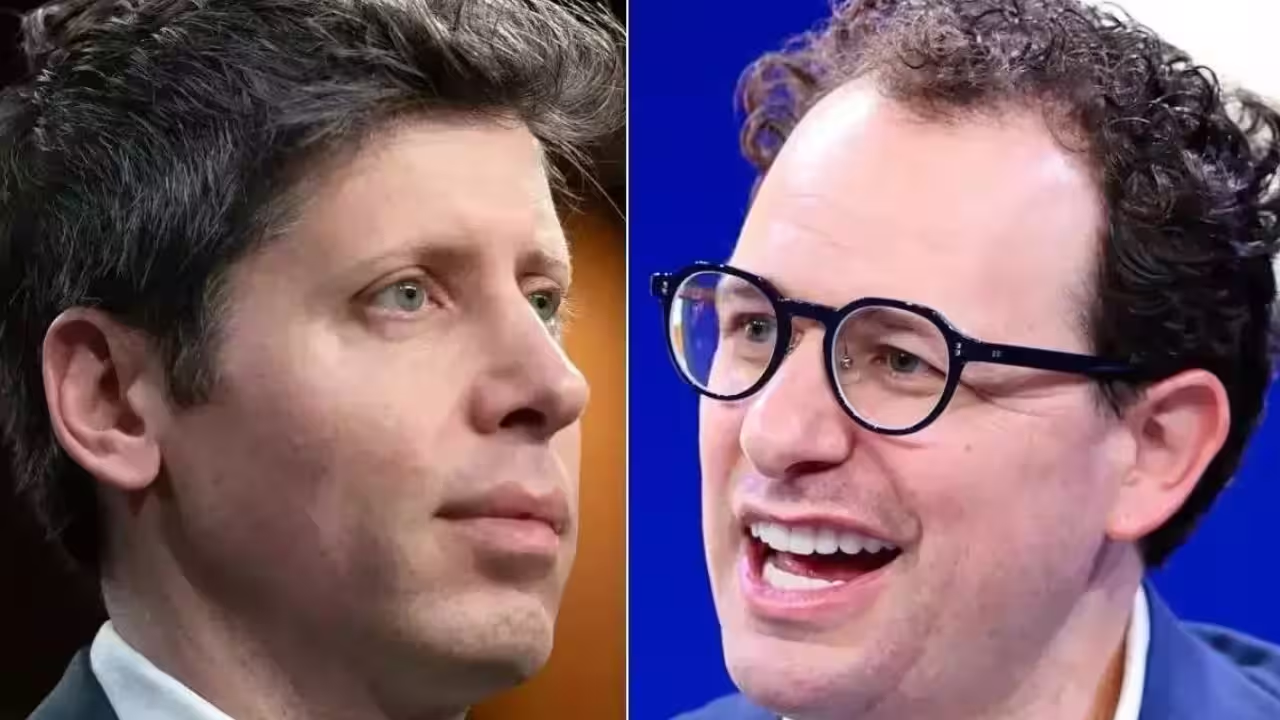
OpenAI CEO Sam Altman has criticised efforts to give artificial intelligence a religious or spiritual dimension, in what appeared to be a pointed response to work being explored by rival AI company Anthropic.Altman said he was "very uncomfortable" with attempts to give AI models religious significance or treat them as entities that could replace human judgement. His comments come as Anthropic researchers are exploring questions around whether AI systems could one day be conscious and how religious ideas might shape the way such systems behave.Altman raises safety concerns"I am very uncomfortable about people trying to ascribe religious force or a surrender of human judgment to AI models, and think it is a real safety issue," Altman said in a post to X.The comments were widely seen as a criticism of Anthropic and its co-founder Dario Amodei, who previously worked with Altman at OpenAI.The disagreement is about more than whether AI can think. It concerns whether future AI systems could have consciousness, feelings or some form of moral status, and whether humans should treat them differently if they do.Anthropic explores AI and religionThe debate intensified after The New York Times reported that Anthropic co-founder Christopher Olah had been speaking with religious leaders about AI consciousness and the possibility of building stronger moral behaviour into AI models.According to the report, Olah had also explored whether AI models could use practices inspired by religion. One idea considered was whether an AI system could take part in something similar to Catholic confession, allowing it to acknowledge mistakes and potentially influence its future behaviour.Before a Vatican event in May, Olah also reportedly tried to persuade advisers to Pope Leo to take the possibility of conscious AI systems more seriously.The issue has now become a wider debate within the technology industry, with some prominent AI researchers openly questioning whether AI models should be given any kind of moral or spiritual standing.Scientists push backGoogle DeepMind principal research scientist Jon Barron criticised the idea in a post on X."I am disturbed by how some of my fellow AI researchers keep trying to elevate the moral standing of checkpoints and harnesses," Barron wrote. "I hope the rest of us on Team Meatbag reject this movement and stay focused on solving real problems and helping actual humans."The discussion has also drawn attention from Pope Leo, who has been vocal about the risks AI poses to human creativity. On Friday, he urged the Catholic Church to work with artists to protect human creativity, saying, "Algorithms lack the spark of humanity."The growing disagreement comes as AI safety discussions have traditionally focused on more immediate risks such as cyberattacks and the use of AI to assist in developing biological weapons.But the latest debate raises a more fundamental question about the future of AI. If machines ever become conscious, should humans treat them as more than tools, and could religion have a role in deciding how they should behave?Neither OpenAI nor Anthropic immediately responded to requests for comment on Altman's post.You use AI every day. Now get your AI Quotient. Take the AIQ test.
Topics in this story
Gathered from external sources. Rights to this text belong to whoever originally published it.