In 2018, Dutch engineers replaced a bike path with hollow panels made from recycled plastic; after 1 million crossings, the trial reported 50–70% lower carbon emissions, and rain storage reached 48% capacity
Discover how Dutch engineers have transformed bike paths using hollow panels made from recycled plastic, achieving 50-70% lower carbon emissions and innovative stormwater management after 1 million rides.
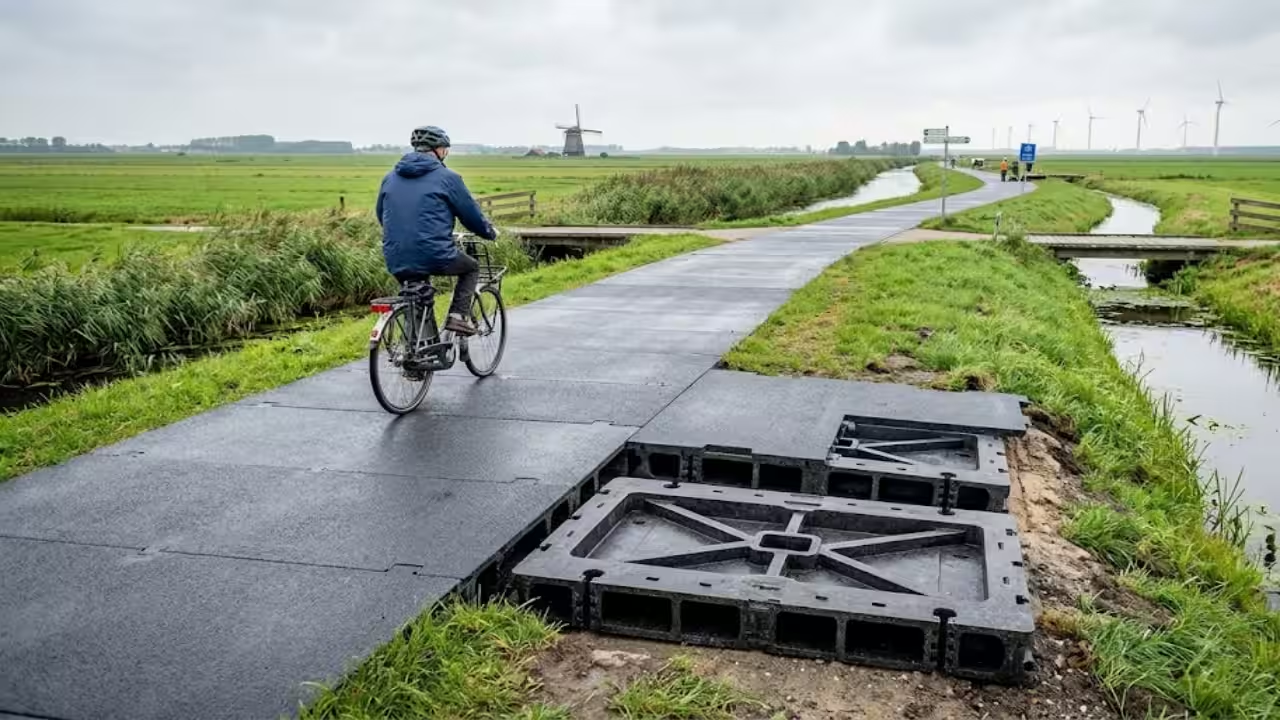
From above, a bicycle path typically appears straightforward, with a strip of ground underneath it, a hard surface, and painted markings. By substituting hollow prefabricated panels made mostly of recycled plastic for a traditional route, engineers in the Netherlands used that hidden area as part of the experiment. Three concepts were combined to create the Plastic Road prototype. The panels' hollow innards might temporarily store stormwater, their modular design could make parts easier to install or repair, and they could provide used plastic a second chance at life.The first pilot, a 30-metre path in Zwolle, opened in September 2018, followed by a second in Giethoorn that November Wavin/Orbia release. By May 2020, the Zwolle path had registered its millionth bicycle crossing. The project team also estimated that the pilot design produced around 50% to 70% lower carbon emissions than typical asphalt or concrete-tile bike lanes. The initiative was an experiment, not a suggestion that plastic roads should replace conventional pavement everywhere. But the never-ending flow of bicycle traffic and the constant monitoring by sensors gave engineers more data than a short laboratory trial could deliver.The hollow space under the pathThe Plastic Road was not a slab of plastic simply laid on the ground. It used prefabricated modular parts with a hollow space below the surface. That hollow space had several purposes. In a heavy rainstorm, it could give space for rainfall, and the same design could also fit wires, pipelines and sensors without having to dig up the pavement later. The Province of Overijssel's 2018 annual report describes the Zwolle section as made of recycled plastic and fitted with sensors for continuous monitoring. It calls the construction a climate-adaptive system, because the internal space can temporarily hold rainfall. The pilot was never meant to represent a whole citywide cycle network, since the Zwolle section was only about 30 metres long.A million bicycle crossingsThe first path in Zwolle opened in September 2018, and the second pilot followed in Giethoorn that November. Sensors in the sections tracked temperature, bicycle passes and loading, allowing the developers to observe how the modular structure behaved rather than relying on visual inspections alone. In May 2020 the project recorded its one millionth bicycle crossing. Developers said the paths had withstood everyday bicycle traffic as well as heavier loads such as maintenance vehicles and garbage trucks after more than a year and a half of testing.The one-million figure is useful because it represents repeated real-world loading. It does not mean the path experienced one million identical stress events, nor does it establish a lifespan of one million rides. It simply shows that the pilot had accumulated a substantial amount of use before the developers moved toward commercialization. A product can perform well during a limited test while still requiring much longer monitoring before engineers can establish how it behaves over decades.Where the carbon figure comes fromThe carbon claim needs similar context. The 50% to 70% estimate compared the pilot design with typical bicycle lanes built of asphalt or concrete slabs, and it relates to the pilot's production and construction processes, not to all possible roads made of recycled plastic. Factors such as the source of recycled plastic, manufacturing energy, transport, and the comparison pavement influence life-cycle calculations.Subsequent work on the technology needed a separate environmental review. An independent life cycle assessment of the later Plastic Road CCL series showed fewer carbon emissions than several reference pavement options; however, the numbers were based on the later product rather than just replicating the original 2018 pilot study. That is why the 50% to 70% figure applies only to the 2018 pilot and should not be read as a general property of plastic pavement.Where the rainwater wentThe hollow structure also provided space for stormwater, so not every heavy rain had to go straight to the normal drainage. Sensors showed that the highest water level in the Zwolle structure reached only 48% of its storage capacity during heavy showers, and the water infiltrated into the soil within two days, according to Wavin.This is a relevant finding for Dutch towns, where so much concrete can make it difficult for rainfall to penetrate the earth straight away. A structure that provides temporary storage just below the path can reduce the amount of water traditional drainage must handle at any one time. Research on modular plastic pavement has also highlighted this internal volume as one of the main differences between prefabricated hollow plastic systems and regular roadways. A 2023 study examining prefabricated plastic pavement systems described hollow modules as a way to combine a lightweight road structure with space for utilities and temporary water storage.What the experiment provedThe Dutch Plastic Road did not prove that all bike paths have to be recycled plastic. Its pilots were short, the design was still evolving and the carbon figure was the developers' own estimate, while the crossing count and the 48% water level came from sensor monitoring. After the pilots, the team formed a standalone company, PlasticRoad, in 2020 to prepare for commercial production. In this pilot, the notable idea was the combination of repurposed material, modular construction and hidden water storage.You use AI every day. Now get your AI Quotient. Take the AIQ test.
Topics in this story
Gathered from external sources. Rights to this text belong to whoever originally published it.