In 2006, a floating-home resident challenged Riviera Beach’s $2.4 billion waterfront redevelopment plan; the city later abandoned it
In 2006, Fane Lozman challenged a $2.4 billion redevelopment plan in Riviera Beach, Florida, leading to landmark legal battles over eminent domain, maritime law, and property rights.
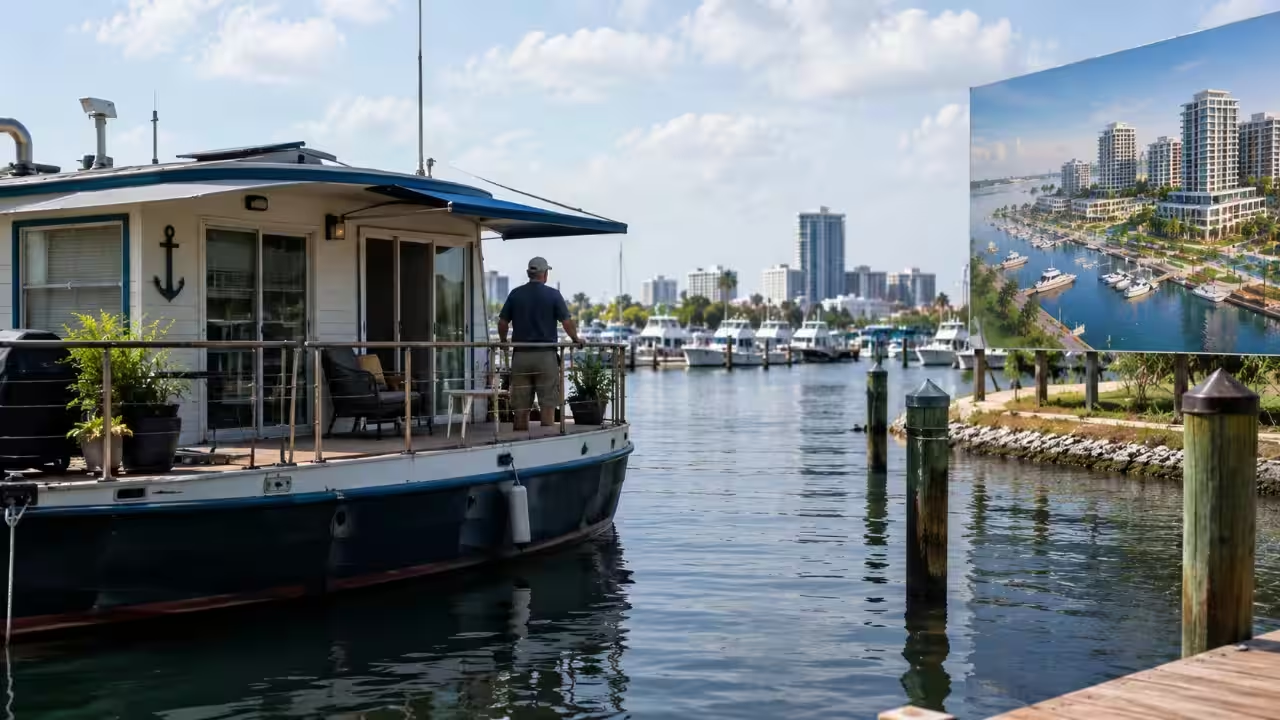
In 2006, a small floating home in Riviera Beach, Florida, became central to a larger fight over land, redevelopment and local government power. Fane Lozman had moved his houseboat into the city-owned marina when he discovered that Riviera Beach was planning a $2.4 billion waterfront redevelopment project. The proposal called for acquiring about 2,200 homes and businesses, along with the marina, through eminent domain and transferring the properties to a private developer.According to the University of Miami Law Review, Lozman became an outspoken opponent of the redevelopment plan and challenged the city's actions surrounding the proposed project. Lozman objected publicly to the plan and challenged how the city approved its agreement with the developer. Within months, the redevelopment scheme was abandoned. It developed into a series of court battles that eventually took Lozman and his unusual home to the US Supreme Court.A waterfront redevelopment plan meets a new lawFor several years, Riviera Beach had been pursuing a major redevelopment of its waterfront. The proposed project, estimated at $2.4 billion at the time, was intended to transform the marina area through private development. Plans included commercial and residential properties, as well as facilities for visitors and yachts. The redevelopment was also affected by changes to Florida's eminent-domain laws. State lawmakers passed House Bill 1567 on May 4, 2006, restricting the use of eminent domain for economic-development purposes, and Gov. Jeb Bush signed the legislation into law on May 11. In the middle of this process, on May 10, the Riviera Beach City Council agreed to work with Viking Inlet Harbour Properties as the project's master developer. By November 2006, however, the city had abandoned the waterfront redevelopment scheme.From redevelopment opponent to courtroom defendantLozman’s resistance to the plan led him to attend Riviera Beach City Council meetings frequently. His lawsuit over the development agreement led to further conflict with the city. In one case, Lozman was described as a loudmouth criticising the redevelopment project and alleging wrongdoing by city officials. Later, the city attempted to remove Lozman from the marina. One dispute concerned the terms of his marina residency.The dispute also drew academic attention. As the University of Miami Law Review notes, the redevelopment controversy came before the dispute over Lozman’s floating home and formed part of the background to his ongoing conflict with Riviera Beach. The city later filed a separate federal suit arguing that the floating home was a vessel subject to federal admiralty law. It was a 60-by-12-foot two-story wooden home consisting of a kitchen, bathroom, bedroom, and office space.The floating home reaches the Supreme CourtAccording to the Florida Law Review, the legal significance of the case extended beyond the unusual appearance of Lozman's home. The dispute eventually reached the US Supreme Court, which ruled in 2013 that Lozman's floating home was not a vessel under federal maritime law. The justices said the key question was whether a reasonable observer would see the structure as designed to a practical degree to transport people or things over water. Because the home lacked features associated with maritime transport and was designed as a residence, the court ruled in Lozman’s favour. The decision established a “reasonable observer” test for determining vessel status, though later cases raised questions about how consistently it could be applied.However, Lozman’s legal disputes with Riviera Beach did not end with the 2013 ruling. In 2018, the Supreme Court said the lower court had used the wrong test to evaluate Lozman’s retaliation claim and sent the case back for further proceedings. What began as a dispute over waterfront redevelopment grew into a long legal history involving eminent domain, open-government laws, free speech and maritime law. The $2.4 billion project was abandoned in 2006, but the legal disputes surrounding Lozman’s floating house continued for years and reached the US Supreme Court more than once.You use AI every day. Now get your AI Quotient. Take the AIQ test.
Topics in this story
Gathered from external sources. Rights to this text belong to whoever originally published it.