Psychology says children who ask you to repeat a silly word again and again may be enjoying more than the joke
There is a moment many parents will recognise.
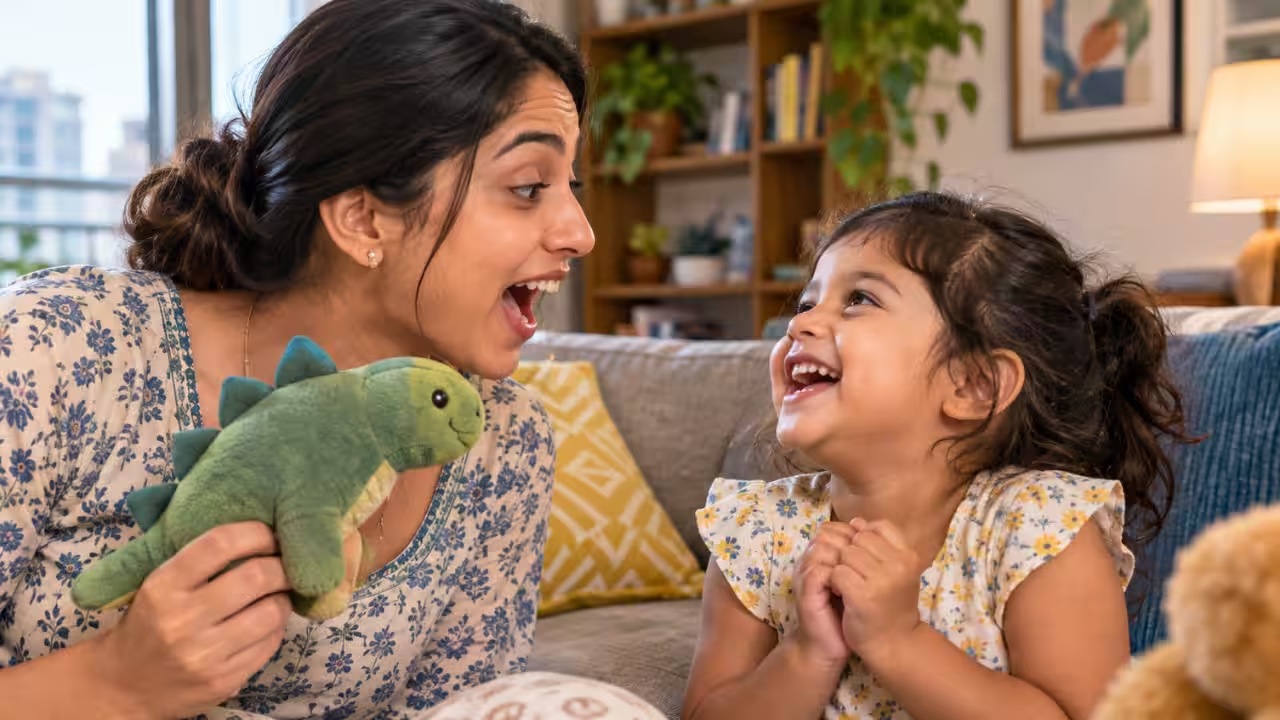
There is a moment many parents will recognise. You accidentally call a spoon a “spoonasaurus”, give a funny name to your child’s favourite toy, or say a completely nonsensical word in a silly voice. Your child bursts out laughing and asks you to say it again. You oblige. They laugh harder. Before long, the same word has been repeated 15 times, and you are beginning to wonder what could possibly be so funny about it.For adults, the joke may have run its course after the first few repetitions. For a young child, however, the fun may lie in much more than the word itself. There is the anticipation of hearing it again, the pleasure of knowing what comes next, and the excitement of sharing a moment that makes both of you laugh.This everyday interaction offers a small window into how children experience humour, communicate with others and learn to participate in playful social exchanges. The word may be silly, but the experience surrounding it is not necessarily trivial.Why does the same silly word remain funny?One explanation lies in the way children learn to recognise and appreciate humour. A word becomes amusing not only because of what it means, but also because it sounds unexpected, breaks an established pattern or is delivered in an unusual way.A parent who calls a cat a “fluffy potato” is deliberately mixing things that do not ordinarily belong together. A toddler may not be able to explain why the phrase is funny, but can still enjoy the surprise.Research published in the journal Developmental Psychology by Thomas R. Shultz and Frances Horibe examined how children aged six, eight, 10 and 12 understood verbal jokes. The study found age-related differences in how children appreciated unexpected elements in jokes and how well they understood the resolution that made those jokes meaningful.The findings suggest that recognising humour develops with age and that children do not necessarily process jokes in the same way adults do. For younger children, the unexpected element itself can be particularly appealing.This helps explain why a made-up word, a deliberately wrong label or an exaggerated sound can entertain a child long after an adult has stopped finding it amusing. The child may be enjoying the sound, the surprise or the playful departure from what is normally expected.However, this does not mean that every child who repeats a funny word is consciously analysing a joke. Their enjoyment may be much simpler: something sounds funny, a trusted adult says it, and the experience feels good enough to repeat.The joke may be familiar, but the anticipation is still excitingThere is another reason children may keep asking for the same word: they know what is coming, and they want to experience it again.Adults often associate humour with novelty. Once we know the punchline, the surprise can disappear. Young children, however, may enjoy the entire sequence of a playful exchange, including the familiar sound, the parent's exaggerated expression and the laughter that follows.Think of a parent who says “chocolate” in a squeaky voice every time a child asks for a treat. Soon, the child may start requesting the word before the treat itself. They may even begin laughing in anticipation.The appeal is no longer limited to the original joke. It has become a little ritual between parent and child.A 2025 study published in the journal Social Development, titled Can You Make Me Laugh? Toddlers’ and Parents’ Shared Positive Expressions in Playful Interactions, examined playful interactions involving 80 parent–toddler pairs, with the toddlers aged around 30 months.Researchers observed smiles and laughter during play and found that positive expressions were shared between parents and children. Both could initiate these expressions, and the intensity of their smiling and laughter was positively associated.The study does not specifically establish why children request repeated silly words. It does, however, offer evidence that laughter during early childhood is a shared, interactive experience rather than simply an individual reaction to something funny.When a child asks for the same word again, they may therefore be asking to recreate an enjoyable interaction. The parent’s voice, facial expression and response are all part of what makes the moment work.Repeating the word can also become a game of connectionFor a young child, asking a parent to repeat a silly word is also a way of taking an active role in a conversation.Instead of merely listening to an adult, the child makes a request, watches the response and decides whether the exchange should continue. The parent follows the child's lead, and the child learns that their words can influence what happens next.This is an important feature of early communication. Conversations are not just about learning the meanings of words; they also involve taking turns, responding to another person and expressing what we want.Research on early language development has examined how parents' speech and repetition relate to children's language abilities. A 2020 study in the Journal of Experimental Child Psychology, for example, explored parental repetition during interactions with two-year-olds and its association with vocabulary at age four.The study involved 21 families. Although its findings were limited and did not establish a general causal effect of repetition, the researchers reported a positive association between fathers' repetition of children's utterances at age two and children's vocabulary diversity at age four.This research was not about silly words or humour, so it cannot prove that repeating a funny phrase improves a child's vocabulary. It does, however, illustrate why repeated exchanges between parents and children are worth paying attention to.When a child requests a word again, a parent can respond, pause for the child's reaction and allow the child to initiate the next turn. These small exchanges give children opportunities to communicate their preferences and participate in a shared activity.The important part is not how many times the word is repeated. It is that the child is engaged in an interaction in which their contribution matters.You use AI every day. Now get your AI Quotient. Take the AIQ testGet the latest Lifestyle News and more. Download the TOI app.
Topics in this story
Gathered from external sources. Rights to this text belong to whoever originally published it.