In 2014, a woman left Oregon alone to walk the world; after six and a half years, she returned with 20,000 miles and one terrifying attack behind her
In 2014, Angela Maxwell embarked on a six-and-a-half-year journey, walking around the world solo, overcoming challenges like heat stroke, dengue fever, and a terrifying assault. Discover her inspiring story of resilience, self-discovery, and adventure.
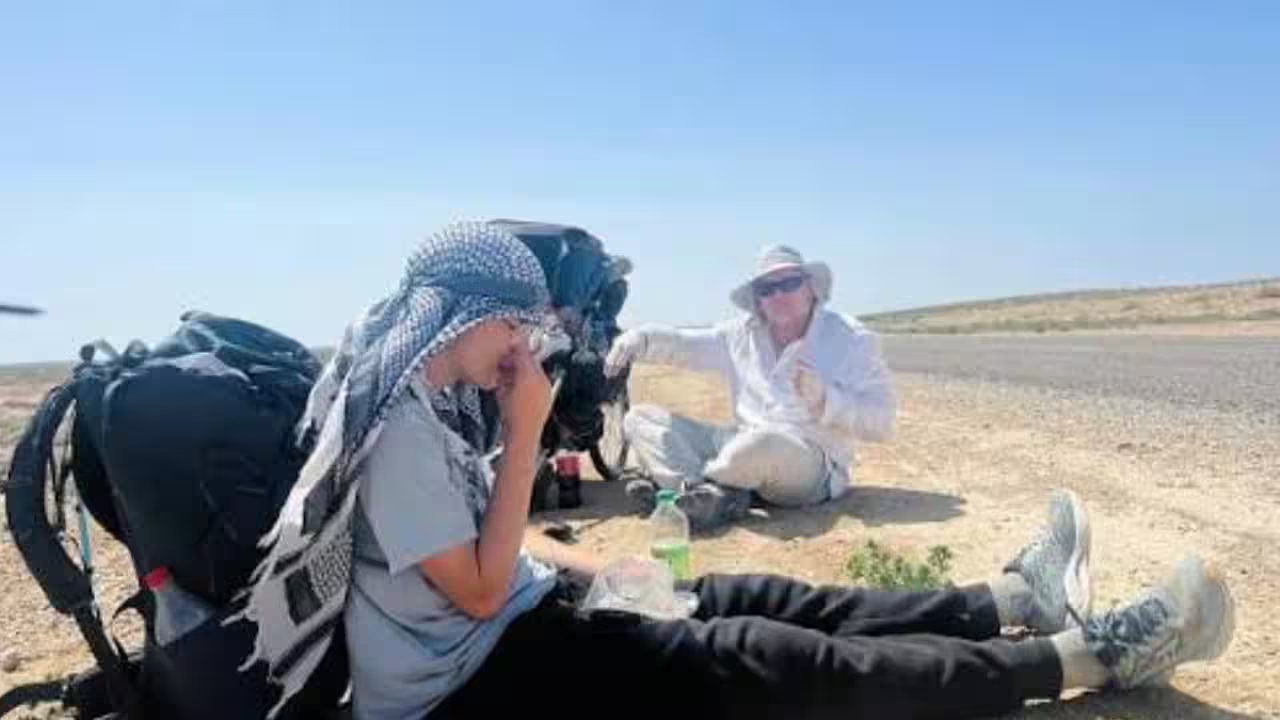
On 2 May 2014, Angela Maxwell left Bend, Oregon, with a two-wheeled cart, camping equipment and no fixed end date. She had decided to walk around the world, despite having little previous experience with long-distance hiking. What began as an unusual personal challenge eventually became a six-and-a-half-year journey across four continents, 14 countries and more than 20,000 miles.According to ABC News, Maxwell had been working as a life coach and business consultant when she began thinking about making a major change. She had heard about people who had travelled around the world on foot and became fascinated by the idea. Within about nine months, she had sold most of her belongings, prepared her equipment and set off. Her journey was not a continuous walk the entire way. She used flights between some destinations and walked for long stretches once she arrived.A journey planned one leg at a timeMaxwell's preparation was relatively short for an expedition of such scale. She told ABC that she had no previous hiking experience and spent about nine months researching equipment, reading about women adventurers and building up her fitness. She eventually carried her belongings in a two-wheeled cart, which became a familiar part of her journey. She spent about $5 a day, which meant camping much of the time and carrying her own food and water. Her meals were often simple, including oatmeal and instant noodles. The cart held her tent, cooking equipment, clothing and other supplies, allowing her to remain largely self-sufficient while travelling.Her route changed as she travelled. She walked from Bend to Portland, then flew to Western Australia and travelled north through some of the country's harshest terrain. She later continued through New Zealand, Southeast Asia, Mongolia and Europe. Her route later took her through Italy, Georgia, Turkey, Switzerland, France, Belgium, England and Scotland before she returned to the United States. The physical demands were considerable. In Australia, she experienced heat stroke and severe sun blisters. In Vietnam, she contracted dengue fever and spent about a month recovering. Yet Maxwell has said that the walking itself was not always the hardest part. Being alone and deciding whether it was safe to continue often required more from her than the distance did.The night in MongoliaAccording to BBC Travel, about a year into her journey, Maxwell experienced one of its most frightening moments in Mongolia when a nomad broke into her tent and sexually assaulted her. After the attack, she moved away from the campsite and spent the remaining hours of darkness hiding with her cart before deciding what to do next. Despite the experience, Maxwell continued her journey and eventually completed her walk around the world.It was the only time during the expedition when she seriously thought about giving up on the trip. Maxwell went on to say that thinking about stories of other women who had managed to survive an attack inspired her to keep going. This experience made her rethink how she approached her safety. Throughout the rest of the trip, she was more vigilant at night, especially when camping out, and she took further steps to protect herself in her tent. She chose to include this experience in her story, but it did not define the entire trip. Most of Maxwell's experiences were with people who helped her on her journey.Six and a half years laterMaxwell reached her destination on December 16, 2020, and returned to Bend, where her journey had begun, to the home of the friend who had helped her set out on the adventure. By then, she had covered more than 20,000 miles and spent six and a half years travelling from one country to another and from one landscape to another. Finishing the trip was not easy. Later, Maxwell said she had changed after years without belongings, talking to strangers and living with uncertainty. When she returned, walking had taken on a different meaning: an attempt to lead a life based on simplicity, travelling slowly and figuring out how far she could go on her own.You use AI every day. Now get your AI Quotient. Take the AIQ test.
Topics in this story
Gathered from external sources. Rights to this text belong to whoever originally published it.