In 2023, British rail researchers tested crushed old glass in place of scarce rail sand; it gave trains comparable grip and caused similar rail wear in wet and leaf-covered tests
In 2023, British researchers explore the feasibility of using crushed recycled glass instead of traditional rail sand to improve train grip during wet and leaf-covered conditions, revealing promising results.
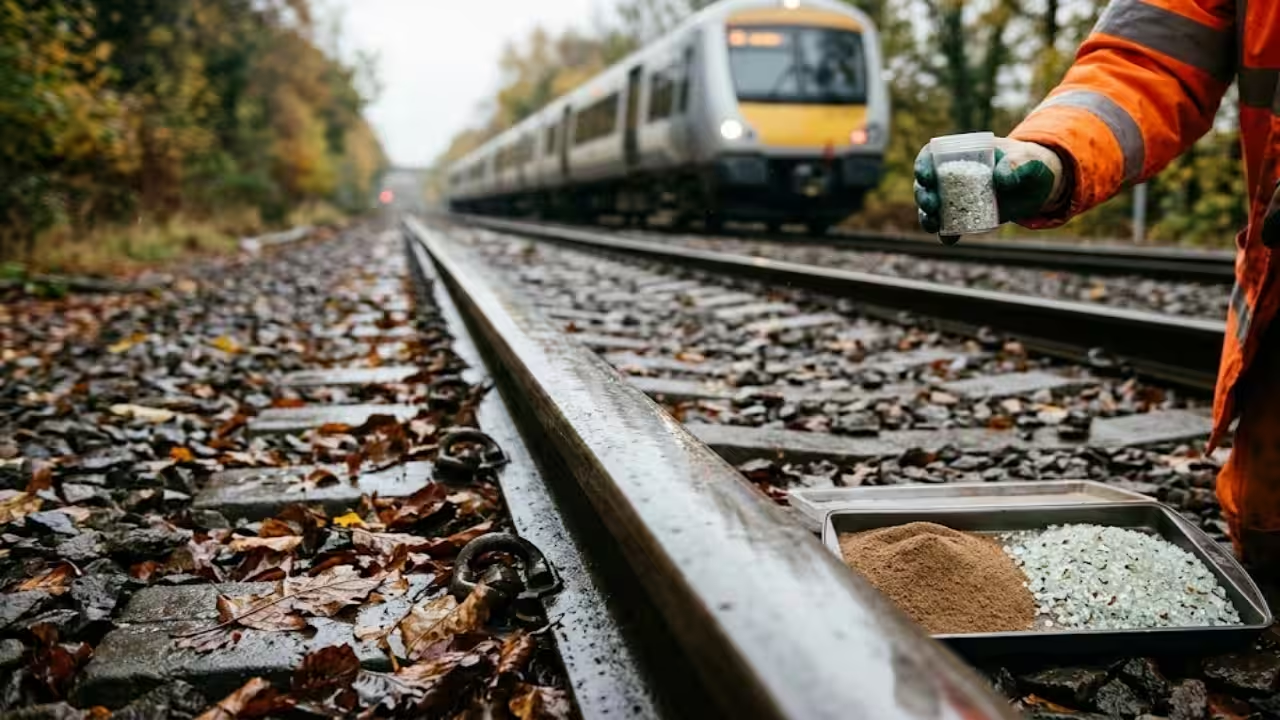
Each autumn, railway workers in Britain get ready for the same slippery situation. Leaves fall on to the track, are mashed by the wheels and turn into a slippery film that is notoriously difficult for trains to get a grip on. The long-standing remedy has been to blow a little sand on to the rail just in front of the wheels. The trouble is that sand is not as plentiful as it once seemed, so a group of British researchers has been testing whether crushed recycled glass could take its place.It’s worth a moment on the broader backdrop. Sand is used in concrete, asphalt and glass and the UN Environment Programme has estimated that the global use of sand and gravel is around 50 billion tonnes a year, making it the second most used resource on earth after water. Rail sanding uses a small amount of it, but when a material is being stretched in all directions, even small users have good reason to seek a substitute.How rail sanding worksAt the tiny contact area between a steel wheel and a steel rail, friction allows trains to accelerate and decelerate. Engineers call it low adhesion when water, oil or a coating of crushed leaves destroys that hold. Spraying grains onto the rail in front of the wheel solves the issue. This is known as sanding. As the wheel rolls over the grains, they split and spread out, packing them into clusters of fine powder. This grinding action raises the friction back to a manageable level. Sand is automatically shot on certain British passenger trains when wheel slip is detected during more forceful braking, and it always descends when the emergency brake is applied.It works, but it generates a lot of waste. The analysis of the field records shows that more than 80 per cent of the sprayed sand can be lost, because so little of it really penetrates the contact. This makes a substitution attractive, and glass is an obvious alternative. Glass is made largely of silica, the main component of natural sand, and there is plenty of waste glass to spare. One academic analysis puts worldwide glass trash in 2018 at roughly 130 million tonnes, of which only around 21 per cent was recycled. The underlying challenge was whether crushed glass could hold onto a slick rail as well as sand does, and that required correct measuring.Glass testingSadaf Maramizonouz and colleagues at Newcastle University and the University of Sheffield published two related papers in 2023. A dataset in Scientific Data characterised seven candidate materials, including standard Great British rail sand, Austrian rail sand, waste glass beads, recycled crushed glass, two types of alumina and dolomite. A separate study in the Proceedings of the Institution of Mechanical Engineers, Journal of Rail and Rapid Transit, examined the recycled crushed glass in detail. The researchers measured density, grain size, shape and how the grains behave in bulk, since a grain's strength and shape matter as much as its chemistry.Then came the tests. Using a high-pressure torsion rig, a laboratory device that mimics the squeeze between wheel and rail, the researchers compared recycled glass with standard sand in dry, wet and leaf-contaminated conditions. The wet and leafy runs are the low-adhesion conditions that cause the most trouble for railways.What the findings tell usThe main finding is reassuring. Recycled glass provided an acceptable level of traction and caused a similar level of rail damage to standard rail sand, according to the study in the Proceedings of the IMechE. The wear result matters as much as the grip: sanding already wears wheels and rails, so an alternative that gripped well but ate through steel faster would only shift the cost elsewhere.Some caution is necessary, however. This was lab research, and real track brings in variables no rig can properly replicate. Other research shows that the way grains spread on the rail differs between dry and wet conditions; thus, glass would need testing on a live track, including checks on cost and on the reliability of the supply of clean crushed glass in bulk. For now the message is simple: in damp, leafy lab conditions, crushed old bottles gave grip and rail wear comparable to sand. Railways will still need real-world trials before glass replaces sand in the sanders, but the idea has passed an important test.You use AI every day. Now get your AI Quotient. Take the AIQ test.
Topics in this story
Gathered from external sources. Rights to this text belong to whoever originally published it.