Japanese researchers embedded wireless-charging coils in asphalt and ran a heavy vehicle over them for 100,000 five-ton wheel-load passes; the pavement and most coils showed no visible damage, but one coil beneath the wheel path recorded a drop in output power
Japanese researchers successfully tested wireless-charging coils embedded in asphalt, demonstrating their durability and efficiency under heavy traffic conditions, paving the way for electric vehicles to recharge on the go.
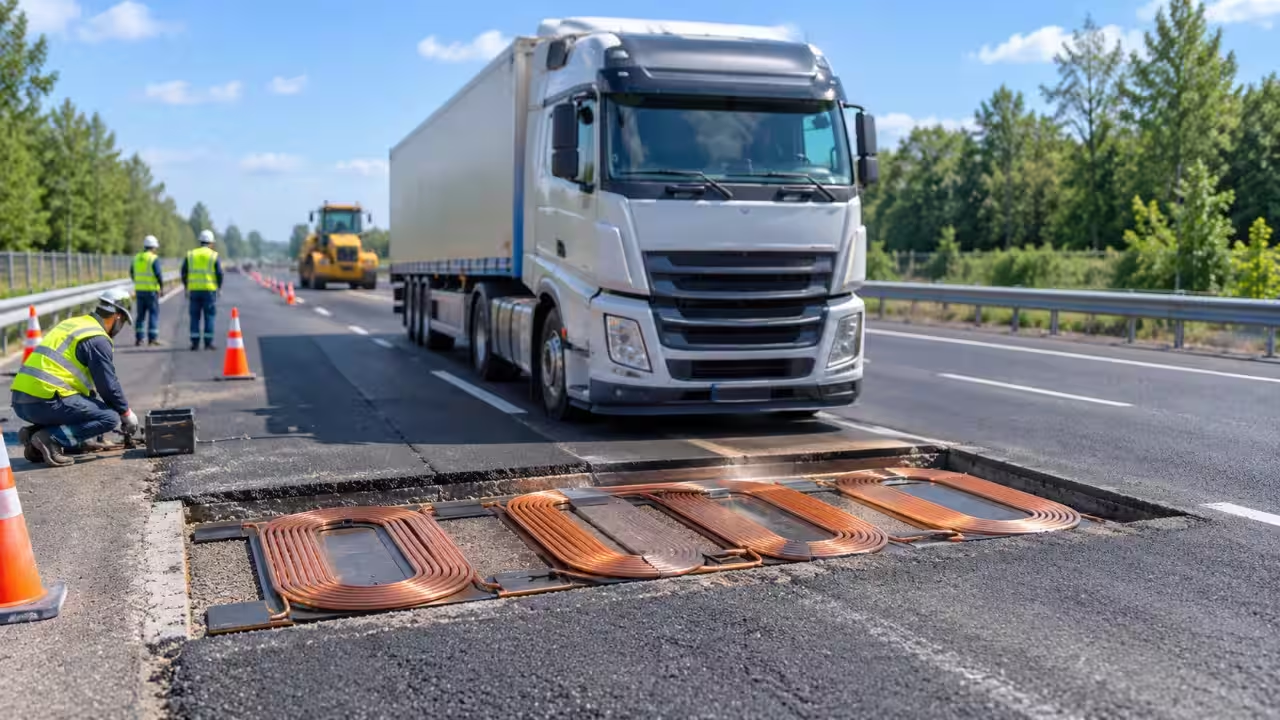
Researchers in Japan are developing a technology that would enable electric vehicles to recharge as they drive. Potentially saving time and eliminating the need to pause at recharging stations. The technology uses power-transmitting coils embedded in roads and receiving coils inserted beneath vehicles. However, equipment must withstand the repeated pressure of heavy traffic without compromising its ability to transmit power. A 2023 study by researchers from Tokyo University of Science and Toa Road Corporation tested the durability of coils embedded in asphalt by subjecting them to a large-scale investigation to simulate 100,000 wheel passes over the experimental area. The test revealed there was almost no visible physical damage after multiple rotations, and electrical measurements recorded an output power of 46 kilowatts.How the wireless charging road system works The technology was named dynamic wireless power transfer (DWPT). The system uses electromagnetic fields to transfer electricity from transmitter coils embedded under a road to a receiver coil on the electric vehicle. When a vehicle equipped with a receiver passes over the charging zone, the section of the road with coils charges the vehicle without the need to plug into a socket or charging cable. This technology could mitigate two major issues faced by electric vehicle owners: range anxiety and long recharging times. As a vehicle will be able to pull power while moving on designated roads, such an automobile could use a smaller battery and fewer charging stations.But installing electrical gear under asphalt roadways is more challenging. Road surfaces are continuously subjected to the weight of wheels, temperature fluctuations, and other factors. The coils also need to remain electrically functional after being buried under the pavement. To determine this, the Japanese researchers used a methyl methacrylate (MMA) resin mixture that would hold and safeguard the gear. They installed eight transmitter coils at two sites on a designated circular for a pavement test drive, with some parts between and others beneath the path of a vehicle.Heavy vehicles put the embedded coils to the testThe durability test was performed at a pavement testing site operated by Japan's Pavement Research Team. A heavy-duty vehicle then moved around the circular test track in automated mode at 30 km/h, with positioning devices kept on track. The team monitored 100,000 wheel rotations, which is equivalent to a five-ton wheel load. This method was chosen to test whether repeated exposure to vehicles weighing heavily on the asphalt would erode the pavement or fry the coils buried in it. The team compared the pavement and the coil properties before and after the vehicle rotations.Findings indicated that there was no damage inflicted on the surface of the pavement or the coils that were inserted. Additionally, electrical performance remained consistent throughout the experimental locations. As reported in the paper, the eight uncased coils had at least 49 kW of output and at least 88% transmission efficiency after the test. The caseless coil that was placed in the surface layer beneath the wheel path showed greater deterioration. It experienced a drop in output power to 4.3 kilowatts and a transmission efficiency of 10.4%. However, it still provided 46.4 kilowatt output and 81.2% transmission efficiency. Researchers speculated that direct wheel loading may have caused the greater deterioration.What the findings mean for future roadsThe Japanese experiment shows that the MMA resin mixture can help coils maintain the same mechanical properties while preserving electrical performance. The researchers also observed that the installation location and cases had effects on durability. Coils below the binder layer or encased exhibited less degradation than coils directly below the wheel path.This might give future designers of wireless charging roads a glimpse of its shortcomings, where engineers will need to factor in traffic volume, wheel distribution, pavement depth, and protective casing. The prototype sent about 10 kilowatts to a car, providing 63.3% of the amount of electricity it used in the experiment; the underground coil remained stable after 18 months, while the 20 23 test looked at how long the coil buried in the asphalt would last.You use AI every day. Now get your AI Quotient. Take the AIQ test.
Topics in this story
Gathered from external sources. Rights to this text belong to whoever originally published it.