Dems vow to confront Israel on violence against Palestinians: ‘Out of control’
If they flip the House, Democrats say they’re ready to confront Israel on human rights. The issue has long challenged the party, pitting staunch Israel defenders against more liberal lawmakers critical of Israel’s treatment of Palestinians. Democratic leaders have taken pains to avoid legislation that might highlight those divisions. But heading into the midterms, when…
If they flip the House, Democrats say they’re ready to confront Israel on human rights.
The issue has long challenged the party, pitting staunch Israel defenders against more liberal lawmakers critical of Israel’s treatment of Palestinians. Democratic leaders have taken pains to avoid legislation that might highlight those divisions.
But heading into the midterms, when Democrats are expected to win control of the lower chamber, party leaders now say they’re preparing to confront head-on Benjamin Netanyahu, Israel’s prime minister, when it comes to Palestinian autonomy and broader issues of human rights.
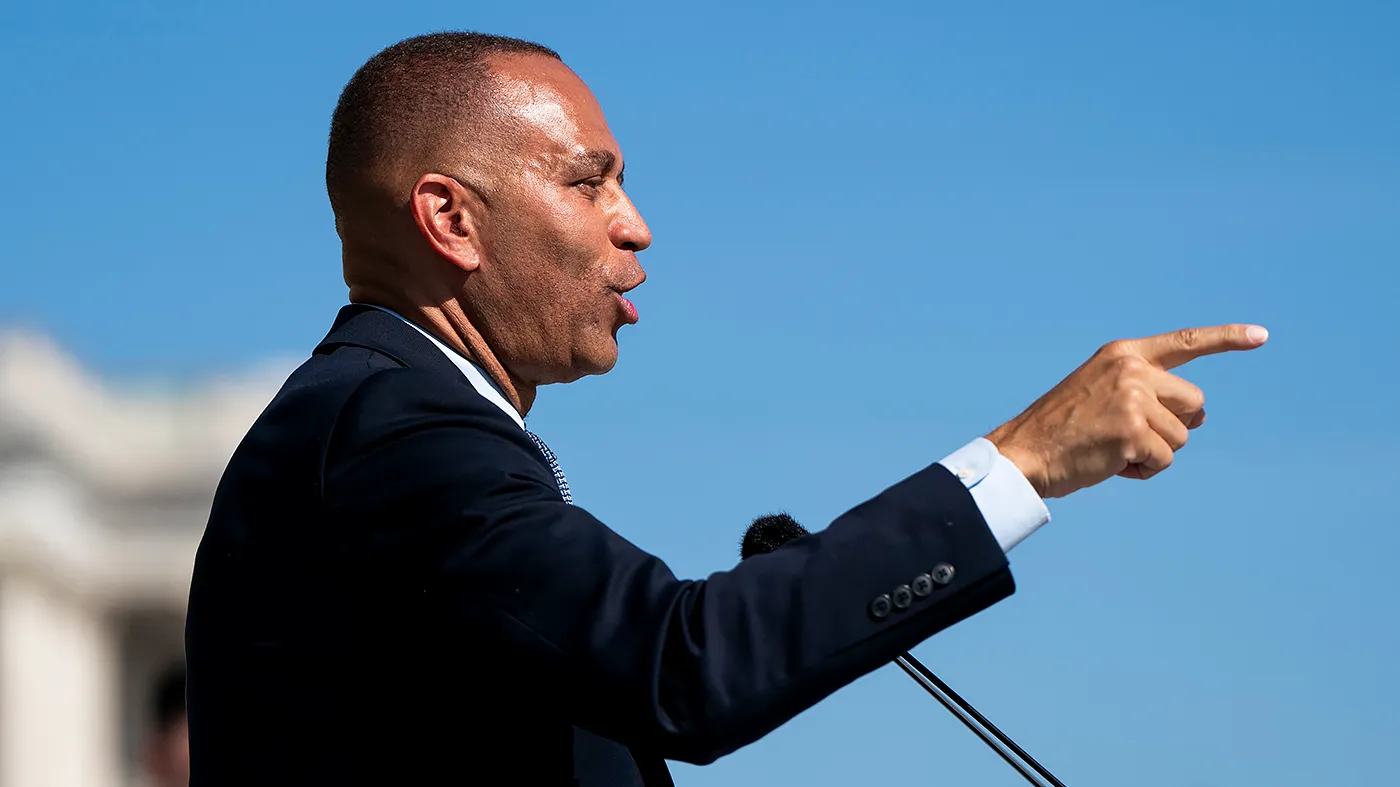
House Minority Leader Hakeem Jeffries (D-N.Y.), who’s in line to become Speaker if the House changes hands, is pointing to one area in particular that Democrats intend to tackle: the rise of settler violence in the West Bank.
“That cannot continue,” Jeffries told reporters last week in the Capitol.
Jeffries and his top deputies — Reps. Katherine Clark (Mass.) and Pete Aguilar (Calif.) — have all endorsed a bill that would slap economic sanctions on anyone who engages in violence in the occupied West Bank, while barring them from entering the United States. Sponsored by Rep. Jerry Nadler (D-N.Y.), a prominent Jewish lawmaker, the proposal is formally endorsed by 174 House Democrats, and Jeffries suggested it would be a priority next year if Democrats control the chamber.
“[It] has broad support across the House Democratic Caucus family [and] is certainly a legislative step that should be considered in order to push back aggressively against the out-of-control settler violence in the West Bank,” he said.
The remarks reflect a stark shift in the politics of Capitol Hill, where the defense of Israel, America’s closest ally in the Middle East, was once viewed as sacrosanct for a vast majority of lawmakers in both parties.
That has changed under the tenure of Netanyahu, a conservative who has assembled the most right-wing governing coalition in the nation’s history — one that opposes a Palestinian state and promotes settlements in the occupied territories as a barrier to creating one. The construction has only accelerated since the Hamas terrorist attacks on Israel in October 2023, when the group killed roughly 1,200 people and kidnapped 250 more.
Democrats are quick to advocate for Israel’s right to self-defense. But they’ve also condemned Netanyahu’s aggressive response, which has killed more than 70,000 people in Gaza while accelerating new settlement construction in the West Bank.
The developments have caused even some of Israel’s most vocal Democratic supporters to endorse Nadler’s sanctions bill, including the two most recent signatures: Reps. Steny Hoyer (D-Md.) and Lois Frankel (D-Fla.).
“It certainly just tells you where the winds are blowing,” Hannah Morris, vice president of government affairs at J Street, a pro-Israel group that opposes the settlements, said of the latest endorsements.
“We have seen such a rapid growth in outposts during the period of this far-right Netanyahu government,” she added. “And Democrats rightly understand that there has to be a stop to this, and a lot of this has to be reversed.”
The legislation comes in response to the explosive growth of Israeli settlements in the West Bank in recent years, which has been backed by Netanyahu and his far-right governing coalition in defiance of international law.
Several Israeli anti-settlement groups monitor those expansions. By their count , Israeli settlers advanced roughly 28,000 new housing units in the West Bank last year alone, more than doubling the previous annual record. More recently, Israeli officials are moving on another highly controversial settlement project, known as E-1, that would effectively detach much of the West Bank from East Jerusalem.
The new construction has been accompanied by a spike in settler violence against Palestinians. Between January 2025 and June 2026, there were 2,803 recorded instances of settler attacks that led to Palestinian casualties, the destruction of property, or both, according to the United Nations . Over the same span, 295 Palestinians were killed by either Israeli settlers or military forces, the U.N. found, while 18 Israelis were killed by Palestinians.
Most Democrats say the settlements represent a simple theft of real estate, undermining the prospects of a negotiated peace agreement founded on the creation of an autonomous Palestinian state, which they see as the only path to a lasting deal.
“I support Israel’s right to exist as a Jewish and democratic state,” Jeffries said. “And we need to lean into the notion that creating a Palestinian state — so that the Palestinian people can achieve the dignity and self-determination that they long deserve — needs to be a twin priority.
“And I think that’s a view broadly shared within the House Democratic Caucus.”
House Democrats are not alone in pushing back against the settlements. In the Senate this week, four Democrats — Sens. Chris Coons (Del.), Ruben Gallego (Ariz.), Ron Wyden (Ore.) and Elizabeth Warren (Mass.) — introduced legislation to sanction any company involved in the development of the E-1 project.
“As Palestinian civilians face a campaign of devastation and fear from violent extremist settlers, the United States must send a strong message that this behavior is unacceptable and that it remains committed to freedom, security, prosperity and self-determination for all Israelis and Palestinians,” Coons said in a statement.
Israeli officials have defended their aggressive response to the Hamas attacks, arguing that the country’s very existence hinges on the alleviation of the threats posed by regional enemies.
Netanyahu amplified those positions during this past week’s appearance at the United Nations General Assembly in New York, where he lashed out at critics who are questioning his handling of Gaza and the West Bank.
“They accuse Israel, tiny Israel, of colonialism,” he said. “And who’s accusing us? Among them are people in Britain and in France. For God’s sake, they invented the term.”
Still, in a sign that Israel is facing growing isolation globally, many delegates walked out at the start of his speech. And President Trump, who spoke at the event earlier in the week, was not even in New York during Netanyahu’s speech. The two have been close allies, but those relations have become strained amid the ongoing Iran war, which was launched jointly by the United States and Israel but has since dragged on months longer than Trump had promised.
Topics in this story
Gathered from external sources. Rights to this text belong to whoever originally published it.