A week on, Nepal moves to rehab as hopes of finding survivors fade
South Asia News: TRISHULI BAZAAR (NEPAL): Govt in Nepal has shifted its focus from rescue to relief, rehabilitation and reconstruction a week after the Aug 26 Bhote Ko.
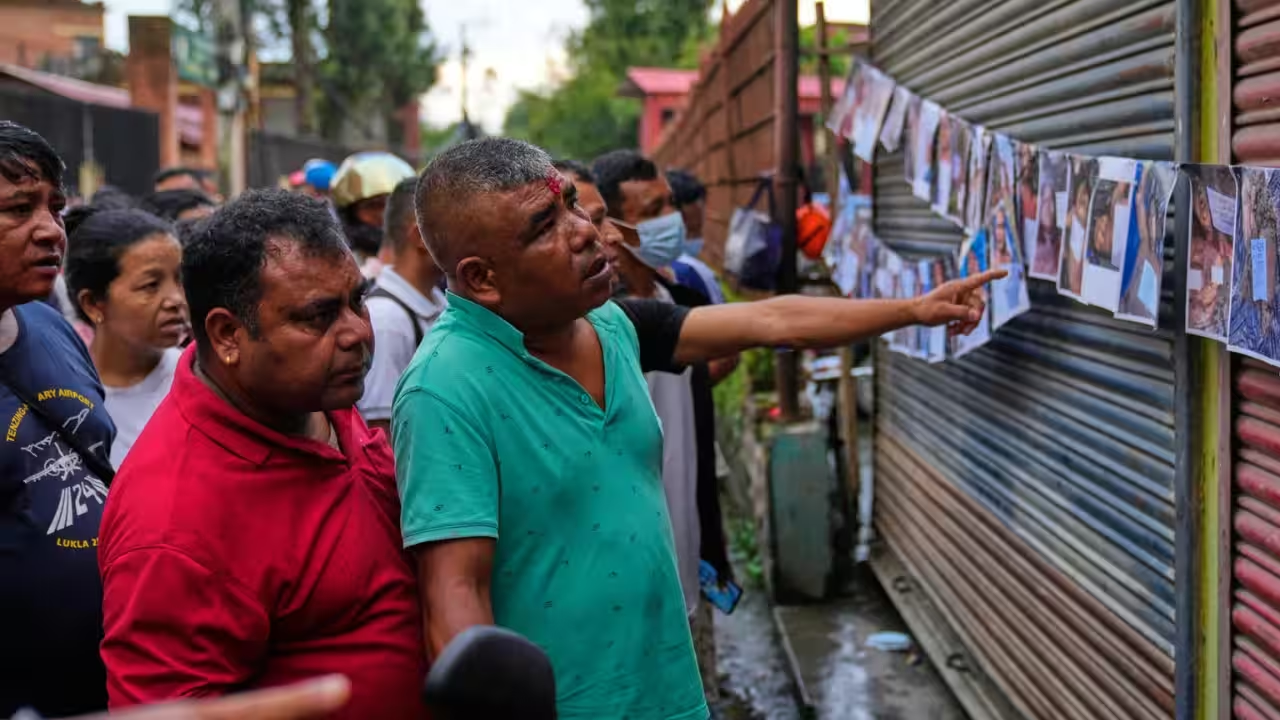
TRISHULI BAZAAR (NEPAL): Govt in Nepal has shifted its focus from rescue to relief, rehabilitation and reconstruction a week after the Aug 26 Bhote Koshi flood as hopes of finding survivors across most of the devastated corridor recede. Search teams, however, continued digging into hydropower tunnels where workers could still be alive in chambers or air pockets.Nepal Police Wednesday put the toll at 1,127 dead and 4,858 missing. For Indian families, uncertainty continued: New Delhi's last detailed missing-person update listed 275 nationals and 128 persons of Indian origin, or PIOs, as missing or uncontactable. India subsequently said 163 of its nationals had been rescued in Nepal, but did not issue a revised missing count. Across the border in Tibet, Chinese authorities raised the toll to 21 dead and 541 missing. The missing there included 49 Indians. The Tibet figure was compiled separately and could overlap with India's list of missing nationals.Prime Minister Balendra Shah announced the change in govt's priorities after days dominated by frantic searches for survivors.Rescue teams already on the ground, though, haven't abandoned search. Police uploaded details of 911 unidentified bodies to help families searching for relatives.Govt is now focusing on rehabilitation while working to protect the lives of people in the affected areas and providing the necessary medical treatment and psychological counselling,” Shah said. The change in emphasis came as the possibility of live rescues diminished sharply outside a few hydropower sites.Binoj Basnet, a retired senior army general who oversaw rescue operations during Nepal’s 2015 earthquake, said, “Looking at the nature of the disaster and the area which has been hit by the flood, as days go by there are less chances of human survivors.”Rescue teams on the ground, though, haven’t abandoned search. Their strongest remaining hope centres on hydropower tunnels in Rasuwa, where workers may have reached rooms or sections containing air pockets and access to water. Hundreds of people linked to hydropower projects are unaccounted for.Nepal had explored drilling or excavating into the tunnels from above rather than relying only on entrances blocked by thick slurry, rocks and debris. Heavy rain repeatedly complicated these operations, with water entering some tunnels and machinery struggling to reach project sites.Indian specialists were among teams working at the tunnel sites. India sent a specialised tunnel rescue team and technical experts to Nepal, while a 19-member forensic team worked in Kathmandu to help identify bodies through DNA and other methods.Shah told parliament Wednesday that govt had mobilised security forces, helicopters, medical teams and relief supplies immediately after receiving information about the disaster. He also thanked India and China for their assistance, including technical support. India’s role remained particularly significant because hundreds of Indians were caught on both sides of the Nepal-Tibet border when the flood struck.Catch the latest World News and Live updates. Download the TOI app.
Topics in this story
Gathered from external sources. Rights to this text belong to whoever originally published it.