Once unthinkable, frequent fires are Hawaiiâs new normal.
Hawaii is seeing bigger, hotter and more frequent fires than ever before. The state is struggling to catch up.
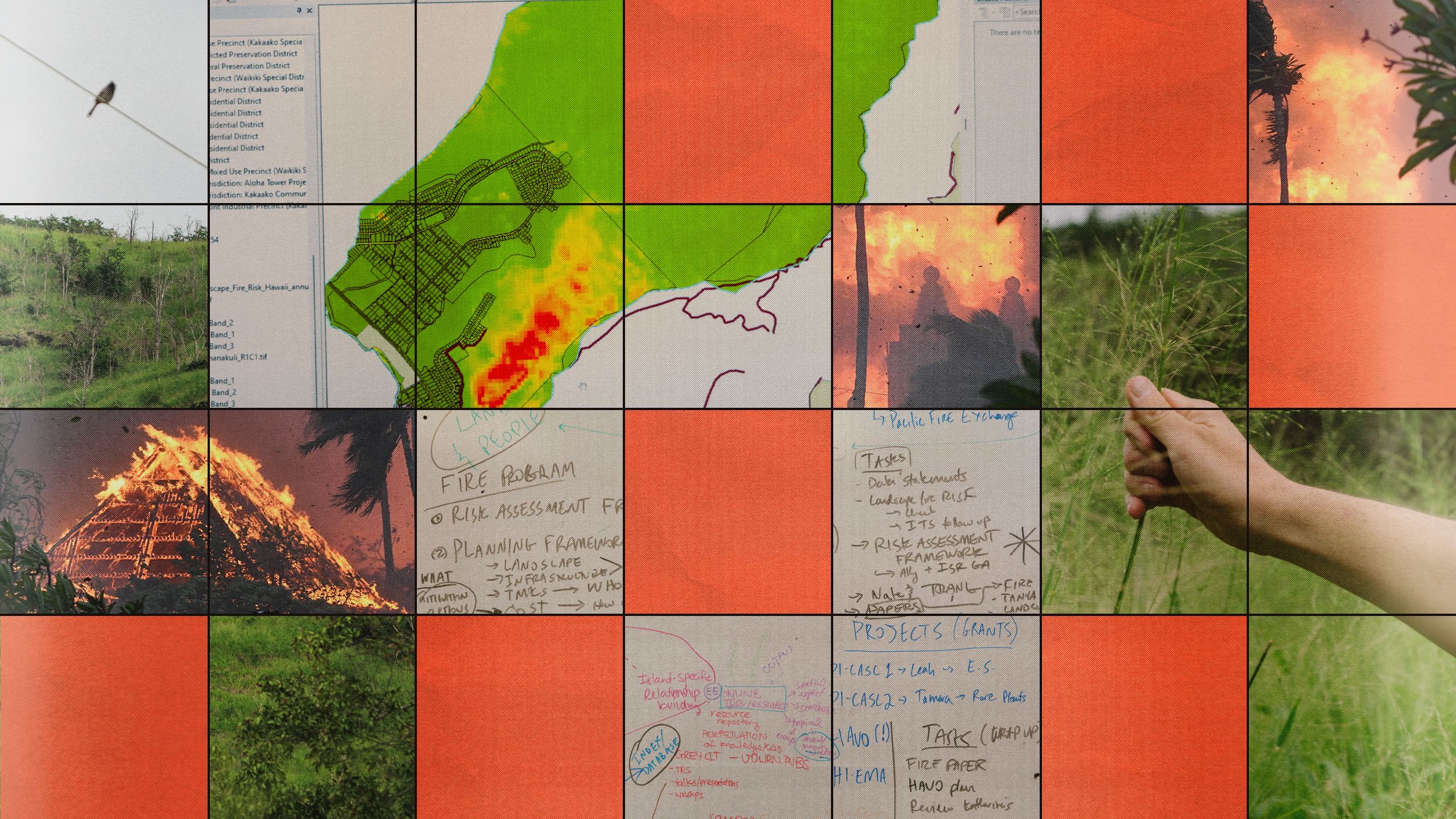
In December 2022, Clay Trauernicht led several dozen federal wildfire officials down a long road on Hawaiiâs Big Island to show them the site of the largest fire in state history. It could happen again, he warned.
A lush green mountain was visible in the distance, but Trauernicht, a University of Hawaii fire scientist, was focused on the dry brown grass at his feet. A fire the year before had burned 42,000 acres, as firefighters struggled to contain it for more than four days. It destroyed some of the stateâs prized, and dwindling, native ecosystems. Many of the native plants were gone for good, he said, but the invasive grass that burned in that fire was already primed to burn again.
âThe fire that we saw that ripped across the landscape here, weâre getting into situations where weâre beyond the capacity that we currently have,â he told the gathered officials. More fires would be coming, he said, making prevention â like trimming tall plants and breaking up big areas of flammable grass â key. âWe have to figure this out.â
He had given the same warnings three years earlier to a group of state legislative staffers on another trip to a fire site on Maui. After both fires, local firefighters had told him the fires burned bigger, faster and hotter than they had ever seen. Wildfire in the Hawaiian Islands was changing.
When Trauernicht was hired by the University of Hawaii in 2013 and began analyzing the stateâs fire data, he quickly saw that the frequency of fires had been rising since the 1990s. But the tropical state still officially considered wildfire a âlowâ to âmediumâ risk compared to other natural disasters.
He began a campaign to sound the alarm, along with a handful of others focused on wildfire prevention in the state. Over the next decade, Trauernicht gave dozens of talks to officials and community groups, wrote articles and spoke to the press after every major fire, always saying the same thing: Hawaii has a new wildfire reality and needs to start prioritizing prevention and management.
But that didnât happen. In August 2023, the Lahaina fire killed at least 100 people and caused unprecedented devastation. Rebuilding will cost an estimated $5.5 billion. While the extent of the damage surprised even Trauernicht, the location did not.
The areas where the Lahaina fire spread fastest and burned hottest were like the site Trauernicht showed federal officials on the Big Island months before â covered in invasive African grasses that evolved to burn and quickly grow again. First imported in the 1800s for agricultural purposes, the highly flammable grasses, sometimes 12 feet tall, now blanket abandoned plantations across the islands.
Since 1999, there have been 13 fires within a 3-mile radius of Lahaina, as many as five in the same spot, according to an NBC News analysis of state fire perimeter data that was compiled by Trauernichtâs lab.
Researchers began consistently tracking wildfire boundaries in Hawaii in 1999. The number of fires and amount of land burned has increased in the 25 years since.
On Maui alone, nearly as much land has burned in the last five years as the previous 20 combined, much of it near communities on the west side of the island.
âWe started putting out information about this in 2014,â said Trauernicht, who noted that fire frequency and severity has only increased since then. âThis is not [just] a Lahaina problem. They just got the worst outcome you can imagine.â
Chris Speicher has sold real estate on Maui for more than five years. Clients might ask about hurricanes, but rarely fire, he said. People donât associate it with Hawaii.
âFire risk is something that should be openly talked about,â Speicher said. âI think that itâs a surprise to people.â
Like many of his clients, Speicher said he didnât realize just how dry parts of the islands could be when he first moved to the West Maui coast, where Lahaina is located, in 2018. âWest Maui is only green a couple of months a year. The rest of the time itâs like a desert,â he said. West Maui had always been dry, but as its carefully maintained plantations of sugarcane and pineapple â both tropical plants â shut down, it became covered in nonnative, difficult-to-remove flammable grasses.
Over the next five years, Speicher was evacuated five times from three different West Maui homes due to nearby wildfires.
Just a few months after he arrived on the island, a wildfire caused by high wind from Hurricane Lane burned through more than 2,000 acres, including parts of Lahaina, and caused approximately $4 million in damage. Speicherâs home survived the fire, but two neighbors lost their houses.
In August 2023, Speicher was living in Kaanapali, just north of Lahaina, when his family received another evacuation order, once again for a wildfire influenced by hurricane winds.
Speicher said he didnât feel any better prepared, though his home survived. His family returned to it, but was evacuated twice more for nearby fires in the next three weeks. The third time was the last straw for Speicher and his wife, who made what they called a âgut wrenchingâ decision to leave Hawaii altogether. They were tired of having to be on constant alert in case a fire broke out, he said. They continue to sell Maui property, but now live in Maryland.
A federal analysis of wildfire risk to communities shows that of all 50 states, Hawaii has by far the highest risk of âfire consequenceâ â the likelihood of high-intensity fires near homes.
âWhen we did this modeling four years ago and we saw how high Hawaii was ranking, we questioned ourselves and really thought, âCan this be right?ââ said Joe Scott, one of the lead researchers of the analysis and head of Pyrologix, a wildfire risk research firm. His team ran the numbers again. âWe were very surprised by this result, but we couldnât find a reason it was wrong.â
Nearly six months after the August wildfires, Speicher says thereâs a lack of guidance on what Mauiâs fire emergency response will look like in the future.
âThey [government officials] havenât even said, âIf thereâs a fire, hereâs what we are going to do,ââ Speicher said. âThe most frustrating thing is that the fire in 2018 almost burned Lahaina to the ground.â
When fire hit the Lahaina area in the middle of the night in 2018, more than 100 homes were evacuated. Officials at the time said it was nothing short of a miracle that the fire did not consume the whole town.
In the aftermath, an angry crowd of community members confronted Maui officials at a town hall, demanding to know why the siren system had not been activated.
There was no protocol for fire sirens, the officials said. But they could potentially look into making one.
But a new siren protocol never came. And a long-promised report on the emergency response to the 2018 fire had yet to be released five years later when fire came to Lahaina again. Hawaiiâs then- most recent emergency management plan still labeled wildfire risk statewide as âlowâ to âmedium.â
Once again, in August 2023, government officials chose not to sound the emergency warning sirens, a decision Mauiâs then-emergency management chief defended . The warning system was set up for tsunami events, not fire, he said, so officials were concerned people might have tried to seek higher ground and run toward the fire instead of away from it.
A few months later, Maui County finally released a draft report on its emergency response to the 2018 fire amid public pressure. It contained no mentions of sirens in its improvement plan for future disasters.
Maui County referred questions about emergency siren protocols after the 2023 wildfires to Hawaiiâs Emergency Management Agency, which told NBC News that siren activation âin case of fires is primarily the responsibility of our counties.â
In response to questions about future wildfires, a spokesperson for Maui County said the county has spent âa considerable amount of time in recent months focusing on response efforts for wildfires and other potentially hazardous emergency situationsâ and noted that its fire department has been advocating to increase wildfire preparedness measures, including evacuation plans, for years.
More big fires have meant increasing awareness of fire risk on the islands, said Elizabeth Pickett, co-executive director of Hawaii Wildfire Management Organization , but preparation and prevention are lagging far behind.
âThereâs no money,â said Pickett. âItâs just a small cohort of people whoâve been trying to make this stuff happen in the absence of legislation, regulation and money.â
Pickettâs nonprofit was founded in 2000, at the request of the stateâs overburdened forestry and fire agencies, to handle much of the fire prevention work that government agencies typically do in large Western states. Today, the nonprofit spends most of its effort training land managers around the state on prevention measures like breaking up large swaths of dry, overgrown invasive grass via grazing, creating fire breaks and restoring native plants.
The nonprofit gets money from the state and county governments, and from foundations, but despite years of sounding the alarm alongside Trauernicht and requesting more funds, Pickett said those grants have only slightly increased.
âVery few funders understand what it really takes to meet, prevent and mitigate wildfire,â said Pickett, whose group collaborates with state agencies and conducts community fire education and wildfire research.
Historically, Hawaii saw fire so infrequently that its ecosystems are not adapted to it. Lightning-caused fires are not as common as they are in the mainland U.S., so most fires are usually the result of human activity.
The stateâs native ecosystems would generally have expected to see a fire every 100 to 200 years.
But increasingly frequent and large fires are ânow our new normal,â said Allyson Earl, a fire researcher who works for the Hawaii Wildfire Management Organization and the University of Hawaii.
Fires are now as frequent as every one to five years in some places, data shows. That shift is a result of a number of factors, but changes in land use and management in the last half-century have had the biggest impact, Earl and other fire researchers say.
The change began with the introduction of large-scale agriculture in the 1800s. Agribusiness took over huge areas of the islands for cattle grazing, sugarcane and pineapple plantations. But the industry began declining in the second half of the 1900s as production costs were higher than abroad, and much of that land became fallow fields covered in invasive plants, particularly tall, flammable grasses.
As the grasses spread, uninhibited, they created ecosystems âtopsy-turvy to Hawaii,â said David Burney, a professor of conservation paleobiology at the Makauwahi Cave Reserve on Kauai. âWeâre seeing a new fire regime in a lot of places. ⦠The difference between an ecosystem that burns every 100 years and a place that burns every five years is like day to night.â
Climate change and population growth have added to that growing risk, according to the stateâs researchers. Hawaiiâs seasonal patterns are shifting, making dry seasons drier and fires larger and more likely, said Earl. While most fires occur on the drier sides of the islands, like West Maui, even areas with more precipitation are seeing increases.
Each of Hawaiiâs four counties has an organization focused on trying to prevent the spread of fire-prone grasses. But the groups are small, and the plants, like fountain grass, buffelgrass and Guinea grass, are widespread.
âThese are not easy grasses to manage,â said Franny Kinslow Brewer, program manager at the Big Island Invasive Species Committee. They are tall, sharp and full of stinging, glasslike fibers that require special tools to remove. âItâs not something you can just get on a little ride-around mower and just trim down.â
Her group and its counterparts go door to door to help control invasive grass on private lawns. But not everyone is interested in their help, and even if they were, the small teams canât reach the whole state.
When criticized over grass management in the past, large landowners have pushed back, saying they maintain their land consistent with county fire codes, including by establishing fire breaks, which are barriers of cleared land.
Many communities around the state are now surrounded by large swaths of these âfire-lovingâ grasses, said Burney, who has studied prehistoric fires and climate in Hawaii and urged communities to prepare. âThereâs no reason why something like Lahaina wonât happen again and again.â
In the aftermath of the Maui fires, the state has begun to take steps toward wildfire preparedness. A November emergency management report updated Hawaiiâs overall wildfire hazard from âmediumâ to âhigh.â It listed Maui County as the âmost vulnerableâ in the state, with almost half its population living in high wildfire-risk areas.
The same month, Hawaiiâs House of Representatives published a report of recommendations for wildfire relief, preparation and prevention for the upcoming legislative session. The county is working with the state emergency management agency to update its wildfire preparedness plan. And the Biden administration and Congress have allocated millions of dollars to reconstruct electrical grids to reduce Hawaiiâs fire risk.
But prevention is still woefully underfunded â substantial new money for Pickett and Trauernichtâs work has yet to materialize. In the months following the fire, they received more attention than they ever had, including more requests to consult and share their expertise than they could handle. They have submitted proposals to federal grant programs and are watching bills in the state legislature that would provide money to expand their capacity, but for now itâs a waiting game.
âItâs really hard to get anything off the ground because the things that need to happen are these major investments,â Pickett said.
After saying the same thing for a decade only to see the devastation of the Maui fires, Trauernicht has been left grieving and angry.
âNothingâs changed,â he said. âThe last thing you want to say is, âWe said this was going to happen,â right? Like the crazy guys in the movies pointing at the asteroid.â
âI couldnât have imagined something this devastating,â said Trauernicht.
Topics in this story
Gathered from external sources. Rights to this text belong to whoever originally published it.