In 2020, a metal detectorist found 933 Iron Age gold coins in an Essex field; another was found later, and the hoard is now on display
UK News: In 2020, a metal detectorist discovered 933 gold Iron Age coins on private land in Great Baddow, Essex, without permission to be detected there. Accor.
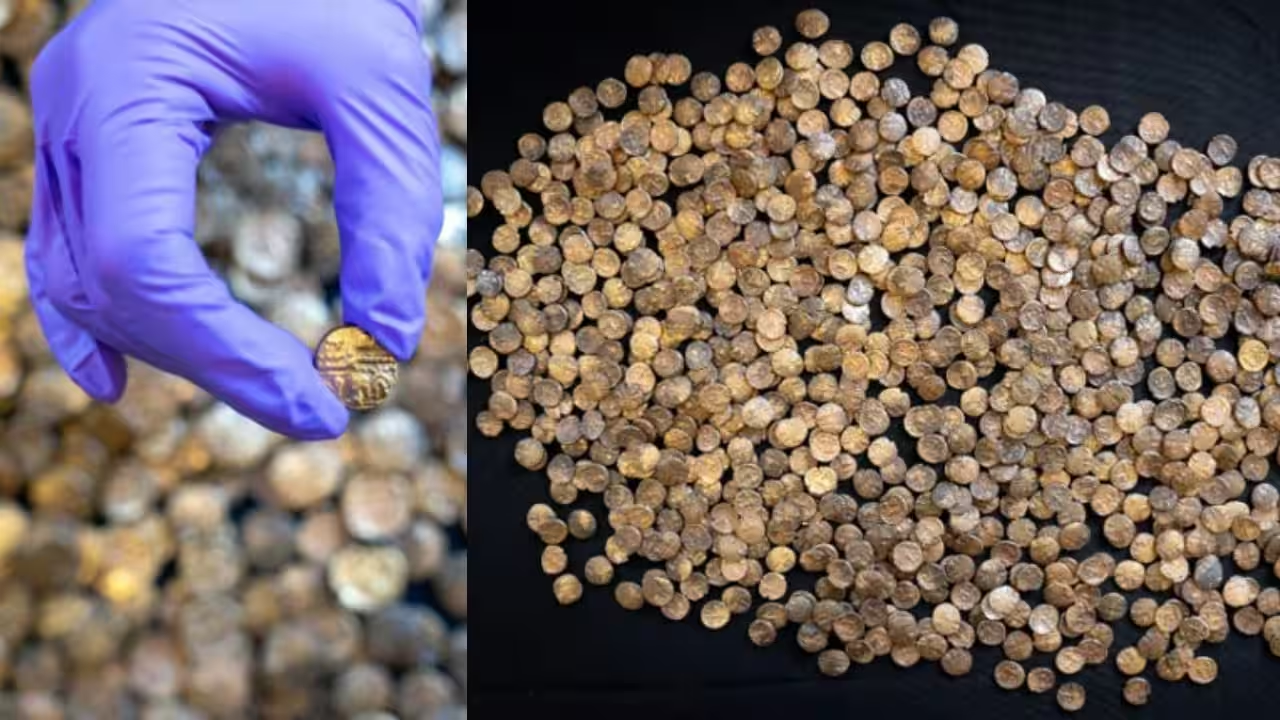
In 2020, a metal detectorist discovered 933 gold Iron Age coins on private land in Great Baddow, Essex, without permission to be detected there. According to the official data available on Museum of Chelmsford’s site, the hoard, now known as the Great Baddow Hoard, is the largest recorded find of Iron Age gold coins ever made in Britain. Acquired by the Museum of Chelmsford in 2025 through a National Lottery Heritage Fund grant, it is thought to be linked to Julius Caesar's invasion of Britain. Here's how the find came about, what happened afterwards, and how it's being shared with the public.How a metal detectorist found 933 Iron Age gold coins in an Essex field in 2020The hoard was found on private land in Great Baddow by a metal detectorist who did not have permission to be detecting there. On discovering it, the finder initially failed to declare the find under the Treasure Act 1996, which limited how well the archaeological context could later be understood. According to Essex Heritage Trust, the hoard itself consists of 933 gold coins, 930 of which are Eastern British staters of the 'Whaddon Chase' type, produced in the North Thames region around 60 to 20 BC. The remaining three coins are a quarter stater, a Continental Gallo-Belgic E uniface stater, and an East Anglian 'Norfolk Wolf' stater, alongside fragments of what may have been a container or vessel.How few more coins were found at the Great Baddow hoard site laterBecause the coins were excavated in an uncontrolled way by the finder, and the accompanying artefacts were fragmentary, the archaeological context of the hoard was diminished. Shortly after the find was declared, the findspot was revisited by the Finds Liaison Officer for Essex, accompanied by a group of local experts. During this follow-up search, they recovered one further coin, though no additional surviving archaeological evidence was found at the site.The Great Baddow hoard may be linked to Julius CaesarThe hoard was found in territory traditionally associated with the Trinovantes, yet most of the coins are believed to have been produced in the region later linked to the Catuvellauni, suggesting a movement of that tribe eastwards. Some experts have suggested that the large number of gold staters being produced in eastern Britain at this time could be connected to Julius Caesar's invasion in 54BC, theorising the coins may have been intended as a tribute payment to the Roman general. While aggression between the Catuvellauni and Trinovantes is recorded in Roman sources, the hoard offers rare archaeological evidence to support it.How the hoard was acquired and where is it on display nowThe Great Baddow Hoard was acquired by the Museum of Chelmsford in May 2025, thanks to £250,000 in funding from the National Lottery Heritage Fund, alongside contributions from Chelmsford City Council, Friends of Chelmsford Museums, Essex Society for Archaeology and History, Essex Heritage Trust, Council for British Archaeology East, and Essex Numismatics Society.It is now recognised as the largest recorded hoard of Iron Age gold coins ever found in Britain. The hoard was on public display for the first time in a dedicated temporary exhibition, Timeless Treasures, in summer 2026, and will now be moving to permanent display at the museum from spring 2027.Catch the latest World News and Live updates. Download the TOI app.
Topics in this story
Gathered from external sources. Rights to this text belong to whoever originally published it.