Imran Khan’s stronghold in crisis: What's happening after emergency rule in Pakistan's Khyber Pakhtunkhwa
Pakistan’s political confrontation over jailed former prime minister Imran Khan has escalated after the federal government imposed emergency and
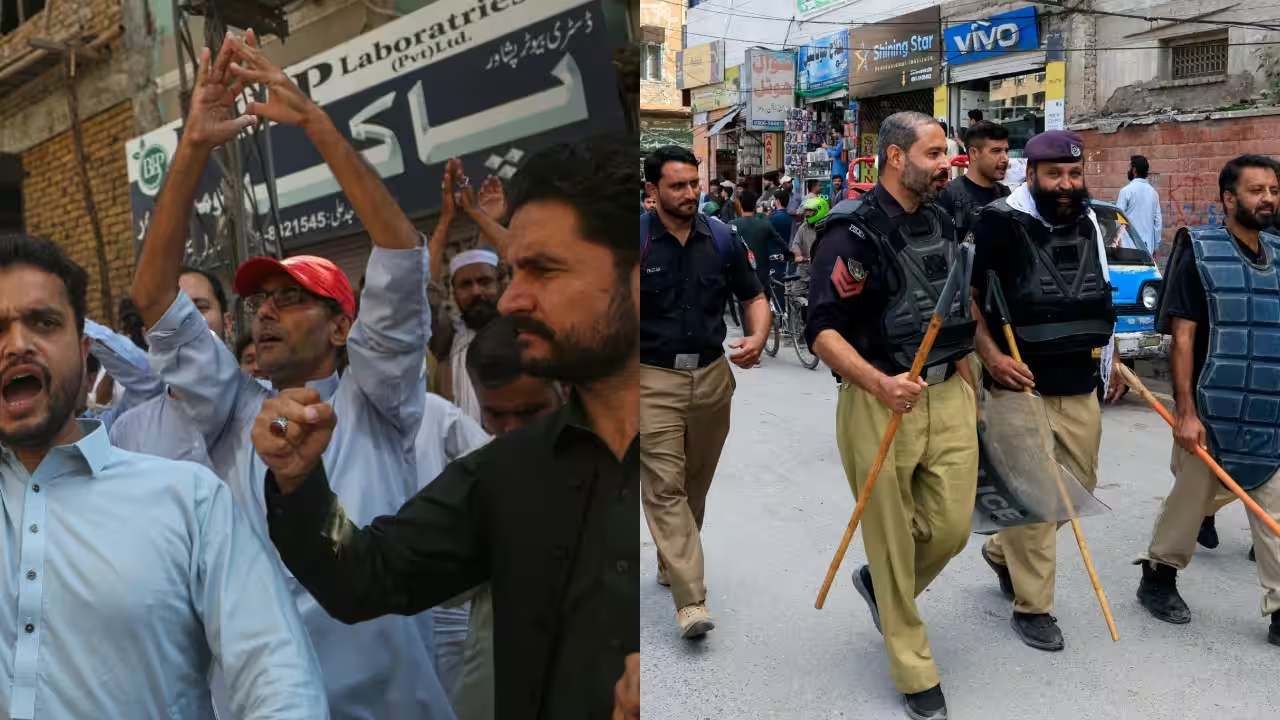
Pakistan’s political confrontation over jailed former prime minister Imran Khan has escalated after the federal government imposed emergency and governor’s rule in Khyber Pakhtunkhwa, suspending the authority of the Pakistan Tehreek-e-Insaf (PTI)-led provincial administration. The move, announced on Sunday, brings one of the party’s most important political strongholds under federal control and has intensified tensions between the government led by Prime Minister Shehbaz Sharif and Khan’s supporters.President Asif Ali Zardari approved the measures under Articles 232(1) and 234(1) of Pakistan’s Constitution, citing a deteriorating security situation. Islamabad has accused the provincial government of failing to cooperate in the fight against terrorism, while the PTI has called the move an attempt to undermine its electoral mandate. A petition challenging the measures was filed in the Peshawar high court on Monday. Meanwhile, arrests, roadblocks, school closures and examination postponements have disrupted life in several districts as the authorities tighten security.Why governor’s rule in Khyber Pakhtunkhwa?The federal government announced emergency and governor’s rule after a cabinet meeting on Sunday reviewed the security situation in Khyber Pakhtunkhwa, which borders Afghanistan and has faced a persistent militant threat.In a statement, Prime Minister Shehbaz Sharif’s office said the cabinet had examined the deteriorating law and order situation and the provincial government’s “deliberate indifference in the war against terrorism”.Islamabad has accused the PTI-led administration of failing to take adequate action against militants and of not cooperating with federal authorities on security policy. Federal ministers have also alleged a “nexus” between the provincial government and terrorist groups, a charge the PTI disputes.Militants linked to Tehreek-e-Taliban Pakistan (TTP), which shares an ideological affinity with the Afghan Taliban, have carried out attacks against security personnel and civilians in Pakistan. The federal government has argued that a coordinated response is necessary to counter the threat.The PTI, however, says it has been excluded from decisions concerning security in its own province. It has opposed military operations on its territory and called for a review of the counterterrorism strategy, including Islamabad’s approach to engagement with the Afghan Taliban.The disagreement contributed to the breakdown of talks between the federal government and PTI representatives on October 3.Under governor’s rule, Governor Faisal Karim Kundi has taken charge of running the province. The federal government has also authorised the deployment of Pakistan Army troops and assets in aid of civil power.The federal government has cited worsening law and order as the basis for its intervention. However, figures from the Islamabad-based Centre for Research and Security Studies (CRSS), cited in the morning report, suggest the trend in reported deaths in Khyber Pakhtunkhwa was not identical to the national picture.Civilian and security personnel deaths in the province reportedly totalled 485 in the first nine months of 2026, a decline of 16 per cent from the same period in 2025. Across Pakistan, such deaths rose by 9 per cent over the corresponding period, according to the think-tank.The figures provide a counterpoint to the federal government’s account of the province’s security situation, but they do not, by themselves, establish whether the provincial administration adequately addressed militant activity or explain the reasons behind the change in fatalities.The new administration has pledged to strengthen the police and the Counter-Terrorism Department (CTD), increase operational resources and continue intelligence-based operations against militants.Khyber Pakhtunkhwa apex committee vows continued operationsThe provincial Apex Committee held its first meeting under the new arrangement on Monday at the Governor House in Peshawar. It was co-chaired by Kundi and interior minister Mohsin Naqvi and attended by senior civil and military officials, including the Peshawar Corps Commander, chief secretary and inspector general of police.Kundi said tackling terrorism would be the administration’s immediate priority, pointing to what he described as a lack of coordination in counterterrorism efforts. “We can sacrifice our development, but never security,” he said, adding that the administration would “fulfil the demands of the Counter-Terrorism Department and police”, reported Dawn.He also promised a more results-oriented approach. “We have to show the difference,” Kundi said, adding that the administration would “work 24/7”.The governor highlighted the impact of militancy on daily life in districts such as Dera Ismail Khan, Tank and Waziristan, saying residents faced restrictions on their freedom to live and travel. He called for restoring normal movement and expressed hope that the new administration would be remembered for bringing peace to the province.Naqvi, meanwhile, accused the previous provincial government of failing to lead the fight against terrorism despite repeated requests from the Centre. “Today is the first time I can proudly say that the federal and the provincial governments are on the same page,” he said.Naqvi argued that security operations could not succeed without political leadership. “But any war, no matter how many resources you have, cannot be won until the government leads it,” he said.He cautioned that the situation would not change overnight but called on the governor, police, administration and federal government to work together.The committee resolved to continue intelligence-based operations and use all available resources to improve law and order. It also decided to strengthen the police and CTD with modern equipment, vehicles, armoured vehicles, weapons and additional personnel.Alongside security, the committee pledged to address public grievances, improve access to basic services and promote development in underdeveloped and conflict-affected areas.Imran Khan’s son condemns emergencyKasim Khan, son of the jailed former prime minister, condemned the emergency and governor’s rule, accusing Army Chief Asim Munir of using terrorism as a justification for another military operation in Pashtun areas.In a post on X, Kasim linked the measures to protests demanding his father’s release and alleged that the authorities were seeking to consolidate power through military action.“Pakistan belongs to its people, not its military,” he wrote.Kasim called for the restoration of Khyber Pakhtunkhwa’s democratic mandate and the immediate release of his father, detained family members, PTI representatives and other political prisoners. He also demanded that the right to protest be respected.The emergency was imposed as the PTI was holding a long march led by provincial Chief Minister Sohail Afridi. The march called for Imran Khan’s release and access to medical treatment for him, while also opposing military operations that the party says have caused civilian deaths and damage.Afridi and seven other PTI leaders were taken into protective custody, according to reports. Afridi had vowed to continue the march before the provincial government’s powers were suspended, PTI reported.“There is no option other than accepting our demands,” Afridi said in a post on X before the takeover.“We will not back down,” he added. “Our long march will continue until the demands are met, in accordance with the law. Here, only Imran Khan’s policy will prevail.”The PTI has accused the federal government of using security concerns to weaken the party and undermine the elected provincial administration.“The arrest of chief minister Sohail Afridi and Junaid Akbar has exposed the political nature of the government’s actions,” PTI spokesperson Sheikh Waqas Akram said in a statement.“These measures are not directed at addressing security challenges; they are intended to weaken PTI, undermine the elected government of Khyber Pakhtunkhwa and disregard the democratic will of its people,” he alleged.The status of Junaid Akbar, a member of parliament and president of the PTI’s provincial chapter, requires separate confirmation before any arrest claim is treated as established.Petition challenges emergency and governor’s rule in courtThe federal government’s decision faced a legal challenge on Monday, with a petition filed in the Peshawar High Court less than 24 hours after the measures were introduced.Filed by Advocate Salman, the petition names President Zardari, Prime Minister Shehbaz Sharif and Governor Kundi as respondents. It argues that the imposition of emergency and governor’s rule is “unconstitutional, illegal and motivated by mala fide intentions”.The petitioner has also alleged that the measures violate fundamental rights and undermine the democratic mandate of the people of Khyber Pakhtunkhwa.Separately, opposition leaders met in Islamabad on Monday to discuss the emergency and its aftermath. Those present included PTI chairman Barrister Gohar Ali Khan, National Assembly Opposition Leader Mahmood Khan Achakzai and PTI secretary general Barrister Salman Akram Raja. The participants also discussed challenging the measures in court.The legal challenge adds another front to the confrontation, with the province’s administrative status now under scrutiny alongside the government’s security justification.Roadblocks, arrests and school closuresThe impact of the emergency has varied across Khyber Pakhtunkhwa, with heightened security deployments, transport restrictions, school closures and arrests reported in several districts.In Peshawar, police remained deployed along major roads, while shipping containers blocked several routes, particularly around the cantonment area. Entry and exit points to Peshawar Cantt were closed, and access to areas including Khyber Road, parts of University Road and GT Road near Pir Zakori was restricted. Commuters were diverted to alternative routes.Traffic was relatively light on parts of the city’s road network on Monday afternoon. Educational institutions across the provincial capital remained closed. Internet and cellular services, which had been disrupted, were reported to have been fully restored in Peshawar, according to Dawn News.In Mardan, government and private schools, colleges and universities were shut, and examinations scheduled for the day were cancelled. Several education boards postponed secondary school examinations, including in Bannu, North Waziristan, Dera Ismail Khan and Lakki Marwat. Fresh dates are to be announced.In Charsadda, police confirmed that 15 PTI workers had been arrested. In Shangla, more than two dozen party workers had been taken into custody, according to the district police chief. Authorities also imposed Section 144, prohibiting gatherings, and ordered intensified patrolling and checks at district entry and exit points.Containers were placed to block the Islamabad-Peshawar Motorway near Swabi, where internet and mobile services remained suspended. In Bannu, road restrictions were reported near the cantonment area.The situation was comparatively calm in parts of Khyber district. A PTI demonstration in Bara was dispersed by police, but roads, including the main Peshawar-Torkham Highway, remained open.In Lower South Waziristan, schools and colleges were closed, but markets and routine commercial activities continued. No major disruption to commercial activity or significant protests were reported there.Tank district imposed a one-month ban on pillion riding from October 10 to November 9 under Section 144, citing security concerns.The differing conditions across districts underline the uneven impact of the emergency. While restrictions have affected transport, education and political activity in several areas, routine life has continued in others.Why Khyber Pakhtunkhwa is important to Imran Khan’s PTIKhyber Pakhtunkhwa has been a key political base for Imran Khan’s PTI, which has governed the province since 2013. The party remained a major force in the 2024 elections despite Khan’s imprisonment and the difficulties faced by its candidates.Khan, a former Pakistan cricket captain who served as prime minister from 2018 to 2022, was removed from office through a parliamentary no-confidence vote. He has been in Adiala Jail in Rawalpindi since 2023 and faces more than 100 cases, including corruption and charges related to inciting violence.Candidates backed by Khan won the largest number of seats in the National Assembly in the 2024 elections, but the party was kept out of federal power as other political parties formed the government.The takeover of Khyber Pakhtunkhwa therefore carries significance beyond the change in provincial administration. It places a crucial PTI-governed province under a federal arrangement at a time when the party is mobilising supporters for Khan’s release and challenging Islamabad’s counterterrorism policy.The PTI maintains that the federal government’s actions undermine the provincial electorate’s mandate. Islamabad, in turn, argues that the security situation requires decisive intervention and closer coordination between the provincial and federal authorities.What nowThe imposition of governor’s rule has sharpened the divide between the PML-N-led federal government and the PTI, which has governed Khyber Pakhtunkhwa for more than a decade. Their dispute centres on responsibility for worsening militancy, the scope of military operations and the provincial administration’s role in security policymaking.The Centre maintains that the provincial government failed to adequately support counterterrorism efforts. The PTI says it was excluded from decisions concerning its own province and argues that the takeover undermines the democratic mandate of its voters.With the emergency facing a legal challenge, PTI leaders in custody and security restrictions disrupting parts of the province, the confrontation is now unfolding on political, judicial and security fronts. The federal government has pledged a more coordinated campaign against terrorism, while the opposition is demanding the restoration of the province’s elected administration.You use AI every day. Now get your AI Quotient. Take the AIQ test.
Topics in this story
Gathered from external sources. Rights to this text belong to whoever originally published it.