Nepal-China border: Why a newly-formed lake is sparking fears of more flooding
South Asia News: Rescue operations continued through thick layers of mud and debris in flood-hit Nepal on Friday, while authorities remained on high alert after a newl.
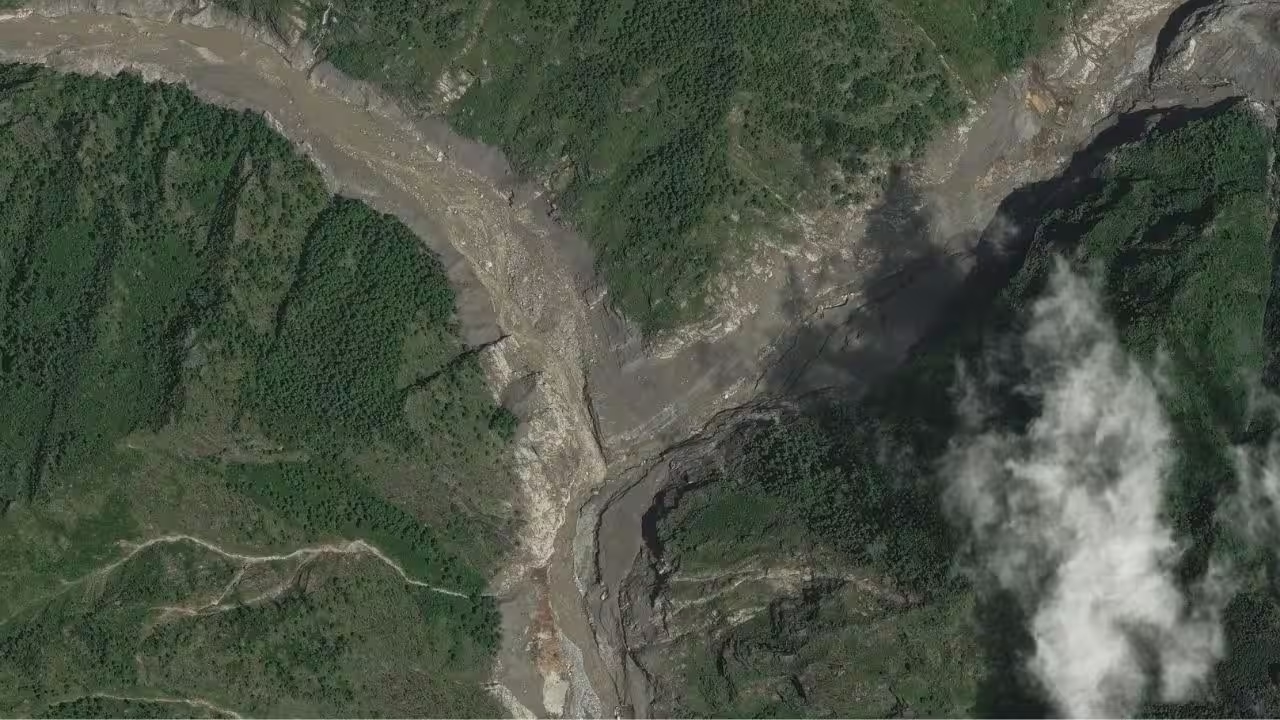
Rescue operations continued through thick layers of mud and debris in flood-hit Nepal on Friday, while authorities remained on high alert after a newly formed lake near the Nepal-China border began overflowing, raising fears of another flash flood.The warning comes two days after devastating floods swept through the Himalayan border region, killing more than 500 people and leaving over 1,500 missing.Nepal's disaster management authorities said satellite imagery and preliminary assessments indicated that a river had been blocked upstream, creating a growing lake that could burst and send a sudden surge of water downstream.The rescue operations were also disrupted for some time after the newly formed barrier lake began overflowing, raising fears of another flash flood in areas already devastated.Where is the newly formed lake?Satellite imagery shown by Chinese state broadcaster CCTV indicated that the lake had formed in the same area where a glacial detachment occurred on Wednesday, triggering the chain of events that caused widespread destruction downstream.CCTV reported that the lake's barrier was more than 10 km from Gyirong Port, a key border crossing with Nepal that was inundated by mud and floodwater.The lake is located at an elevation of about 2,950 metres, nearly 1,000 metres above Gyirong Port.How did the lake form?The lake was formed after debris from a massive glacier collapse blocked the river near the Nepal-Tibet border, creating a natural barrier and trapping water upstream. Debris and rocks blocked part of the river, creating a temporary natural dam and causing water to accumulate behind it.The lake is located near the confluence of the Chhochen Khola and Purepu Tsangpo rivers. Both rivers originate in Tibet and merge before entering Nepal, where the combined river is known as the Bhote Koshi, which later flows into the Trishuli river.The lake had already begun overflowing, with Nepal's National Disaster Risk Reduction and Management Authority (NDRRMA) warning that it could continue to grow and potentially burst.“The lake is continuing to grow and there is a risk that it could burst,” the NDRRMA said."Another dammed lake was formed by the August 26th ice-rock avalanche and this has begun to outflow," Qianggong Zhang of the International Center for Integrated Mountain Development said, the Associated Press reported.Zhang said the lake contains a few million cubic metres of water and is located in a valley with a limited elevation drop towards downstream areas. The volume of water is equivalent to roughly 1,200 Olympic-sized swimming pools.Why are authorities worried?Scientists have warned that continued glacial melt, high temperatures and debris blocking river channels could lead to further flooding."There is still a lot of glacial melts going on because of high temperatures and the water is accumulating at various points, as there is bound to be a lot of debris and rock on the river’s path," said Jakob Steiner, a geoscientist at the University of Graz in Austria.Both Zhang and Steiner said the warnings should be taken seriously, particularly as rescue teams continue searching for people missing in the floods. However, they said another flash flood on the same devastating scale was unlikely.India monitoring situationWednesday's flash floods swept through villages and valleys, destroying roads, bridges and hydropower infrastructure along a key route linking Kathmandu with Lhasa in Tibet. The area is also frequented by trekkers and pilgrims travelling towards Mount Kailash.At least 320 Indians remain missing, while around 400 others are stranded on the Chinese side following the floods along the Nepal-Tibet border, the ministry of external affairs (MEA) said in a media briefing.MEA spokesperson Randhir Jaiswal said India was ready to provide all possible assistance to Nepal in its rescue efforts. He said 96 Indian nationals stranded on the Chinese side had safely crossed into Nepal by land.Twenty-one Indians also arrived in New Delhi on Friday, a day after reaching Kathmandu from the flood-affected areas of Nepal, PTI reported.Since Wednesday night, India has also sent a total of 47.5 tonnes of emergency supplies to Nepal in two military transport aircraft and is in the process of sending more relief materials.Catch the latest World News and Live updates. Download the TOI app.
Topics in this story
Gathered from external sources. Rights to this text belong to whoever originally published it.