In 1966, an Alaska dairy farm went up for sale; the community helped keep it off the open market, and it later became a 1,790-acre refuge visited by about 150 bird species
Discover how the Fairbanks community came together in 1966 to prevent a dairy farm sale, transforming the land into Creamer's Field Migratory Waterfowl Refuge, home to 150 bird species and an annual festival.
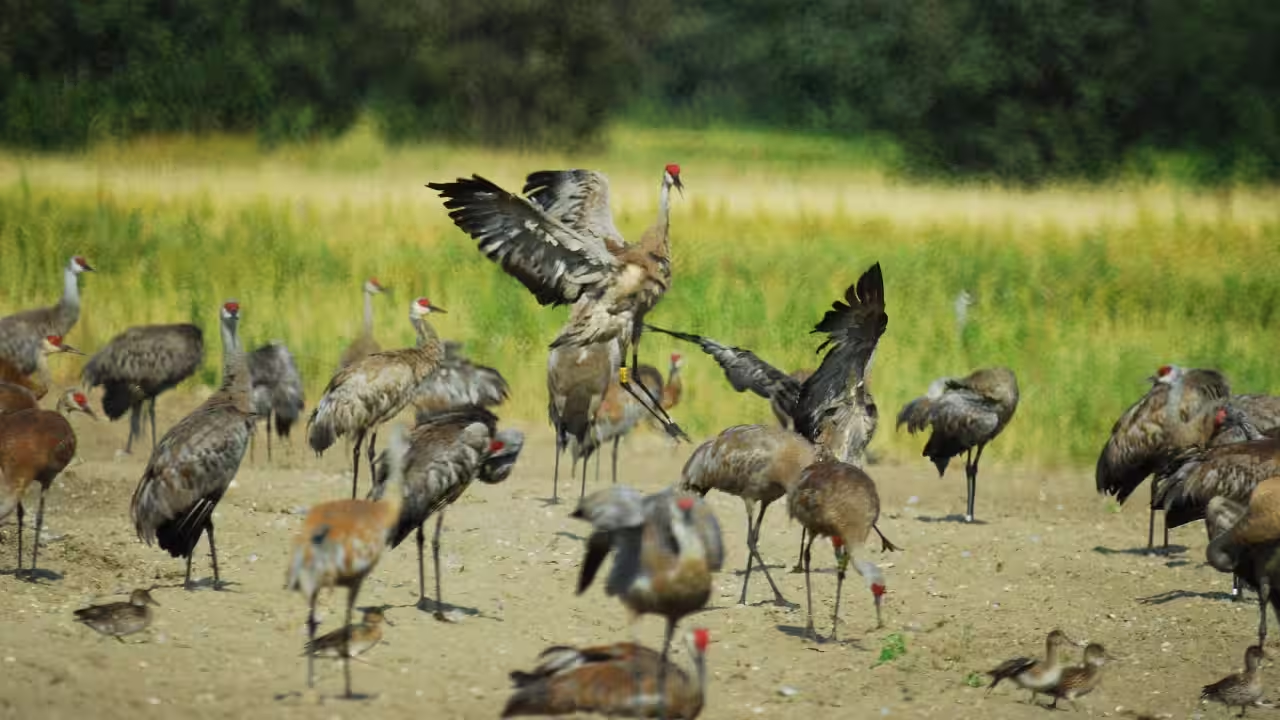
Every spring, a large number of migrating waterfowl settle on open fields beside College Road in Fairbanks, in Interior Alaska. The fields were cleared for a dairy farm, and the 1993 interim management plan for the refuge, published by the Alaska Department of Fish and Game (ADF&G), notes that dairy operations began attracting migrating birds around 1910. The fields contained leftover grain and had been spread with manure, allowing them to thaw quickly and provide the birds with shallow pools of water and food before the surrounding landscape thawed.The people of Fairbanks realized that the roadside provided a clear view of the spring migration, and the local media covered it yearly, along with the breakup of the interior rivers. The yearly migration made the dairy farm a familiar feature of the community, and hence the news that the property was going to be sold posed a serious question about the future of the land. This problem was solved by volunteers, a family willing to wait, and state and federal funding. The state of Alaska acquired the fields, and ADF&G now manages them as the Creamer’s Field Migratory Waterfowl Refuge, as the same plan records.The dairy fields go up for sale in 1966The 1993 interim management plan for the refuge states that the dairy fields were put up for sale in 1966. Residents who valued the land as wildlife habitat and as open space for a growing city came together to find a way to buy it for the public. The Creamer family supported that goal and kept the property off the open real estate market while the effort took shape.A 1967 fund drive buys an option on the landBy 1967, the Alaska Conservation Society had undertaken a fundraising campaign to raise sufficient money for the purchase of the option to the fields. The option kept the land safe from being sold until the state obtained the necessary federal Pittman-Robertson funds and legislative appropriation for the purchase of some 250 acres of land. The strategy notes that the fundraising effort took place shortly after the Great Flood of 1967. The section on land acquisition highlights the purchase of the dairy fields in 1968. Next, ADF&G joined the Alaska Department of Natural Resources in making the 1,500 acres of adjoining state lands, together with the dairy fields, the Fairbanks Wildlife Management Area.From wildlife management area to state refuge, 1979 to 1982In 1979, a state game refuge was created by the legislature of Alaska for the location. The aims mentioned were the protection and improvement of the habitat of migratory birds, particularly those of waterfowl, and also for viewing and studying these animals. The dairy buildings were placed on the National Register of Historic Places in 1977, and the state acquired them in 1982 along with 12 surrounding acres, as that plan records. The Conservation Fund describes the present-day refuge as roughly 1,790 acres. It also reports that approximately 150 bird species turn up there over the course of a year, including Canada geese, snow geese, trumpeter swans, mallards, northern shovelers, and sandhill cranes.The 1976 survey and the ponds built from 1984 to 1989A baseline for the refuge’s wildlife came from the Ecological Survey of the Birds, Mammals, and Vegetation of Fairbanks Wildlife Management Area, a master’s thesis by Michael A. Spindler completed at the University of Alaska Fairbanks in December 1976, as documented in the Alaska Department of Fish and Game’s interim management plan for Creamer’s Field Migratory Waterfowl Refuge. It is referred to as an inventory of the natural resources of the area, especially birds. The habitat enhancement came later. The neighboring property owner, George Dornath, constructed the first pond in 1984 together with the ADF&G. The department’s [hyperlink]Restoration and Enhancement of Aquatic Habitats report states that in 1987 ADF&G and Ducks Unlimited built six ponds at the refuge to increase nesting habitat for waterfowl. In 1989, a five-acre pond was put up, which was intended for sandhill cranes to have roosting areas in the summertime.Sandhill cranes, the airport and the banding projects of 1988 to 2007The crane pond grew out of a safety concern. Friends of Creamer’s Field, a nonprofit, recounts in Tracking the Northern Travelers: The Legacy of the Sandhill Crane Banding Project that airport officials asked ADF&G for help in 1987 because cranes were crossing the runways. Between 1988 and 1990, the biologists ringed 59 cranes. The banding project found that sandhill cranes feeding at Creamer’s Field in autumn also flew past Fairbanks International Airport each day on their way to and from nighttime roosts along the Tanana River, according to the Friends of Creamer’s Field account.The second effort involved 342 birds between 2001 and 2007. In 2001, four cranes were fitted with satellite GPS telemetry, and the data showed that they nested within 100 miles of the Tanana Valley and overwintered in north-central Texas. The management plan also says additional barley was seeded at the refuge while hazing and habitat changes at the airport aimed to make it less attractive to cranes and waterfowl.August crane counts and the festival that grew around themThe Alaska Department of Fish and Game recorded daily counts of migrating waterfowl and sandhill cranes at Creamer’s Field from August 1 to September 15, 2016, and reported them in its FY2017 Refuges and Other Special Areas Management Annual Performance Report. Crane and waterfowl counts at Creamer’s Field generally reached 1,500 to 2,000 during the last two weeks of August, and the Friends of Creamer’s Field article on the banding project lists peaks of 2,770 in 2002 and 2,575 in 2004. This aggregation takes place during the Tanana Valley Sandhill Crane Festival. The department’s [hyperlink] official festival announcement lists Friends of Creamer’s Field as the organizer, in collaboration with the Alaska Department of Fish and Game, the Alaska Songbird Institute, and the Arctic Audubon Society.You use AI every day. Now get your AI Quotient. Take the AIQ test.
Topics in this story
Gathered from external sources. Rights to this text belong to whoever originally published it.