Two rescued from Nepal tunnel nine days after flood
Two people have been pulled alive from a tunnel in Nepal nine days after the floods.
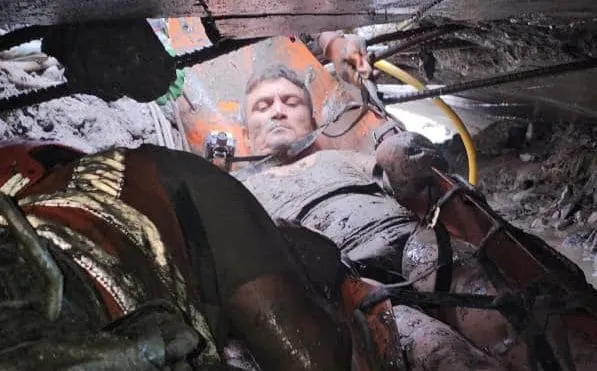
Two people have been pulled alive from a tunnel in Nepal nine days after the floods.
On Friday, Sanjay Sah and Kabir Maharjan, hydropower workers who became stuck in the tunnel when ice, rock and a mudslide swept through Nepal last week, were lifted to safety.
Officials believe the glacier collapse in the upper reaches of the Trishuli River trapped at least 900 people in tunnels related to six hydropower projects along the river.
The rescue has brought hope to a devastated region where 4,200 remain missing .
At least 1,252 people were killed in Nepal as houses, streets and schools in towns and villages near the border with China's Tibet were swept away.
China has put the death toll in Tibet at 21, with 541 others listed as missing.
Mr Sah, a mechanical foreman, and Mr Maharjan, a mechanical supervisor, were working inside the Trishuli-3A Hydropower Project when the floods hit the area on Aug 26.
They had been found halfway through the tunnel after rescuers had heard their voices, said Shriram Neupane, a politician involved in the rescue operation.
"When the rescue team said, 'Don't panic, we are rescuing,' the response from inside was 'yes,'" Mr Neupane said.
The rescue team drilled a manhole in the Trishuli tunnel, allowing the rescuers to abseil into the blocked passage.
They sent oxygen inside before wading through mud, rocks and debris to find the tunnel entrance.
But their progress was blocked by wreckage the size of cars, choking access points. In a rare move for a live rescue operation, the teams used tactical explosives to open up a path towards the trapped workers.
Using drilling machines, excavators and hydraulic cutters, rescuers forced their way inside and travelled 180m to reach the workers.
Bhim Gautam, the chief executive of the Independent Power Producers' Association, told The Telegraph: "They are going to rescue more workers as they go further inside the powerhouse."
Hirasova, Mr Maharjan's wife, said: "He came back with a second life. We are very happy. We have been waiting for him for 10 days. Now I am going to the hospital to meet my husband."
She told local media: "It must have been very difficult to spend 10 days [in the tunnel]. Not one day, not two days.
"We had no food or sleep. We believed that he was there. We thought he would come."
Mr Maharjan had been working at Trishuli-3A for seven years and last spoke with his wife an hour before the flood struck.
The two workers pulled from the tunnel at the Upper Trishuli 3A Hydropower Station are the first to be rescued from the hydropower projects.
Videos and photos released by Nepali authorities showed Mr Maharjan being pulled out of a hole in the ground and put on a stretcher while bystanders cheered.
Mr Sah was carried out on the back of a worker to a rescue tent.
Mr Maharjan could not move his hands and legs, but Mr Sah's injuries were not critical, an aide to the energy minister told Reuters, adding that both of the workers would be taken to a hospital in Kathmandu.
Amir Maharjan, Mr Maharjan's brother, said he had not received any news officially but had been told to go to the hospital.
"I have been hearing from the news that my brother has been found. The entire family is very happy," he said.
Mr Sah said he had been working in the control room when flooding had hit the tunnel. Rather than fleeing immediately, he said, he had first tried to get others to safety.
"I was working in the control room. My responsibility was to save everyone's life," he told a medical team from the Nepali army.
He said he had urged everyone to run, but by the time others had left, it was too late for him to escape.
"I told everyone to run. In doing that, my time was lost. In the end, I could not get out," he said.
He said he had spent his time inside the tunnel reciting a mantra as he waited to be rescued.
Asked how many people might still be trapped inside, he said he had heard or communicated with three or four people in his vicinity.
"There were only three or four people with whom we were able to communicate nearby, by talking or making noises," he said.
Rajaram Basnet, a spokesman for the Nepali army, told The Telegraph that further search-and-rescue operations were ongoing.
Topics in this story
Gathered from external sources. Rights to this text belong to whoever originally published it.