In 2008, an Italian mineralogist spotted a wheel-like mark on Google Earth in Egypt; scientists later collected 1.7 tons of meteorite fragments
Rest of World News: In 2008, Italian scientists discovered the Kamil Crater in Egypt, leading to the recovery of 1.7 tons of meteorite fragments. This well-preserved impact site offers new insights into meteorite behavior and Earth's geological processes.
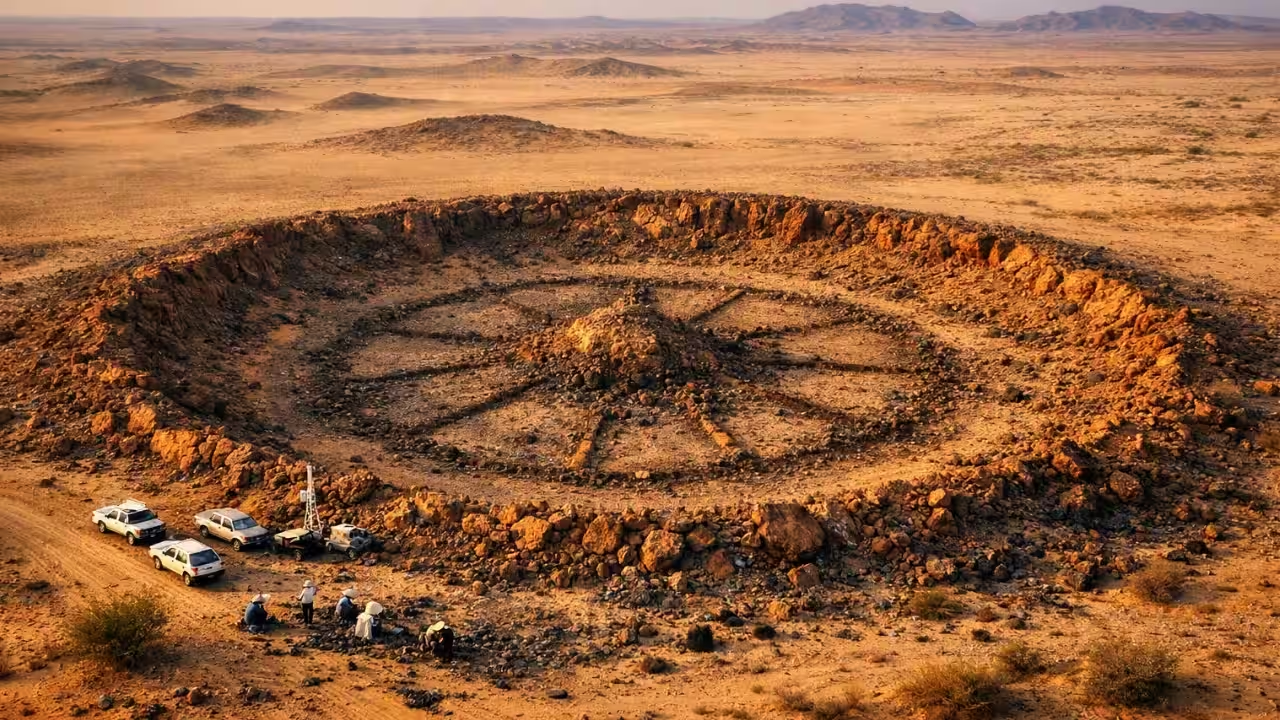
In 2008, an Italian scientist browsing satellite images of southern Egypt noticed a wheel-like mark in the desert. It looked strange enough to send a research team deep into the Sahara. The meteorite is officially named Gebel Kamil after the nearby locality, according to the Meteoritical Bulletin, and the crater is commonly referred to as the Kamil crater. D'Orazio and colleagues call it an exceptional example of a small impact structure still very close to its pristine state. It also left behind a huge scatter of iron meteorite fragments.A rayed crater found by an Italian curatorThe study of the Kamil Crater in Egypt, published in Science in August 2010 by Folco and colleagues, credits V. De Michele with the identification. At that time, De Michele was the curator of the Natural History Museum in Milan, and he noticed this particular feature while surveying Google Earth. The researchers mention a rayed formation, which is an ejecta pattern coming out from the center of the crater. These formations are very common features found on rocky and icy objects in space. They are rare to see on Earth due to erosion. The article in Science explains that craters less than 300 meters in diameter are uncommon on Earth and highly eroded. This means that researchers have been heavily depending on simulations to know how such craters come into being and the dangers that small impactors pose to humanity. The discovery provides an intact crater to compare to these simulations.What the 2010 expedition measuredA geophysical investigation carried out in February 2010, published in Meteoritics & Planetary Science, found that the crater is a simple, bowl-shaped structure about 45 meters wide and 16 meters deep, with a rim rising about 3 meters above the pre-impact surface. Geochimica et Cosmochimica Acta reports that the target rock is Cretaceous sandstone from the Gilf Kebir Formation, and the crater's age is believed to be less than 5,000 years. In Gebel Kamil: The iron meteorite that formed the Kamil crater (Egypt), D'Orazio and colleagues describe a site that still looks remarkably fresh: ejecta deposits extend 50 meters from the rim, ray ejecta reach up to 350 meters, and numerous meteorite fragments lie scattered across the surrounding desert.How much meteorite was found and recoveredGebel Kamil is classified as an ungrouped, nickel-rich iron ataxite, with about 1.6 tonnes of meteorite observed in the field and roughly 800 kilograms recovered, according to the Meteoritical Bulletin database. The metal was discovered within and outside the crater in February 2009 and February 2010 by a group of geophysical experts from Italy and Egypt. The Bulletin also gives its nickel content as 19.8 percent by weight and notes extensive shear deformation and low weathering. According to D'Orazio and colleagues, the shear bands formed during the explosive impact itself.The description provided of a 634 grams type sample includes shrapnel-like shapes, flattened, dark brown in color, with etching showing a chaotic structure and containing schreibersite, troilite, and daubreelite crystal inclusions. It was officially named on July 12, 2010. The major mass of this recovered meteorite is currently preserved in the Egyptian Geological Museum located in Cairo, Egypt. Type samples weighing 15 kilograms and 5 kilograms are kept in the institutes of Siena and Pisa, respectively.How the fragments were scatteredThe above-mentioned study shows the locations of the fragments; there were thousands of fragments in the crater and even as far away as 1.6 kilometers east of the crater's edge. Except for one fragment weighing 83 kilograms, all of the fragments are impact fragments and weigh between 1 gram and 34 kilograms. The photographs of the scientific study show the location of the 83-kilogram fragment in a straight line 230 meters north of the crater, and its surface has regmaglypts, the thumbprint-like depressions created when the meteorite travels through the atmosphere. The authors' density map puts the total mass of shrapnel fragments larger than 10 grams at about 3,400 kilograms, roughly twice the 1.6 tonnes of meteorite observed in the field.Why the crater surprised researchersThis paper also shows that the impactor fractured into thousands of pieces only after hitting the surface. Shock metamorphism and melting in the rocks both in the target and projectile indicate that the formation of the crater was an explosive excavation. This was concluded by the study conducted in 2010 on the crater itself. According to geophysical models, a large iron meteorite was expected to fragment in the atmosphere; however, the authors state that even large iron meteorites of tens of tons can penetrate the atmosphere. Kamil makes an invaluable point of reference for determining how small iron impactors behave when striking hard ground.Catch the latest World News and Live updates. Download the TOI app.
Topics in this story
Gathered from external sources. Rights to this text belong to whoever originally published it.