In 2017, Sweden replaced a motorway’s top-layer stone with steel slag; 7 years later, the 200-metre test road had comparable overall performance, but deeper rutting
Discover how Sweden is paving the way for sustainable road construction using steel slag, a byproduct of the steel industry, as an alternative to traditional asphalt. Learn about the benefits and long-term performance of this innovative material after seven years of testing.
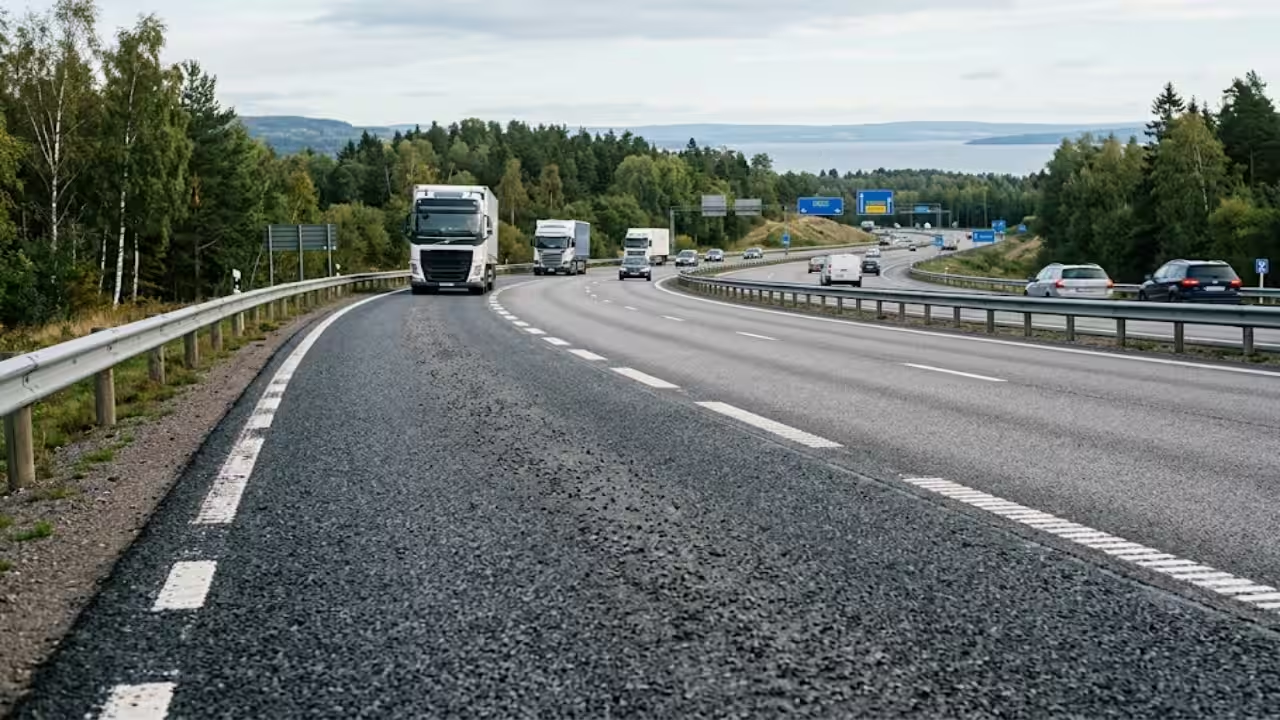
Steel mills produce massive mounds of waste material each year, and quarries are finite. Because studded winter tyres erode asphalt faster than most other wear factors, road builders in Sweden have to be picky about what goes on a motorway's surface. Engineers on the E4 near Jönköping had to try something a little different because of that tug of war.They chose a material called slag, which is the stony residue left over from melting down scrap steel in an electric arc furnace. Most of it already has a use in Sweden, and the steel industry group Jernkontoret estimates that just over 80 per cent of the slag produced in the country is reused. But the same group admits that this kind of slag remains an untapped resource for creating asphalt.So when they repaved the E4 through Huskvarna in August 2017, a research team recognised an opportunity to test the concept at full scale. In one portion, they replaced the native stone in the top layer with crushed steel slag, a stretch of around 200 metres. Seven years on, the stretch was still in use, and the results make for compelling reading for anyone who cares about greener roads.How the test road was builtThe test was conducted on a busy section of the E4 just north of Jönköping, with Lake Vättern on one side and hillside residences on the other. According to Trafikverket, the motorway has two lanes each way and a speed restriction of 90 km/h. Some 26,000 vehicles use it per day, and one in six are big vehicles. The slag was in the slow lane, where most lorries go, with about 18,000 vehicles a day, a fifth of which are heavy.The surface is double-layer porous asphalt, designed to reduce traffic noise. It has a 30 mm top layer lying on a 50 mm bottom layer, and the slag replaced stone just in the top one. The builders used a slag product called Smedjebacken, supplied by NCC, in diameters between 4 and 11 mm, and contractor Svevia laid it on the same days as the ordinary pavement beside it. The slag mix required less binder by weight, at 4.5 per cent compared with 6 per cent for the stone version. It also retains its dark grey hue for life, so the road appears fresher than it is and the markings are more visible after dark.Findings from seven yearsThe results are from Ulf Sandberg, a researcher at the Swedish National Road and Transport Research Institute, who presented them at a noise engineering conference in 2024. The Swedish Transport Administration, Trafikverket, financed the work. The paper has been published on the research webpage of the agency.In fresh condition the slag surface reduced tyre noise by around 7 dB compared to the conventional Swedish reference surface, which corresponded to the stone version. Its noise reduction was comparable to or slightly better than the standard double-layer pavement after five to seven years. The results had startled Sandberg; the slag surface was clogging up a little faster. After four years, the water drainage test took 86 seconds on the slag surface and 47 seconds on the stone surface. Sandberg thinks tiny pores among the slag particles may help balance things out.Other figures gave a similar tale. For both surfaces the Transport Administration accepts wet friction ratings of between 0.60 and 0.64 for fresh asphalt. Rolling resistance on the slag was roughly 2 per cent lower in 2018, but that differential was too minor to count as a real change. Rutting was the one field where slag lagged behind. By 2022, the wheel tracks in the slag part were 10.8 mm deep compared to 7.8 mm in the stone section, a difference that the report says is negligible and nonetheless acceptable.A notable moment came in May 2023. The road authorities repaved the conventional part of the highway after six years but left the slag section alone, possibly because it appeared to be in better shape. By summer 2024 it had hit the seven-year mark, and no repaving was in the works for that year.What this means for highwaysBecause slag is heavier than natural stone, it takes more to bring it to the asphalt plant and subsequently to the site. The team also had difficulty hitting the air voids target, ending up slightly over 20 per cent instead of the expected 25, which may have contributed to the earlier blockage. Sandberg says the density disparity means slag blends must be constructed differently, but he thinks that improved material selections and proportions could enhance the outcome.The upside is that it is a bigger upside. Steel slag is a waste item that can leak heavy metals in countries with substantial stockpiles, but the report adds that leaching is insignificant when slag is sealed into asphalt. In some situations high-grade natural aggregates are also becoming scarce. Separate research from VTI looked at ten slag products from various Swedish companies and found most met or surpassed the standards for road aggregate.The lesson for now is small yet useful. A test road in Sweden, about 200 metres long, has shown over a seven-year period that steel slag can, in at least this case, replace natural stone in the top layer of a busy roadway and perform roughly the same as a traditional surface, according to the researchers behind the study. One disadvantage is that it causes slightly deeper ruts. Larger tests will show whether the idea can be implemented, but early results suggest that this waste product can perform well on the road.You use AI every day. Now get your AI Quotient. Take the AIQ test.
Topics in this story
Gathered from external sources. Rights to this text belong to whoever originally published it.