Near South Africa’s Orange River, researchers found two large mineral deposits beside a prehistoric skeleton’s spine; lab tests identified material commonly found in urinary stones
Discover how researchers found evidence of kidney stones in a prehistoric skeleton, revealing insights into ancient health problems linked to urinary conditions.
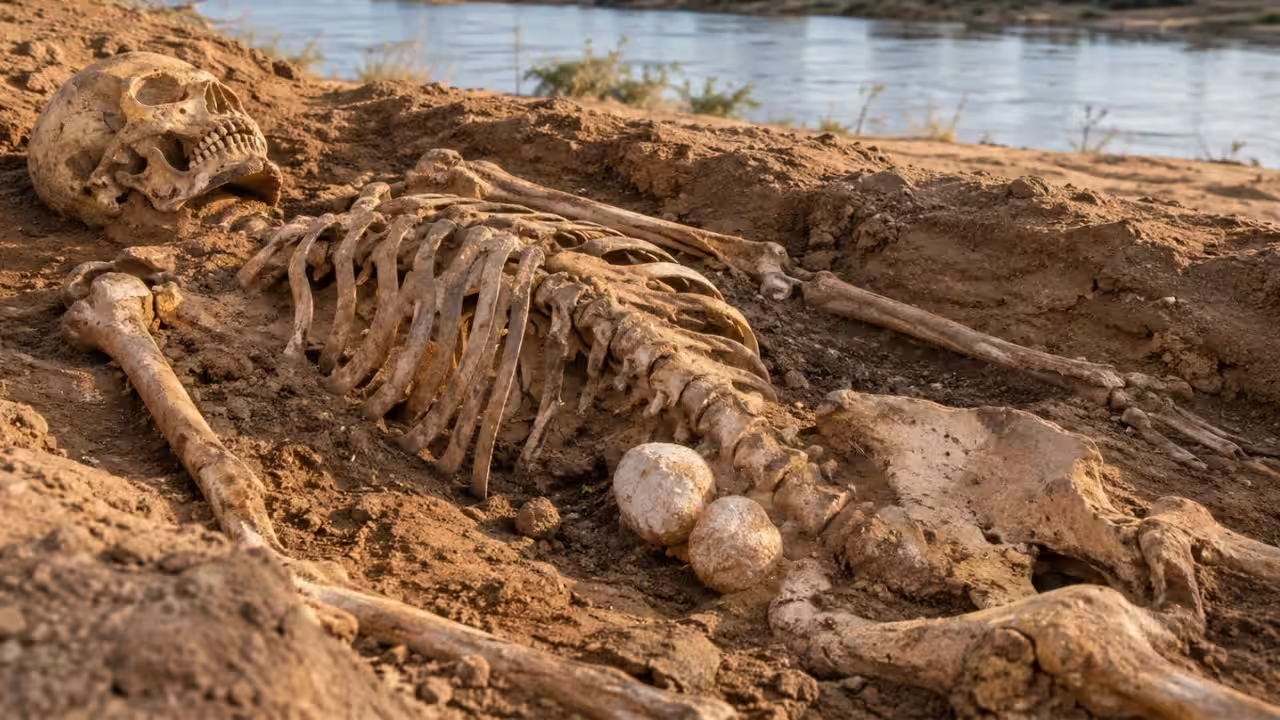
Anyone who has had a kidney stone, or sat next to a friend who has, probably knows how much it can hurt. The problem is also much older than modern times. In a 1989 paper titled ‘A probable case of prehistoric kidney stone disease from the northern Cape Province, South Africa,’ Alan Morris and Allen Rodgers wrote about a skeleton found near South Africa's Orange River. Two large mineral deposits were found near its lower spine. Lab tests revealed what they were made of. The finding connected a person from the distant past to a health problem that many people still face today.The grave on the banks of the Orange River The skeleton came to light during excavations of isolated graves along the north side of the Orange River in the Cape Province of South Africa. The archaeologists discovered two calcium-rich deposits near the lumbar region, the lower portion of the spine. The skeleton belonged to an adult female who died at about 55 years of age. The paper's title called the case prehistoric. This finding provided insight into what could be a possible medical condition from ancient times. It also showed how much one grave could reveal about the daily health of people in the distant past.What the lab tests found It's difficult to identify hard lumps in a grave just by looking at them. So, the team ran some lab tests. They used X-ray powder diffraction and scanning electron microscopy. These methods help scientists find out what a material is made of. They both identified the deposits as apatite, a mineral form of calcium phosphate. Apatite is a common constituent of human urinary stones. These are hard lumps that can form in the kidneys and urinary tract. The deposits were not kidney-like in shape or in internal structure. But the authors provided an explanation. They suggested that the build-up on both sides of the body was caused by a long-running kidney problem. They called it a probable case, not a proven one.How scientists tell a stone from a pebble Another study explains why scientists cannot rely only on their eyes. Donatella Usai and colleagues discovered three stone-like objects in a grave at Al Khiday, Central Sudan, in 2013. In their 2017 paper published in PLOS ONE, the authors reported that one of the objects was found between the pelvic bones, and two other objects were found near the lower spine of an adult male. They were all about 26 to 30 millimetres in diameter. Ordinary rocks were ruled out because the objects were too light compared to rocks. They had a density of about 1 gram per cubic centimetre, while most rocks are 2 to 3. The minerals inside, hydroxylapatite and whitlockite, then suggested the prostate rather than the kidney or bladder.What the findings do and do not show These two cases are not the same. The Sudan stones were linked to a man's prostate. The South African findings pointed to a suspected kidney problem in a woman. However, both findings showed how scientists use minerals and location to work out what a lump is. The Sudan team argued that prostate stones can no longer be considered a purely modern disease. This matched the idea that people suffered from urinary stones for a long time. However, the limits still matter. Morris and Rodgers said that their case was probable, and the deposits did not match the shape of a kidney. The South African discovery did not prove that the woman died of kidney stones or even that she definitely had them. They only showed that a calcium-based material common in urinary stones was there close to her spine. Careful lab work turned a puzzling discovery into a small piece of someone's medical history, someone who walked the Earth a long time ago.You use AI every day. Now get your AI Quotient. Take the AIQ test.
Topics in this story
Gathered from external sources. Rights to this text belong to whoever originally published it.