Convicted Bosnian Serb war criminal Ratko Mladic dies
The ‘butcher of Bosnia’ died age 84 in a UN prison hospital in the Netherlands, the UN tribunal in The Hague confirmed.
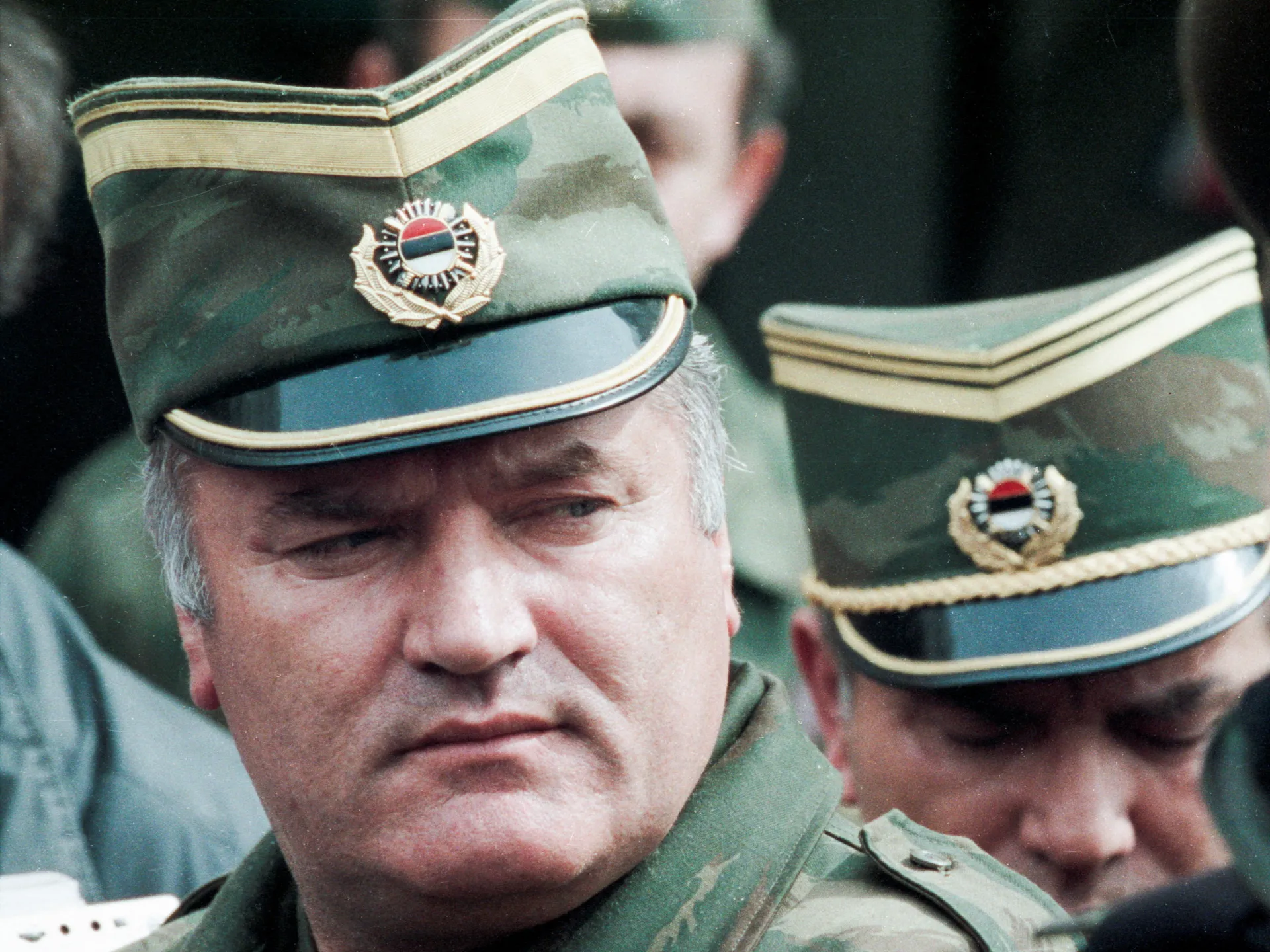
Former Bosnian Serb general Ratko Mladic, who was serving a life sentence for genocide, war crimes and crimes against humanity during the bloody 1992-1995 war in Bosnia and Herzegovina, has died.
Mladic, 84, the so-called “butcher of Bosnia”, died at a United Nations prison hospital in the Netherlands, the UN tribunal in The Hague confirmed on Thursday.
“Mladic passed away today while hospitalised in The Hague,” said the International Residual Mechanism for Criminal Tribunals, adding that judge Graciela Gatti Santana had ordered “a full inquiry into the circumstances” of his death.
A family member of Mladic confirmed the reports of his death earlier in the day and told The Associated Press that Mladic’s son, Darko Mladic, was on his way to The Hague.
Mladic was convicted of genocide for orchestrating the 1995 massacre of at least 8,000 Bosniak (Bosnian Muslim) boys and men in a UN-designated “safe area” of Bosnia, in Europe’s worst atrocity since World War II.
He spent his last years in jail after he was convicted in 2017 for crimes the tribunal said at the time were “amongst the most heinous known to humankind”.
Former UN rights chief Zeid Ra’ad al-Hussein described him as “the epitome of evil” after his conviction.
The former communist officer-turned nationalist warlord was one of the most notorious figures of the conflict in which more than 100,000 people were killed and more than two million were driven from their homes.
He commanded his troops to “scorch the brains” of the Bosniaks and boasted of being a “Serbian god”.
When the Bosnian war started in 1992, Mladic became the commander of the Bosnian Serb troops and took control of large swaths of the country in an attempt to form a Serb mini-state.
Serbs under Mladic’s control laid siege to the capital, Sarajevo, and other cities and villages, established camps for detained Bosniaks and enemy soldiers, and systematically killed prisoners.
The killings, recognised as a genocide, were the culmination of a war that had lasted at least three years, in which Mladic pounded Sarajevo daily with the artillery, tanks, mortars and heavy machineguns of his nationalist Serb army, killing 10,000 people.
The dead from Srebrenica were bulldozed into mass graves over four days in July 1995, some of them dug up and relocated to remote mountains in order to hide evidence of the killings.
The goal, as determined by the UN International Criminal Tribunal for the former Yugoslavia (ICTY), was “ethnic cleansing” — the forcible expulsion of Bosniaks, Croats and other non-Serbs to clear Bosnian lands for a Greater Serbia.
The tribunal found that Mladic, together with late Serbian President Slobodan Milosevic and Bosnian Serb political leader Radovan Karadzic, were part of a criminal conspiracy to implement the plan.
Defiant to the end, Mladic said, “I do not recognise this court,” at an ICTY hearing of his case in 2014.
When he was sentenced to life in prison in 2017 he shouted: “This is all lies, you are all liars!”
Mladic death ‘doesn’t clear the mass graves’
Despite Mladic’s crimes, many Serbs continue to revere a military commander who painted himself as a “simple man” whom fate had chosen to protect his people.
Bosnian Serb separatist leader Milorad Dodik reacted to Mladic’s death saying: “It is a murder. He was respected by Serbian people. As a commander he stood to defend Serbs.”
Remir Suljagic, the head of the Srebrenica memorial, however said it is important to remember Mladic’s victims and not glorify him after his death.
“It doesn’t bring back the dead. It doesn’t clear mass graves. It does not change judgments. It does not turn the criminal into a historical figure.” Suljagic said.
Kada Hotic’s husband and son were killed by Serb forces in 1995. They were 56 and 29 at the time.
The 82-year-old told Reuters that justice has been served because Mladic died in prison. “I am grateful to the Tribunal because it sentenced Mladic to life and has not released him. He died in disgrace, because he killed so many people.”
Topics in this story
Gathered from external sources. Rights to this text belong to whoever originally published it.