She was a ’90s grunge queen. These are her photos on the road
Bassist Melissa Auf der Maur toured with Hole and the Smashing Pumpkins during a whirlwind decade she documented on film. But she held onto the photos in private, until now.
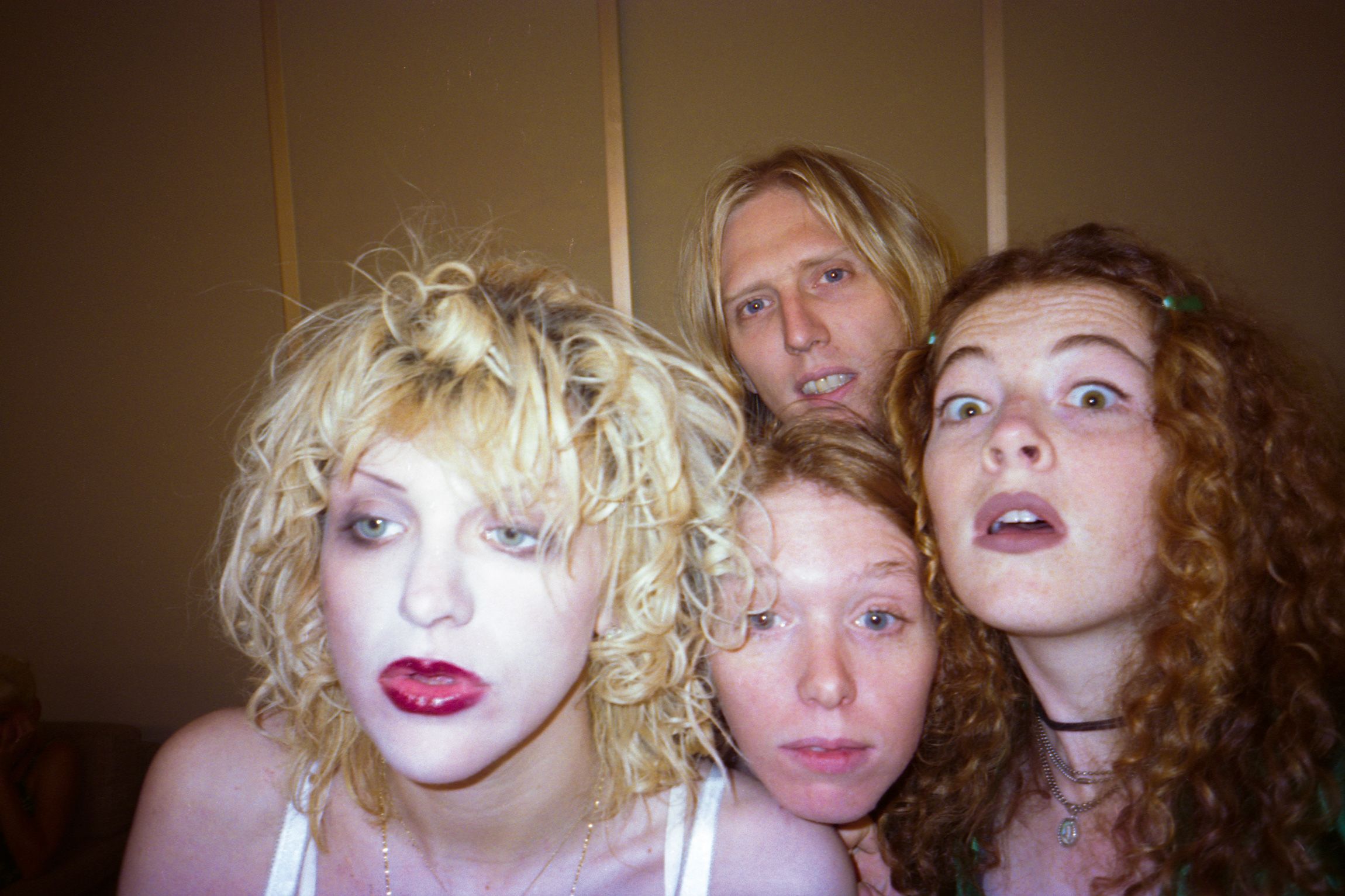
If Courtney Love was the unpredictable fire of Hole, bassist Melissa Auf der Maur was her cool counterpart, the frontwoman’s right-hand woman both on and off the stage. For five years, the Montreal-born Auf der Maur joined the grunge-rock act just as they crested toward a vertiginous, yet precarious peak, shortly after the release of their explosive album “Live Through This.” The album came out one week after Kurt Cobain, Love’s husband, shocked the world with his suicide, and two months before Kristen Pfaff, the band’s founding bassist, died by overdose. The seismic cultural shift by Cobain and Nirvana — along with bands including Soundgarden, Pearl Jam, and Alice in Chains — ushered the underground into the mainstream and has yet to be replicated since. The period was captured on MTV, VH1 and radio; on analog cameras for music magazines and videotapes now archived as grainy clips on YouTube. And as the period recedes further in memory, the gatekeepers are fewer, too. At 54, Auf der Maur is now offering her own account, a vast but rarely seen archive captured on point-and-shoot film cameras. The forthcoming book, “My ’90s Rock Photographs,” brings together more than 200 images of the bassist’s life on stage, backstage, on the road and in hotel rooms, as she both documented the alternative renaissance she was part of and kept up with the artistic photography practice she had originally intended to be her career. It accompanies an exhibition this September at The Art Gallery of Ontario and a future feature-length documentary film about her archive. It also follows her release of a tell-all memoir, as well as a batch of early demos, all in the same calendar year. It’s what Aur der Maur calls her “21st-century midlife resurrection.” “2026 is definitely my purging of the ‘90s, but also my healing of a decade that made and broke me,” the musician and artist explained from her home in New York’s Hudson Valley, where she’s lived since 2008 and where she co-founded the arts center Basilica Hudson with her husband, filmmaker Tony Stone. Reclining on her couch over a Zoom call, she reflected on the time that’s passed since her five-year stint with Hole, followed by a year with The Smashing Pumpkins for their farewell tour — a decade of exhilaration and excess and tragedy all at once. “It’s (been) enough time for healing to happen, but also a good amount of time for clear perspective on how it sits in the big, big picture of human history.” Across the book, we follow Auf der Maur as she is thrown into the fray, as an aspiring artist who studied photography but was pulled into Love’s magnetic orbit by way of the musician Billy Corgan (Auf der Maur’s own band Tinker opened for his band, The Smashing Pumpkins, in 1993 thanks to her fan letter to him). She snaps photos backstage at Saturday Night Live, where Hole performed the furious anthem “Violet” during a holiday episode in 1994; and from balcony seats during Nine Inch Nails’ “Self-Destruct” tour, which they opened for a handful of dates before Love’s infamous fall-out with the industrial act’s frontman and founder Trent Reznor. She describes in the book the experience of being onstage with Hole as a battle, like ancient Roman gladiators. But off-stage they were silly, and messy, and real. She photographs Love against a sea of thousands of fans, smiling wide with ruby-red lips and a slice of cake, and with Auf der Maur in a limo to the 1995 MTV Awards, Love and Cobain’s daughter Frances Bean stretched across their laps. For Auf der Maur, part of the work of unearthing her archive has been to advocate for Love while still acknowledging the problems she had. “It’s very much enforced by the memoir, too, but I absolutely give a f**k of a lot of time to reframe Courtney as one of the most misunderstood women in history,” she said. “(It’s a) very solid, lucid perspective of what the world did to her, while also telling the truth.” Returning and reconnecting Across her images, Auf der Maur reckons with fame and performance and visibility in different ways. Sometimes, her documentation is simple and lighthearted, taking selfies and portraits with other stars in her orbit, from Danny DeVito to Drew Barrymore and Chloe Sevigny. But the period was tumultuous, too. Love battled addiction and faced endless scrutiny from the media, drummer Patty Schemel — Auf der Maur’s closest bandmate — struggled with her own drug problems, and Auf der Maur lost her father just before the release of the 1998 album ‘‘Celebrity Skin.” In the book, she intersperses photos of that time, of her ill father, his funeral, and the things he left behind. After the musician quit touring in the early 2000s, she put down both her instrument and her camera. For the first decade of her daughter River’s life, the child didn’t know her mother was ever in a band; but the talk became unavoidable when other parents would tell her that they saw her mother on stage in her ’90s heyday. Auf der Maur only seriously began to revisit her archive once she’d turned 50 and River was nearing her teenage years. “I needed that much time to be able to look at the death of my father, look at the life of extreme pain, drug addiction, death that I was bathed in in my 20s,” she said. “I needed to grow as a human and become a mother and stop making music and get off the road, so that I could be strong enough to look at the hard parts and to celebrate the things that I couldn’t have seen then.” Returning to her photographs meant returning to a much earlier version of herself, too: the artist who had originally said no to joining Love’s band because she felt she was meant to get her master’s in photography instead. Auf der Maur had looked to the self-portrait practices of women photographers like the late Francesca Woodman and had been developing a visual language of her own, which can still be seen in a more transitory state in hotel rooms as Auf der Maur turned the camera on her own body. “I thought I was going to be a fine-art photographer who had my own practice, which was rooted in self-portraiture and reflection of time and the feminine body,” she explained. “I figured that’s what my life was going to be, but then overnight, like literally, grunge Cinderella.” She found herself documenting everything, every day, but at the time she couldn’t put the full ‘why’ into words. “I just knew that history was happening, and I knew I was just like a servant to our generation.” “This was not about me — even though, yes, I took a lot of photos of me,” she continued. “I was trying to also capture (being) a woman in a rock band, but also a woman in my generation watching our magic be co-opted by corporate machines and ripping our souls out.” For a long period, she and Love fell out of touch, but have reconnected over time. And in the process of writing her memoir, she said she received the blessing of all of her former bandmates. She believes the reason why she’s had their support is a deep sense of trust, that Auf der Maur “doesn’t give a f**k about money, fame, or power,” she said. “That is not why I exist, nor what I call to. In fact, I run away from that quite often. If anything, I’m trying to elevate our higher selves.” Her renaissance year is continuing in full force. She’s teased reunions on stage with Love, and joined The Smashing Pumpkins as a guest onstage at Lollapalooza alongside Olivia Rodrigo — one of River’s favorite artists, who joined her on the trip to Chicago. “She’s only getting to know that part of me now,” she said, smiling. “It was a full-circle dream for her to see her mother get aligned with things that she likes. She and her friend took an entire suitcase of my ’90s clothes to incorporate in their Lollapalooza weekend outfits, and that’s when I thought, ‘OK, I really, I really, I really made it now.’”
Topics in this story
Gathered from external sources. Rights to this text belong to whoever originally published it.