In 2005, New York buried 1.1 million scrap tyres beneath I-87 near Plattsburgh; the discarded rubber helped replace two ageing bridges with a highway
US News: In a groundbreaking highway project, New York State utilized 1.1 million scrap tyres as alternative fill beneath I-87, transforming waste into infrastructure while replacing obsolete bridges over an abandoned railroad.
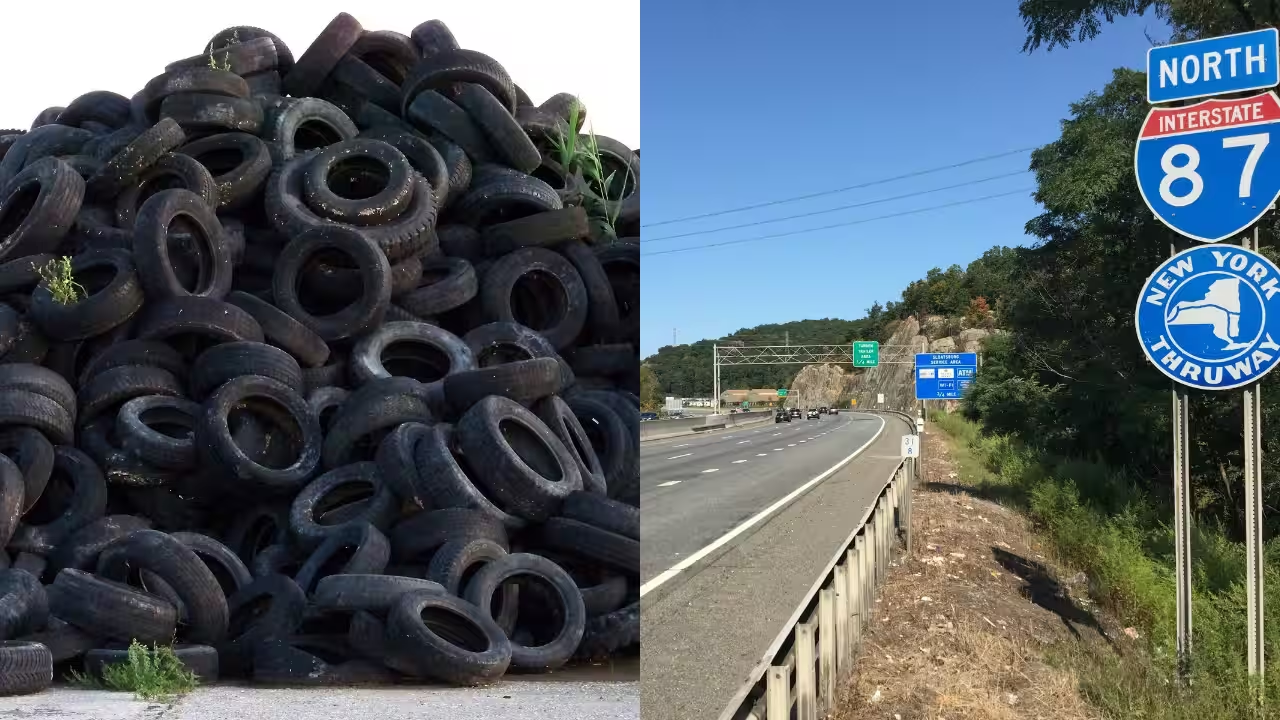
About 1.1 million discarded passenger tyres ended up beneath Interstate 87 south of Plattsburgh, New York inside an engineered embankment built after two ageing bridges over an abandoned railroad were removed. The New York State Department of Transportation used shredded tires as fill beneath the reconstructed roadway, and turned a large waste stockpile into part of the highway project. NYSDOT processed tires into large pieces known as tire shreds and used them as lightweight fill in selected embankment projects instead of sending the material to disposal sites. The state’s Tire Shred Initiative was developed alongside the New York State Department of Environmental Conservation as a way to address waste-tire stockpiles while using the material in highway construction.The I-87 project involved two bridges that carried the interstate over the abandoned Delaware and Hudson Railroad in Clinton County, south of Plattsburgh. Engineers removed them and filled the old railroad crossing with tire shreds and conventional earthen embankment material rather than rehabilitating or replacing the bridges. The new fill then supported the reconstructed roadway.The tyres became the fill beneath the roadNYSDOT’s own account says the tire-shred embankment represented approximately 1.1 million passenger tires and was completed in early 2005. The agency said the approach avoided the expense and labor that was associated with rehabilitating or replacing bridges that were no longer needed. A separate NYSDOT annual report states that work began in September 2004 under a $2.1 million contract, was completed in November 2005 and involved removing the northbound and southbound I-87 bridges over the abandoned railroad. The replacement used tire shreds together with earthen embankment fill.The tyres were shredded to specified sizes and placed in engineered sections. An earlier NYSDOT annual report described the project as a first-of-its-kind construction effort in the agency’s Region 7 and documented the installation of tire cells that contained hundreds of thousands of tires during the construction process. Tire shreds are much lighter than conventional soil and aggregate, which can reduce the load imposed on underlying ground, although the engineering design has to account for factors such as drainage, settlement and the potential for heat buildup in thick tire-shred fills.New York was also cleaning up tyre stockpilesNYSDOT records say that by November 2005, two projects under the Tire Shred Initiative had used the equivalent of about 1.4 million tires and helped remediate two waste-tire sites. The second project, on State Route 240X in Erie County, used nearly 300,000 tires in a new embankment section. A technical summary prepared for NYSDOT and the New York State Department of Environmental Conservation describes the wider program and its environmental controls, and states that the I-87 Railroad Grade Crossing Elimination Project used approximately 1.1 million tires and was completed in spring 2005. The report also says tire-shred embankments were subject to design criteria that were intended to keep them above the water table and away from environmentally sensitive locations.The state monitored water quality around the projects, with testing for metals and other potential contaminants. The technical report said groundwater testing from the early projects showed very low levels of iron and manganese, while the design guidance took a conservative approach to site selection.NYSDOT had expanded tire-shred construction to several projects across the state by the late 2000s, and its program eventually used millions of passenger-tire equivalents and helped clean up large waste-tire sites. At the Plattsburgh crossing, however, the idea was that two obsolete bridges disappeared, the abandoned railroad corridor was filled, and roughly 1.1 million discarded tires became part of the engineered ground supporting I-87.Catch the latest World News and Live updates. Download the TOI app.
Topics in this story
Gathered from external sources. Rights to this text belong to whoever originally published it.