The Pakistan paradox: The rise of a pre-pardoned autocrat
International News: The geopolitical landscape of South Asia has shifted fundamentally following Pakistan's formal institutionalisation of an absolute military autocracy..
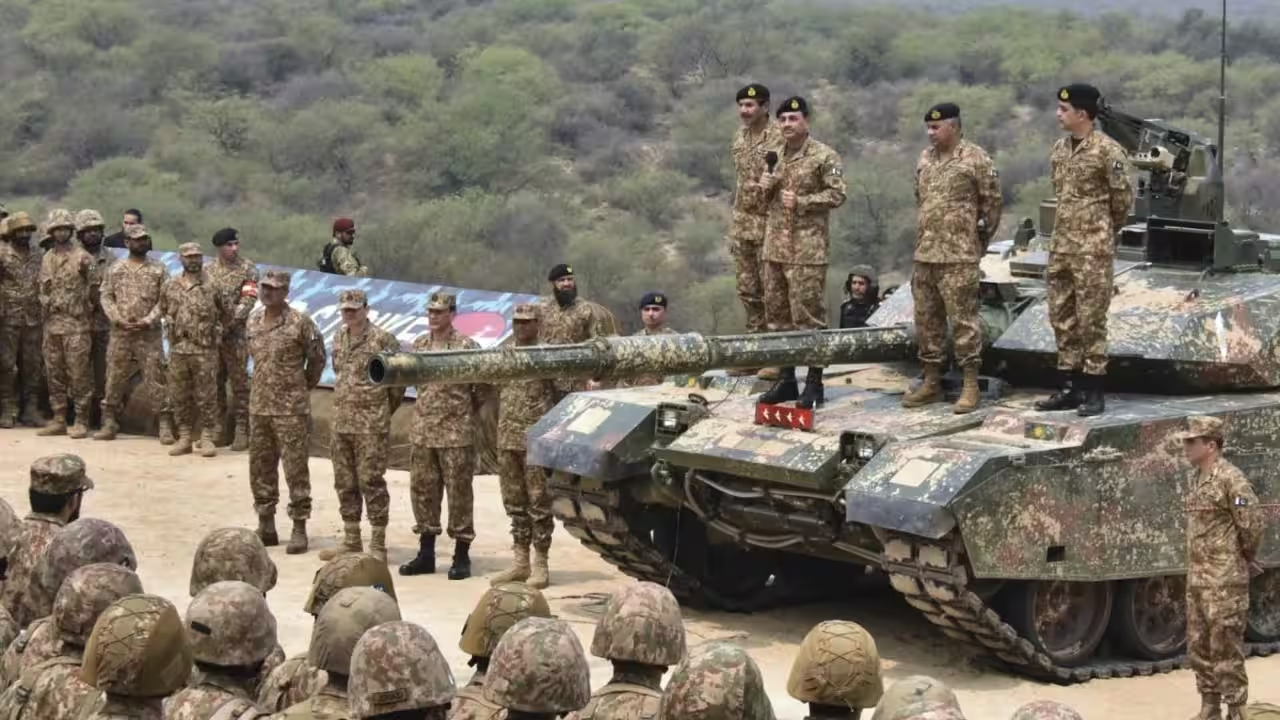
The geopolitical landscape of South Asia has shifted fundamentally following Pakistan's formal institutionalisation of an absolute military autocracy. Through the passage of the 27th Constitutional Amendment and the subsequent enactment of the Defence Services of Pakistan Act 2026 on 20 August 2026, Field Marshal Syed Asim Munir has been granted unprecedented, legally enshrined absolute power. He now wields a degree of unchecked authority that surpasses any previous military dictator in the nation's history, presenting a grave escalation risk for regional stability and Indo-Pak relations.Pakistan has engineered a legal anomaly by the creation of a "pre-pardoned" ruler. The restructuring codifies a level of control that hollows out what remains of Pakistan's democratic and judicial institutions. The 27th Amendment grants Field Marshal Asim Munir sweeping, lifelong legal immunity that insulates him from any future criminal or constitutional prosecution, even after his tenure ends.By abolishing the Chairman Joint Chiefs of Staff Committee, the newly enacted Defence Services of Pakistan Act 2026 vests absolute operational command over the Army, Navy and Air Force directly in the office of the Chief of Defence Forces (CDF), held concurrently by Munir until at least 2030. The legislation grants the Field Marshal sole authority to "hire, fire, promote and retire" all personnel across all three branches of the armed forces. No head of state or civilian leader in a modern democratic framework commands such sweeping personnel and institutional leverage. Amendments to the National Command Authority (NCA) Act have further consolidated Pakistan's nuclear and strategic command frameworks directly under his immediate orbit.He will also play the role of the Prime Minister's principal military adviser on national security, defence and matters concerning the armed forces. The point to ponder is whether the Prime Minister will have the authority to go against his advice.The Contrast: Dictatorship Without AccountabilityThis absolute centralisation of authority marks a dangerous departure from historical precedent. During the 1999 peace process, General Pervez Musharraf unilaterally launched the Kargil infiltration. While he seized power in 1999 and remained President from 2001 to 2008, Musharraf still operated within a framework where he could later be tried, and ultimately sentenced, for high treason for suspension of the constitution in 2007, when he declared an emergency in a move intended to extend his tenure. Even though the charges remained pending and he was even allowed to leave the country, owing to the massive clout of the Army, there existed a provision to frame charges against him and pronounce a sentence. Under the 2026 legal framework, that internal accountability mechanism has been completely dismantled. Field Marshal Munir rules with total pre-facto immunity, leaving no domestic legal or political recourse to penalise strategic miscalculations or unilateral state actions.The explosive timingThis unprecedented consolidation of power comes at a time when Pakistan is facing severe institutional and socio-economic breakdown.The economy remains fragile, relying on external bailouts and suffering from structural inflation. Armed violence is surging across Balochistan and the Khyber Pakhtunkhwa border lands. Relations with the Taliban-led administration in Afghanistan remain volatile amid cross-border TTP terrorism. Underground political volatility persists, driven by the systemic suppression of Imran Khan and his widespread support base.Historically, when a Pakistani military regime faces an existential internal crisis, its default survival mechanism is to externalise domestic anger. A dictator holding absolute institutional control and total personal immunity is highly incentivised to trigger a controlled flashpoint with India to enforce national cohesion and divert public focus from a collapsing state.The threat matrix facing IndiaIndia must recalibrate its security doctrine to account for a nuclear-armed neighbour run by a commander answerable to no one.Future provocations may bypass deniable proxies or non-state actors entirely. Operations could be driven directly by state organs, secure in the knowledge that their commander-in-chief holds pre-pardoned immunity. Unchecked power over all military echelons allows the CDF to align regular forces with radical elements without institutional opposition.If a major cross-border terrorist attack is orchestrated under Rawalpindi's direct supervision, India's current military doctrine dictates a swift punitive response.Should India initiate a significant retaliatory counter-offensive, the conflict trajectory under a highly centralised, paranoid military command becomes entirely unpredictable. Pakistan's political class and its citizens must recognise that formalising absolute military supremacy through parliament is a short-sighted move that places the country on a precarious path. India must work out its options in light of this development in the neighbourhood.
Topics in this story
Gathered from external sources. Rights to this text belong to whoever originally published it.