Last known North East sword maker hopes to pass on craft
Frank Lee believes he is the only person making the swords so integral to the North East.
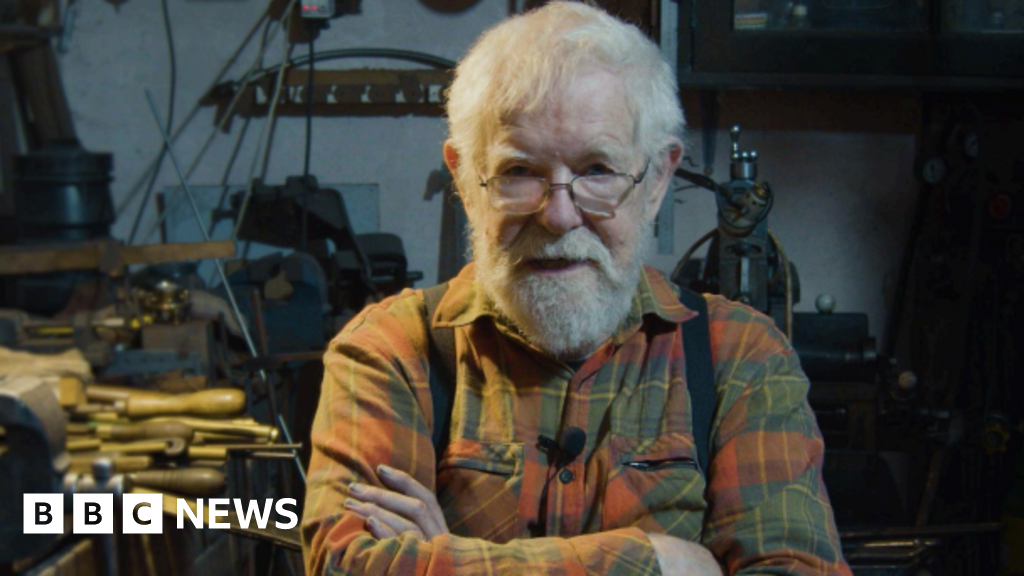
The tradition of rapper sword dancing developed on the coalfields of north-east England as early as the 18th Century. While dance troops continue to entertain audiences across the world, it is believed 81-year-old Frank Lee, from Cumbria, is now the last maker of the swords so integral to the dance.
Retired professor of cultural studies Trish Winter says rapper sword dancing, using two-handled bending swords, was a "North East story".
Developed in the mining communities of Northumberland and County Durham, Winter says it evolved due to lay offs in the mines over winter when miners were forced to find other ways to make money.
"There were traditions of sword dancing around Europe from the Middle Ages," she said.
"But rapper develops on the coalfields, presumably, from existing practices of sword dancing, to something very unique and very particular to the coalfields."
The dance troops are made up of at least five men, each connected by flexible rapper swords. The dance is fast and the men weave in and out of each other and moving around the swords.
While the dance is traditionally performed by men, there are modern examples of female troops.
"Most people are familiar with colliery banners and brass bands as part of the North East industrial heritage," Winter says.
"And rapper dancing is just as much a part of that heritage, but I think it's less well known.
"I think it's actually a really good example of how industrial heritage isn't just about buildings and machinery."
Lee started making swords in 1977, albeit sporadically.
A former dancer himself, he first came across the tradition when he was 12 years old.
"I was just totally wrapped up in it," says Lee.
"It's fascinating to watch, it's got an element of conjuring in it, it's got fast movement, it's complex, it's got music involved in it, and it's got comedy involved in it."
The former craft, design and technology teacher started making the swords more regularly years later out of "necessity".
"At the time they were quite difficult to get and I have the wherewithal to make them," Lee says.
And he believes the popularity is growing.
"I'm quite surprised it isn't much better known than it is, but it's been getting better now over the last few decades," Lee says.
"I think when I started in 1977 there might have been about 20 teams in the whole country.
"And I'm just about to make my 500th set of rappers."
So while the form of dancing is far from a dying art, the same cannot be said for the art of rapper sword making.
This is the motivation behind Amble-based Dry Water Arts' latest project to try and preserve Lee's knowledge.
The project, which is fronted by Winter, has received a grant from The National Lottery Heritage Fund to preserve the craft for future generations.
"The first thing we want to do is to safeguard the craft," Winter said.
"Because Frank Lee is the last known maker of rapper swords.
"We realised there was a danger that that knowledge would disappear before it had been passed on."
Part of the project involves a film documenting how Lee makes swords.
"I suppose the concern at the moment is that there isn't anybody on the horizon that looks like they might want to take over, and there's not enough worldwide demands to justify a commercial set up," Lee says.
"Everybody who's ever made them has always been the last of the rapper-makers and I'm just the current last of the rapper-makers.
"But I am 81 now and at some point my body's going to say enough."
Winter says: "We want to document his knowledge for the future in the hope there will be future makers of rapper swords.
"The big sort of paradox is that the rapper sword dance is very much alive all over the world and it's a vibrant lively dance tradition.
"But the craft that it relies on is held in the knowledge of one person, so there's a point of vulnerability there."
The project officially launches on the 15 November at Dry Waters Art Centre with an exhibition.
It then runs until September 2027 and includes talks and demonstrations from Lee, workshops and performances.
"The project isn't going to completely solve the problem," Winter says.
"But what it will do is document Frank's knowledge so it is saved."
Follow BBC North East on X and Facebook and BBC Cumbria on X and Facebook and both on Nextdoor and Instagram .
'For 150 years my family have been dancing with swords'
Sword dancers perform in Boxing day tradition
Topics in this story
Gathered from external sources. Rights to this text belong to whoever originally published it.