In 1970, Fullerton paved a 600-foot California street with crushed waste glass; 2 years later, the EPA found the unusual recycled road was still in good condition
Discover how Fullerton, California pioneered the use of crushed waste glass in asphalt in 1970, paving a 600-foot road that impressively stood the test of time. Learn about the innovative experiments that transformed bottles into durable road materials and the ongoing implications for recycling and infrastructure.
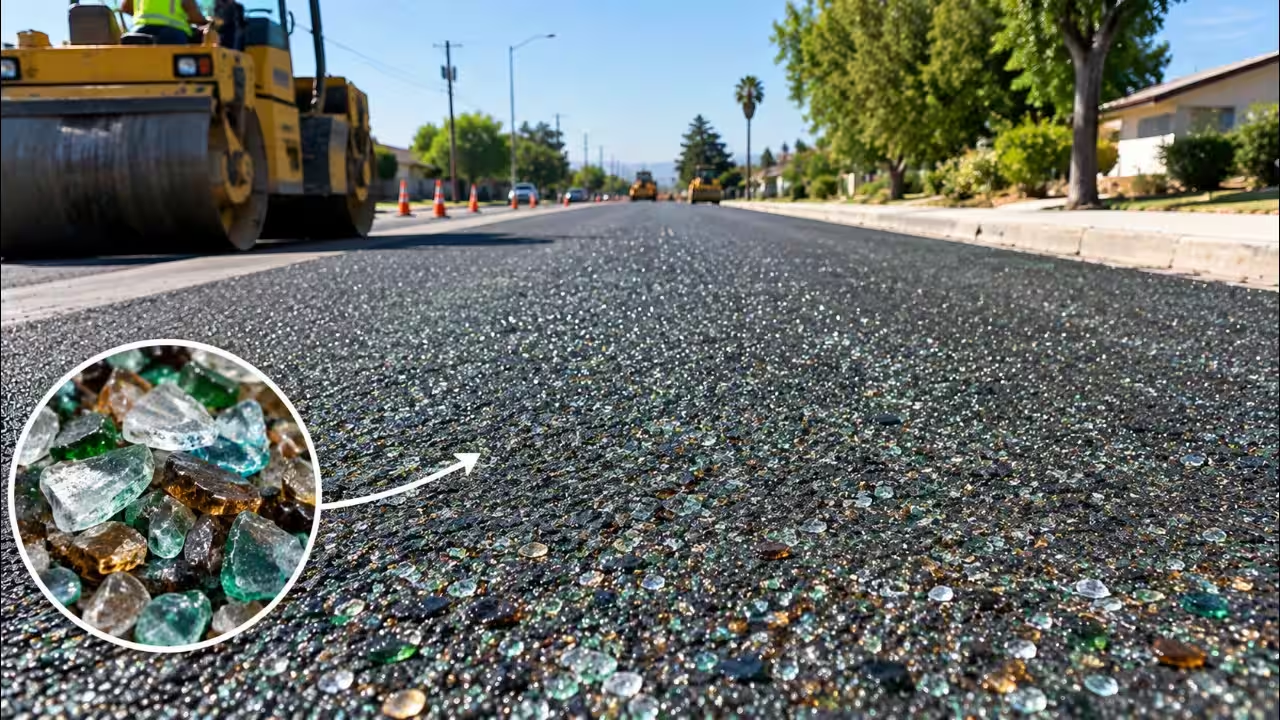
In 1970, a street in Fullerton, California, became an unusual experiment in recycling when crushed waste glass was used as a major part of its asphalt surface. Instead of sending unwanted bottles to disposal, the material was processed and incorporated into a road mixture that covered part of a 600-foot stretch in the Fullerton Air Industrial Park. At the time, researchers were investigating whether discarded bottles could replace some or all of the conventional mineral aggregate used in asphalt. The Fullerton experiment provided an opportunity to observe how such a material behaved under actual traffic rather than only in laboratory tests.Turning bottles into road materialAccording to the EPA report, the Fullerton street was paved on October 26, 1970. The road was 600 feet long and 40 feet wide, although only 30 feet of its width received the glass-containing asphalt. The remaining 10 feet was paved with conventional asphaltic concrete, providing a comparison within the same road. The glass came from clean, non-returnable bottles collected at a Fullerton bottle redemption centre and crushed in a hammermill. The resulting glass aggregate was then blended with rock dust and hydrated lime.The final aggregate mix consisted of 63% glass, 36% rock dust, and 1% hydrated lime. Then, a 3-inch-thick layer was laid over a crushed rock base of 7.5 inches. The inclusion of hydrated lime in the aggregate was intentional. It had been previously discovered in laboratory testing that lime addition would enhance the water-resistance properties of glass-asphalt mixtures. The EPA study found that asphalt mixes could be produced with crushed glass aggregates and conventional paving equipment, though compaction was challenging.What happened after the road opened?The initial construction process revealed one of the practical problems associated with using glass in asphalt. Because it tended to flow under pressure at high temperatures, the Fullerton mix was rolled only after it cooled to 220°F or lower. Core samples showed an average compaction density of 93.5%, and no further density changes were noted the following year.Another test was done on the skid resistance of the road by the California Division of Highways in March 1971. The test found skid numbers of 61 to 69 at 25 miles per hour, equivalent to 54 to 62 at 40 miles per hour. After a year, the surface showed some ravelling caused by fractures in the larger glass particles. Even so, the surface was still rated good, and the pavement performance was considered satisfactory. Later analysis provided additional evidence about aggregate performance. There were no signs of excessive degradation of the aggregate on the Fullerton and Rolla roads, according to the EPA report. In Fullerton, the aggregate gradation change was minimal.An early experiment in glassphaltHowever, the use of glass-in-asphalt in Fullerton was not an isolated case. At about the same time, similar trials were carried out in Missouri, Ontario, Pennsylvania, and other regions. As stated by the EPA summary for 1975, the field installations usually provided adequate skid resistance and satisfactory performance from a structural point of view; however, surface ravelling was observed in some cases. In a subsequent report issued by the Federal Highway Administration, the Fullerton trial installation was described as 600 feet long and made of asphalt material with 63 per cent of crushed glass in the aggregate composition. This does not mean the experiment proved waste glass was always a better alternative to traditional road aggregates. Rather, the experiment showed that used bottles could be converted into asphalt material and tested under real traffic conditions.You use AI every day. Now get your AI Quotient. Take the AIQ test.
Topics in this story
Gathered from external sources. Rights to this text belong to whoever originally published it.