In 1990, Sue Hendrickson discovered a T. rex in South Dakota; seven years later, its skeleton sold at auction for $8.36 million
Explore the incredible story of Sue Hendrickson's discovery of the T. rex skeleton in South Dakota, its record-breaking auction price of $8.36 million, and the ongoing scientific insights it provides.
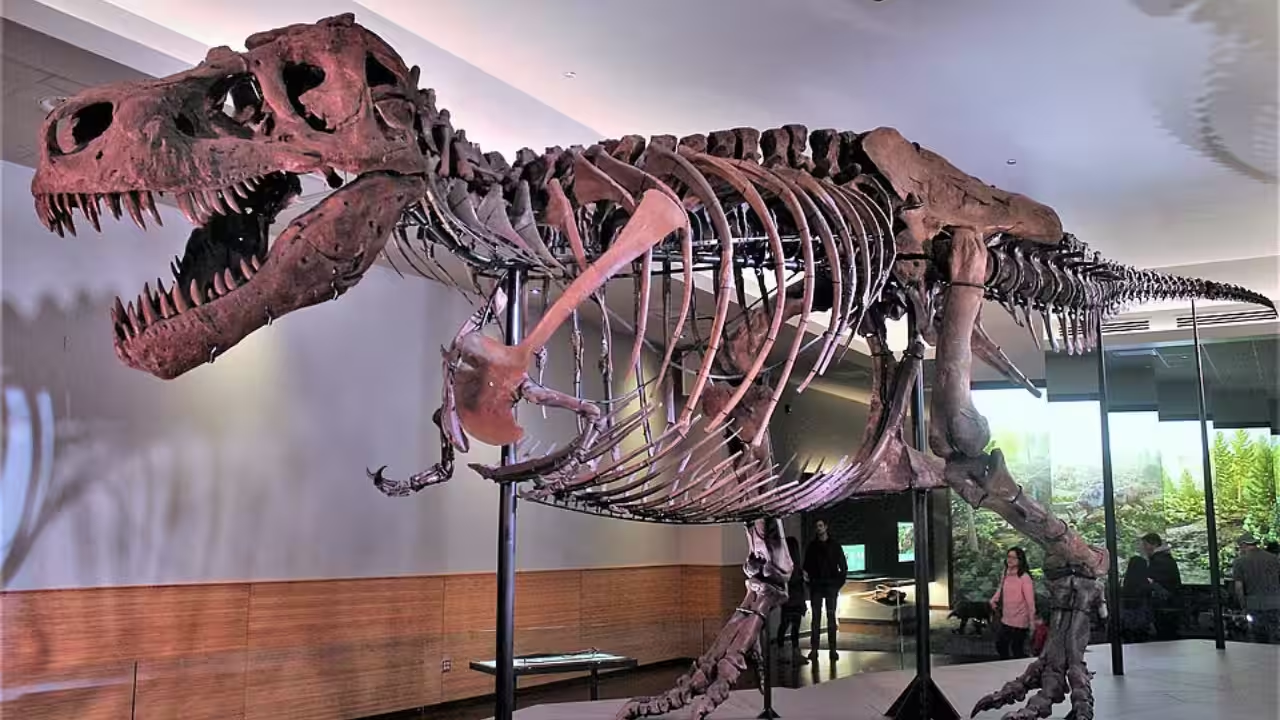
In August 1990, fossil hunter Sue Hendrickson noticed a few large bones sticking out of an eroded bluff in South Dakota. According to the Field Museum in Chicago, she followed a hunch that more was hidden under the surface. She was correct. Seven years later, the skeleton she discovered sold at auction for $8.36 million. The story is about science, money, and one big question: who owns a dinosaur?A lucky find in South DakotaHendrickson was on a commercial excavation trip north of the town of Faith when she stumbled upon the skeleton. The museum reports it took six people 17 days to excavate the bones. The dinosaur was named Sue after its finder, but it wasn't clear if the animal was male or female. The fossils date back to the Cretaceous era, about 67 million years ago. Growth rings in the bones, similar to those of tree rings, indicate that the dinosaur lived for about 28 years, which is at the upper end of a T. rex's life expectancy. Scientists also observed a teenage growth spurt, with the animal reaching full size at 19.Why Sue is such a big dealSue is the largest T. rex skeleton ever found, measuring over 40 feet (12 metres) long and 13 feet (about 4 metres) tall at the hip. It is also the most complete. About 90% of the skeleton by bone volume survived. That means that scientists have 250 of the roughly 380 bones in a T. rex skeleton, including the wishbone. The Field Museum calls Sue the most celebrated T. rex and one of the most famous fossils in the world. Peter Makovicky, the then museum's curator of palaeontology, said some questions about T. rex can only be answered by Sue. Scientists have learned about movement, intelligence, and even body weight from the bones.The fight over who owned SueFinding Sue was one thing; deciding who owned it was another. Three parties began a five-year struggle for custody after the find that ended in an auction in 1997. A 2020 article published by Elizabeth D. Jones in History and Philosophy of the Life Sciences analyses the legal battles in the 1990s. Jones notes that, according to her research, academic palaeontologists, fossil collectors, Native Americans, private citizens, and government officials all claimed ownership of Sue. She argues that the debates were started and kept going by assumptions of ownership, expertise, or both.A record-breaking auctionThe public auction took place in 1997. The Field Museum won, with support from McDonald’s Corporation, Walt Disney World Resort, and private donors. The final price came to about $8.4 million, or $8.36 million to be exact. That was the most money ever paid for a fossil at an auction at the time. Following the sale, 12 museum preparators spent more than 30,000 hours preparing the skeleton and another 20,000 hours building the exhibit. The dinosaur was unveiled in the museum's Stanley Field Hall on 17 May 2000. The skeleton is now on display in the Evolving Planet gallery.What Sue is still teaching scientistsSue’s work is far from over. In 2016, one of the small forelimbs was scanned at the Argonne National Laboratory in Lemont, Illinois. Micro-CT scans revealed detailed images of the bone’s interior, helping scientists understand how T. rex used its arms. The actual skull, weighing 600 pounds (about 272 kilograms), is kept separately in a case for visiting scientists to study. Some scientists thought that the holes in the lower jaw were bite marks. However, it is now more commonly believed that they were the result of an infection. The museum adds that it cannot wait to find out what discoveries the skeleton will lead to next.You use AI every day. Now get your AI Quotient. Take the AIQ test.
Topics in this story
Gathered from external sources. Rights to this text belong to whoever originally published it.