In 1342, Europe suffered its worst flood year in 700 years; scientists now say 16 major floods struck the continent within just three years
Europe News: For centuries, the Magdalena Flood of July 1342 stood out as one of the great flood disasters of medieval Central Europe. A new study published in Nat.
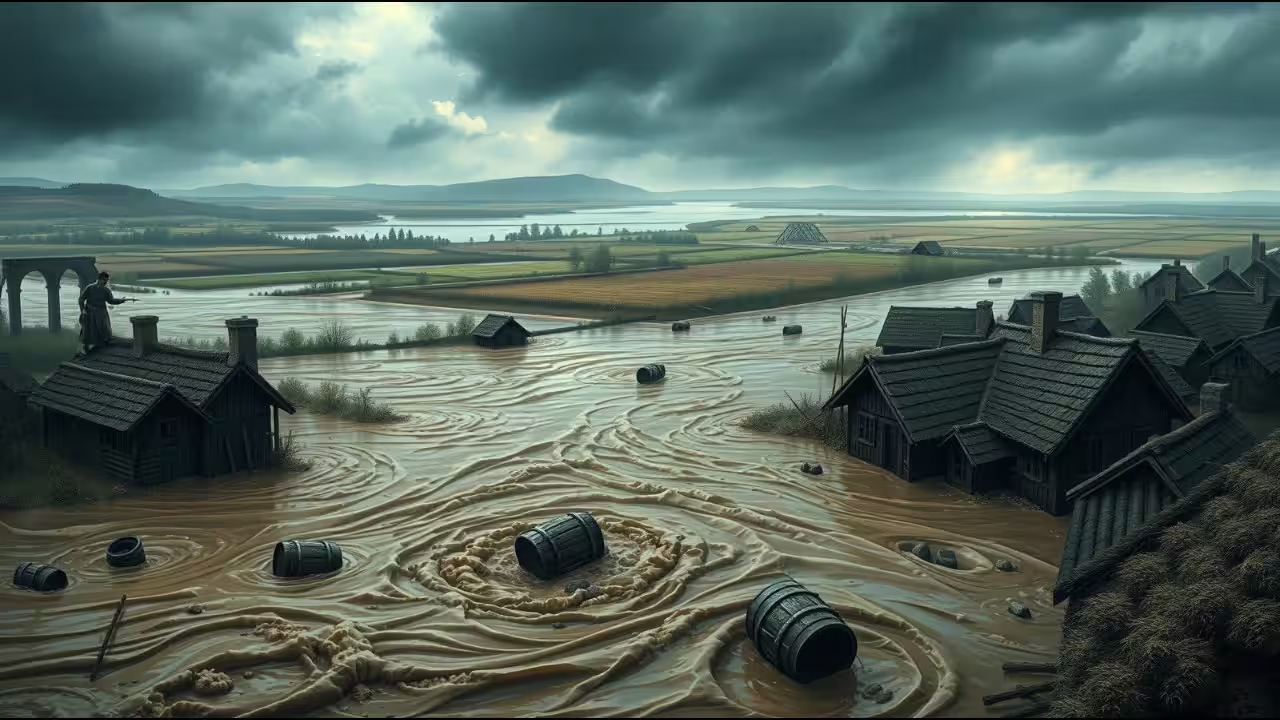
For centuries, the Magdalena Flood of July 1342 stood out as one of the great flood disasters of medieval Central Europe. A new study published in Nature suggests the disaster was actually part of something much larger: a run of 16 major floods that hit different parts of Europe between late 1341 and 1343. Researchers led by Andrea Kiss, a historian, medievalist and geographer at TU Wien, pieced the sequence together from more than 1,000 entries in contemporary records and other historical evidence. Four of the floods were classified as extreme events, with estimated return periods of 500 to 1,000 years. The researchers found that 1342 had more great and extraordinary floods than any other year in their 700-year European record, while 1343 ranked among the top 10. The repeated flooding damaged settlements, farmland, roads and other infrastructure, while the disruption contributed to food shortages and wider economic problems. The researchers link the unusual cluster to volcanic activity alongside major changes in the Arctic and North Atlantic climate.How researchers reconstructed 16 medieval floods from historical recordsThe study, Cascading continental-scale floods across Europe in 1342–1343, was published in Nature on August 12, 2026. To reconstruct what happened, the researchers went through more than 1,000 contemporary records describing floods during the period and compared accounts from different parts of Europe. That approach changed the story considerably. Instead of treating the Magdalena Flood as a single exceptional disaster, the researchers found evidence of repeated flooding beginning in eastern and southeastern Europe in November and December 1341. More followed during the winter and spring of 1342, including the Candlemas Flood in February. Then came the Magdalena Flood in July, followed by further major floods affecting northern Italy, the Mediterranean region and the Carpathian Basin later that year. The pattern continued into 1343. Taken together, the records show that Europe was dealing with one major flood after another across several seasons, rather than experiencing one unusually destructive summer.Why the repeated floods caused such widespread destructionThe timing made the damage particularly difficult to deal with. Communities that had barely begun repairing roads, bridges and buildings could be hit again by another flood months, or sometimes weeks, later. The Magdalena Flood caused extensive destruction in parts of southern Germany, while other events affected major river systems including the Rhine and Danube. Settlements were damaged, farmland was inundated and transport routes were disrupted. Mills and river crossings were especially important pieces of infrastructure because losing them could interfere with both food production and movement between communities. The effects did not end when the water receded. Damaged farmland meant lower agricultural production, while interruptions to transport made it harder to move food and other supplies. The study describes the wider period as having major socioeconomic consequences, with flooding, hunger and disease contributing to substantial loss of life.What volcanic eruptions and Arctic changes may have had to do with the floodsThe sheer number of major floods raised another question: why did so many occur within such a short period? The researchers looked at climate conditions around the same time and found a possible explanation involving both volcanic activity and changes in the Arctic and North Atlantic. Several eruptions occurred around the beginning of the period, while climate evidence points to significant changes in Arctic sea ice. The idea is not that one volcano directly caused all 16 floods. Instead, the authors propose that a combination of volcanic eruptions and multi-year changes in Arctic sea ice altered atmospheric circulation across the Northern Hemisphere. Those changes may have created conditions that made intense rainfall and flooding more likely in parts of Europe. It is a reminder that extreme weather does not always happen in isolation. Large-scale changes in the climate system can create a period in which several otherwise unusual events occur close together.Why the Magdalena Flood became famous while the wider sequence was forgottenThe Magdalena Flood has survived in European historical memory far more prominently than many of the other floods identified in the study. That may partly be a consequence of how disasters are recorded and remembered. A flood that leaves behind particularly detailed written accounts, physical markers or a strong local memory can remain visible for centuries. Another disaster, even one that was highly destructive, can gradually disappear from the historical record. Looking at records from across Europe changes that perspective. What appears to be one exceptional flood when viewed from a single region becomes part of a much broader pattern when accounts from different river basins are compared. The researchers also identify the 1342–1343 sequence as an important period in the development of European flood protection. Repeated disasters forced communities to think more seriously about how to prepare for severe flooding rather than treating every event as an isolated catastrophe.What Europe's medieval flood sequence means for modern flood riskThe floods of 1342 and 1343 offer a useful warning for modern Europe because they show how quickly extreme events can pile up. Flood planning often focuses on the likelihood and expected severity of individual events. But a community hit by several major floods in succession faces a different problem. Repairs may not be finished, emergency resources may be depleted and damaged infrastructure can make the next disaster even harder to manage. The medieval record shows that unusually severe floods can cluster across relatively short periods and affect different regions in succession. More than six centuries later, the sequence of 1341–1343 offers a broader lesson: Europe's worst flood periods are not necessarily defined by one extraordinary river overflowing its banks. Sometimes the real danger is what happens when one major disaster is followed by another, and then another, before the continent has had time to recover.Catch the latest World News and Live updates. Download the TOI app.
Topics in this story
Gathered from external sources. Rights to this text belong to whoever originally published it.