Meet Arman Shpuza, the Georgia student who designed a tiny turbine that generates electricity from rainwater flowing through drainpipes and won a national invention award in 2026
Arman Shpuza, a ninth-grade student from Georgia, has won two awards at the Raytheon Technologies Invention Convention US Nationals with Ampipe, a tiny
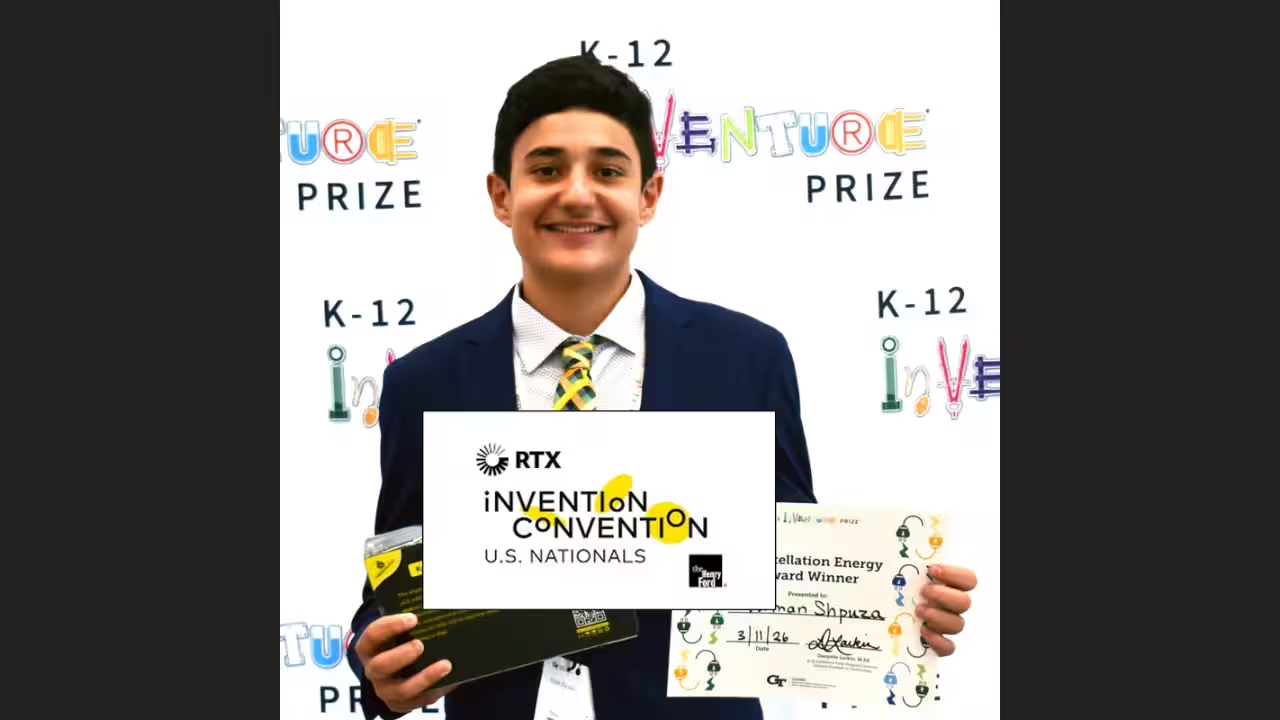
Arman Shpuza, a ninth-grade student from Georgia, has won two awards at the Raytheon Technologies Invention Convention US Nationals with Ampipe, a tiny turbine system installed in downspouts that converts the energy of falling rain into electricity. According to the K-12 InVenture Prize, he took the Innovation Process: Best Logbook Award and Second Place for Ninth Grade on 5 June 2026 in Dearborn, Michigan. He competed as an independent student for the first time. The idea began when he watched rain fall outside his window during a heavy storm, and he is now working on further improvements with a patent in mind.How Arman Shpuza developed Ampipe, a rainwater-powered turbine systemShpuza is the inventor of Ampipe, and the invention is a tiny turbine system installed in downspouts that converts the energy of falling rain into electricity. The programme's report of 9 June 2026 describes it as "a tiny turbine system installed in downspouts that converts the energy of falling rain into electricity."The idea came from a heavy storm. In the K-12 InVenture Prize's report of 15 July 2026, Trammell writes that Shpuza got the idea from watching rain fall outside his window during a heavy storm. Something about the rain reminded him of a hydroelectric plant, "and an idea for an invention was born, just like that." The report says Ampipe's artificial intelligence system was inspired by his uncle in Sweden.Arman Shpuza earns national recognition for his Ampipe inventionThe Raytheon Technologies Invention Convention US Nationals Award Ceremony took place on 5 June at The Henry Ford in Dearborn, Michigan. The 9 June 2026 report states that Shpuza "won a Best Logbook Award as well as Second Place for Ninth Grade." The 15 July 2026 report gives the fuller title of the first award as the Innovation Process: Best Logbook Award. It also says he earned the Constellations Energy Award and a patent application award at State Finals at Georgia Tech in March.Danyelle Larkin, director of the K-12 InVenture Prize programme, is quoted in the 9 June report as saying: "We are so proud of all of our students who represented our state at U.S. Nationals." She added: "Team Ampipe was an independent student competing for the first time in the competition, and he earned an application for a patent to take the invention to the marketplace. You really can't do much better than that. What an amazing accomplishment this is from such a self-driven young student."Arman Shpuza explains how repeated testing strengthened his Ampipe projectStudents at Nationals had the chance to engage with representatives from the United States Patent and Trademark Office. They also had the opportunity to pitch their inventions to Shark Tank casting agents and to take part in a youth panel discussion. K-12 InVenture Prize is an affiliate of Invention Convention Worldwide and "reserves several spots to invite select student teams from State Finals to represent Georgia at the U.S. Nationals competition each year."Shpuza said State Finals helped him prepare. In the 15 July 2026 report, he says: "State Finals was really valuable to help me get ready for Nationals. I think the judges' feedback was very useful to see my project from a different perspective, which I think helped me stand out at Nationals." He continues: "I kept going through prototype after prototype, testing and improving my design using the feedback. So, when I got to Nationals, I knew what to expect and felt more confident with my improved project."How family support and persistence helped Arman Shpuza develop AmpipeIn the 15 July 2026 report, Shpuza describes how he felt when his name was called: "It was unforgettable. I wasn't expecting to win at that high level, so when they called my name, I sprang out of my seat. It felt like everything around me paused for a moment." According to the report, he credits his teachers and family, near and far, for supporting his invention journey. These include the Economics for Entrepreneurs and science teachers who sparked his creativity and curiosity, his uncle in Sweden, and his mother, who encouraged him to enter the K-12 InVenture Prize competition with Ampipe.He says: "Ampipe failed several times, and I went through many different iterations, so I think it's really important to persevere and try on, even when things don't go your way." With a patent in mind, he told the K-12 InVenture Prize that he is working on further improvements. In his words: "There is no perfect invention. There is always something you can improve. So, I'm still trying to test different models to see how I can advance Ampipe's efficiency and impact." His advice to other young inventors is to "stay curious about the world around you and find something that you have a personal connection to."You use AI every day. Now get your AI Quotient. Take the AIQ test.
Topics in this story
Gathered from external sources. Rights to this text belong to whoever originally published it.