In 1995, Galápagos crews began clearing goats and burros from Alcedo Volcano; after 62,868 goats vanished by 2006, juvenile tortoises and growth rates increased
The successful eradication of 62,868 feral goats from Alcedo Volcano in the Galápagos Islands has resulted in significant growth in the juvenile giant tortoise population and improved overall health of the species, as revealed by recent research.
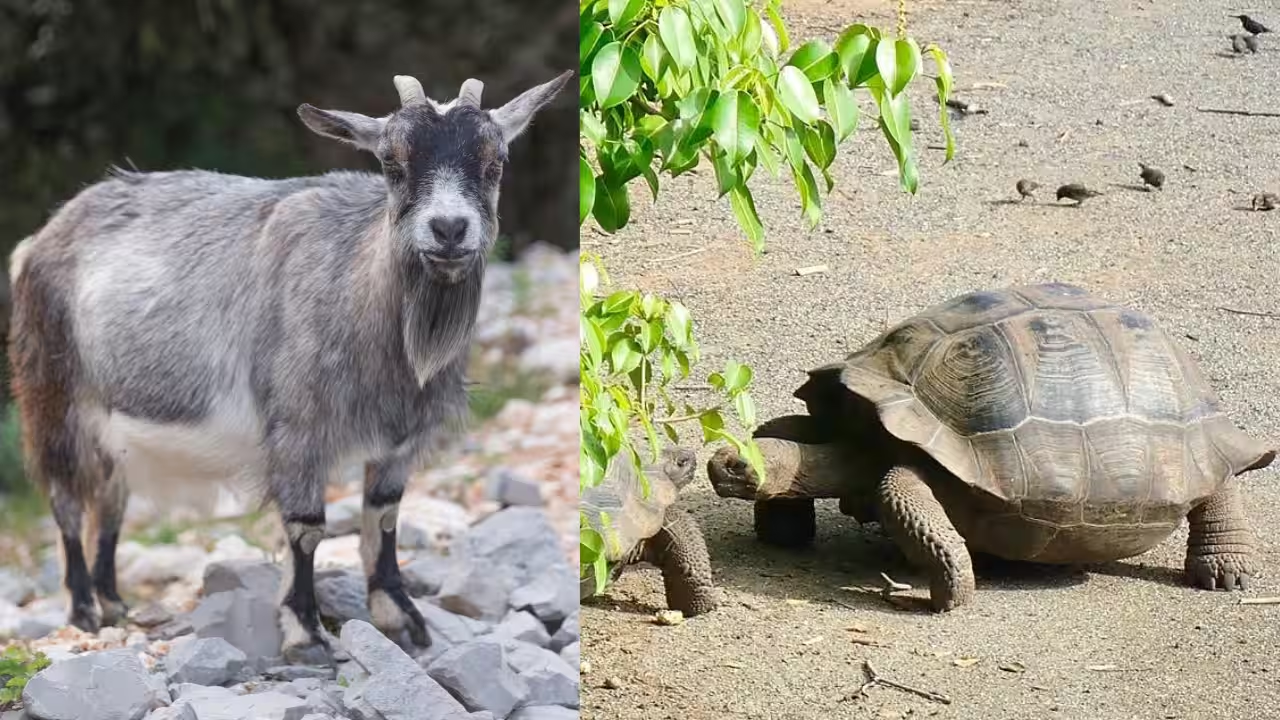
A goat eradication campaign on Alcedo Volcano in the Galápagos removed 62,868 animals by 2006, and researchers who were tracking the island’s giant tortoises found changes in the population as the goats disappeared. The proportion of juvenile tortoises increased, while individual tortoises also recorded higher growth rates during the later stages of the eradication campaign. The findings came from long-term monitoring that was carried out alongside the effort to remove the introduced animals.The campaign began in 1995 against feral goats and burros on Alcedo Volcano, where the animals had become a major pressure on the native ecosystem, and the giant tortoise population was one of the main reasons for the eradication effort. The study was published in Restoration Ecology, and compared tortoise data from earlier and later stages of the campaign and also looked at a control population on nearby Santa Cruz Island, where goats and donkeys were not removed.The researchers found that the proportion of juveniles among the Alcedo tortoises increased as the eradication progressed, and individual tortoises also grew faster during the later period. In Santa Cruz, where the introduced animals remained, researchers did not see the same changes in juvenile proportions or individual growth rates.Finding the goats that were left behindConservation teams had to find animals that had become increasingly difficult to locate across northern Isabela’s terrain as the population declined. Project Isabela used sterilized goats fitted with radio collars, known as “Judas goats,” to do that. Goats are social animals, which is why the released animals sought out other goats and joined them. Rangers could then track the Judas goats by radio telemetry and locate the remaining feral animals. Galápagos Conservancy says about 770 Judas goats were eventually used on Isabela. Helicopters were also used for aerial hunting and tracking, while GIS technology helped teams map their work.The goats had changed Alcedo's vegetationGalápagos Conservancy says that goats reached northern Isabela after being introduced elsewhere on the island and eventually expanded into the Alcedo area. Their grazing had damaged forests and vegetation that provided food and water resources for giant tortoises by the early 1990s.Project Isabela officially began in 1997 after an international workshop produced a plan for eliminating introduced mammals from northern Isabela, Santiago and Pinta. Northern Isabela was declared goat-free in 2006, although monitoring continued with a small number of Judas goats. Galápagos Conservancy reports that small trees regenerated from stumps that were left by grazing, while highland shrubs, forest seedlings, Opuntia cactus and other endemic plants increased. Some species that had survived only in protected craters or fenced areas were also found expanding as grazing pressure fell. Alcedo is home to one of the Galápagos' major giant tortoise populations, and they depend on vegetation for food and use parts of the volcano's highlands during the island's dry periods.The eradication period overlapped with a rare climatic event that increased forage availability, but the researchers noted that the nearby control population on Santa Cruz did not show comparable changes. Their analysis therefore identified goat and burro removal as the primary cause of the improvement in the Alcedo tortoise population status.The animals that had altered the volcano's vegetation were gone, while monitoring of the native tortoises had documented measurable changes in the population by 2006. The eradication became part of the larger restoration of northern Isabela, where introduced mammals had altered habitats that were occupied by native species for decades.You use AI every day. Now get your AI Quotient. Take the AIQ test.
Topics in this story
Gathered from external sources. Rights to this text belong to whoever originally published it.