A Georgia family built an outdoor kitchen and pool pavilion without HOA approval; a dispute over the community’s design rules ended up before an appeals court
A Georgia appeals court has upheld an order requiring a couple to demolish an outdoor kitchen and pool pavilion built without homeowners association
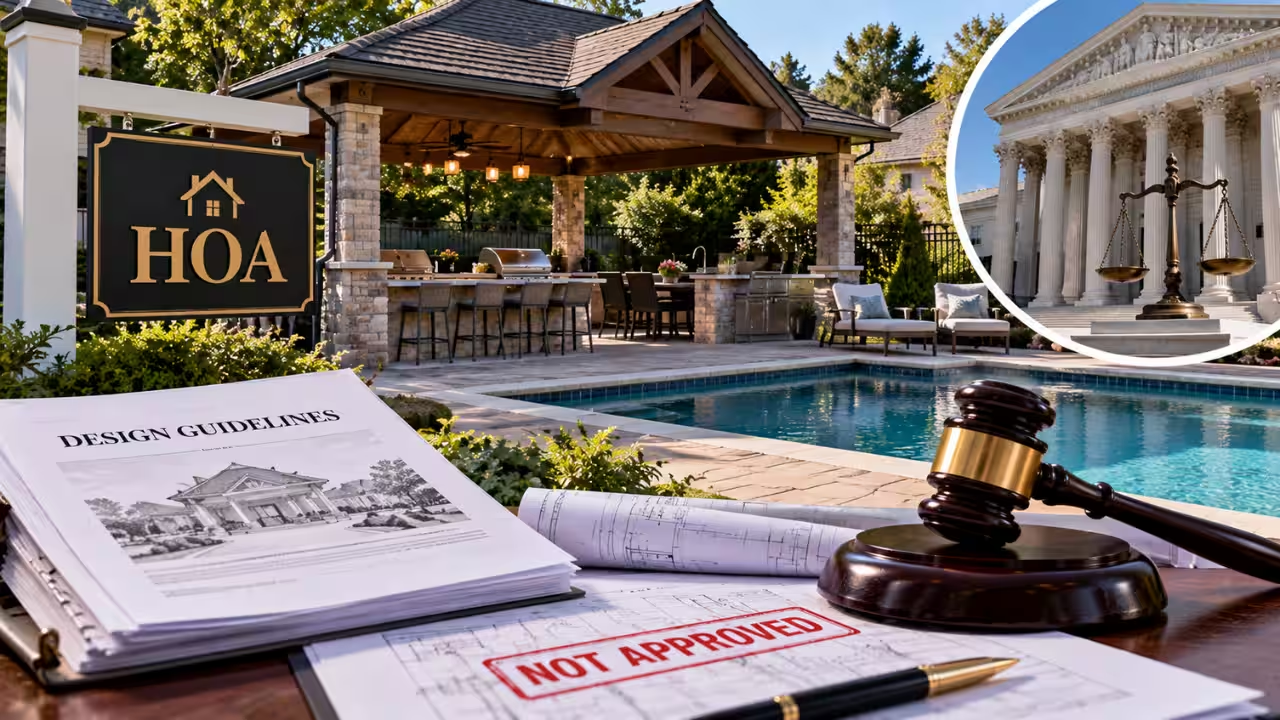
A Georgia appeals court has upheld an order requiring a couple to demolish an outdoor kitchen and pool pavilion built without homeowners association approval. Earl and Deidre Cotton constructed the 594-square-foot structure, which stood 19.5 feet high, despite design rules limiting detached structures on properties smaller than one acre to less than 120 square feet and 12 feet in height. The Vining Estates Community Association had rejected their plans and warned them to stop construction. On 6 May 2026, the Georgia Court of Appeals affirmed a jury award of $6,475 in unpaid fines and $73,000 in attorney fees, alongside the removal order.Why did a Georgia pool pavilion dispute reach courtThe Cottons lived in the Vinings Estates subdivision in Mableton, Georgia, where homeowners were subject to the community’s Declaration of Protective Covenants and the association’s architectural review procedures. Under the declaration, proposed exterior construction and alterations required written plans and approval from the association’s board or its designated representative. The rules also required detached structures to receive prior written consent and to remain consistent with the home’s design, materials and colours.On 23 September 2021, the couple submitted a request seeking permission to construct a freestanding outdoor kitchen and pool pavilion. According to the court’s judgment, the proposed structure measured approximately 594 square feet and stood 19.5 feet high. The plans included an enclosed bathroom, storage space, a covered outdoor kitchen and utilities, including water and electrical power. By signing the application, the couple acknowledged that construction would not begin until the association’s architectural review committee or board had communicated its approval.Why did the HOA reject the pavilion plansThe association’s design guidelines imposed specific limits on structures proposed for properties measuring less than one acre. Under those rules, permitted structures had to be smaller than 120 square feet, no higher than 12 feet and positioned in the rear garden within the extended sidelines of the house. They also had to use materials and finishes compatible with the home’s exterior, and utilities were prohibited.The architectural review committee rejected the Cottons’ proposal because it exceeded the permitted size and height, fell outside the specified location and included prohibited utilities. The association informed the couple that they could submit an amended application or appeal the decision. They subsequently appealed to the board and requested a variance, but their revised proposal did not change the structure’s dimensions or location and continued to include utilities. Although the couple later said the pavilion’s height would be reduced to a maximum of 15 feet, that remained above the 12-foot limit. The board rejected the proposal, noting that changes had not been made to the structure’s size.Why did the family continue building despite HOA warningsThe court record showed that the couple had already entered into a construction contract and purchased materials before submitting their modification request. Deidre Cotton also testified that construction began before the architectural review committee had reached a decision. When association representatives learned that work had started, they instructed the couple to stop until the proposed structure had been approved.James Funk, the association’s president, visited the property and warned Earl Cotton that continued construction could lead to fines and that the pavilion might have to be demolished. The property manager also told him that the committee was still reviewing the request for a variance and that work should stop in the meantime. According to the judgment, Cotton responded that he was “on the right side of this” and was “going to keep building”. On 28 February 2022, the board sent a letter demanding that construction cease and that the structure be removed. It imposed an initial fine of $1,500, together with a further $25 for each day the structure remained unapproved. The couple nevertheless continued building, completing the pavilion on 24 May 2022.Why did the appeals court uphold the pavilion’s removalThe association subsequently sued the couple, seeking unpaid fines, attorney fees and a permanent injunction requiring the removal of the pavilion and restoration of the property. After the case proceeded to trial, the jury found in favour of the association and awarded $6,475 in unpaid fines and $73,000 in attorney fees. The trial court then ordered the couple to remove the entire detached structure and restore the area to its original condition. The order was stayed while the appeal was pending, subject to a supersedeas bond of $230,000.The Cottons challenged several aspects of the proceedings, including the enforcement of the design guidelines, the rejection of their proposed structure and the trial court’s decision to grant an injunction after the jury had dispersed. The Court of Appeals rejected their arguments and affirmed both the jury’s verdict and the injunction. In its reasoning, the court noted that the couple had completed a structure they knew violated several requirements and had never obtained the necessary approval. It also concluded that they had not identified an adequate legal remedy or a less oppressive alternative to the injunction. The judgment therefore left in place the order requiring the pavilion’s removal and restoration of the affected area.You use AI every day. Now get your AI Quotient. Take the AIQ test.
Topics in this story
Gathered from external sources. Rights to this text belong to whoever originally published it.