The Asian silktree was brought to America for its delicate pink flowers; its seeds can remain viable for up to nearly 150 years under dry storage
Few garden trees look as graceful as the silktree in midsummer, when its fern-like leaves carry soft pink pompom flowers that seem to float above the
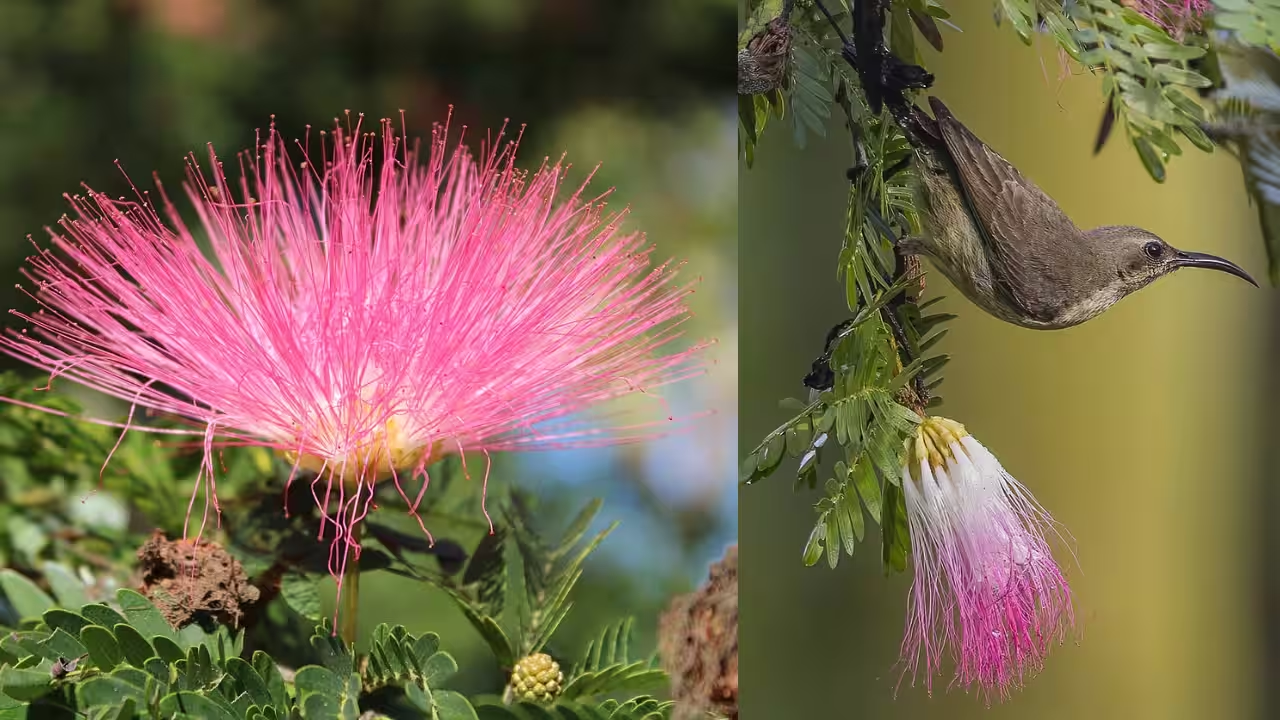
Few garden trees look as graceful as the silktree in midsummer, when its fern-like leaves carry soft pink pompom flowers that seem to float above the branches. That beauty explains why people carried the tree across the ocean from Asia centuries ago and planted it beside homes and in gardens. Yet the same traits that made it appealing, including fast growth, abundant seeds, and tolerance of poor conditions, also allowed it to wander beyond yards. Today it appears along roadsides, in old fields, and at forest edges.How this pink-flowering Asian silktree arrived in North AmericaThe US Department of Agriculture states this tree does not belong to North America. It is native to Asia and occurs from Iran to Japan, and its scientific name is Albizia julibrissin. The review lists mimosa and silky acacia as other common names, and it notes that the genus is sometimes spelt with a double z, likely because the genus honors a man who introduced silktree to Tuscany, Italy. Silktree is a deciduous, nitrogen-fixing tree or shrub, usually between three and fifteen metres tall, with a broad crown. Its showy flowerheads form clusters at the ends of branches, and each head holds fifteen to twenty-five flowers.Why the 1745 introduction date is often repeated while another source places the arrival around 1785The US Department of Agriculture treats the arrival date with care. It states that silktree was introduced as an ornamental in the eighteenth century, and it acknowledges that many sources assert a specific year, 1745, for its introduction to the United States. It then adds a different account from Cothran, who wrote that the tree was brought to North America about 1785 and was first offered for sale in 1807. Either account places the introduction in the 1700s. By the 1950s, silktree was established locally in Georgia; it was a new record in Oconee County, South Carolina, in 1972, and it was first reported in the flora of Connecticut in 2008. In between, it was described as newly documented around Washington, District of Columbia, in 1995.How silktree took hold across the United States, from the Southeast to New York, Utah, and CaliforniaBy 2010, the US Department of Agriculture also reports silktree occurred as far north as New York and Massachusetts, in southern parts of the Midwest, throughout the south-central and southeastern United States excluding tropical Florida, and in New Mexico, Arizona, Utah, and California. The distribution and effects of silktree are best documented in the Southeast, where inventory data collected from 2001 to 2008 showed it is most common in north-central Alabama. Cold limits the tree to low elevations. In the Southeast, it does not typically grow above about 900 to 1,000 metres, and in Great Smoky Mountains National Park it was common between 370 and 610 metres and absent above 740 metres. Cold also matters in Connecticut, where it typically kills seedlings in their first winter, although silktree has established near the milder coast.Why silktree thrives on disturbed roadsides, old fields, and forest edges via seeds and root sproutsSilktree reproduces from seeds and regenerates by sprouting from roots after the top of the tree is killed or injured. Several authors note that it produces many seeds, and one source reports 8,000 seeds a year. Seeds fall mainly by gravity and secondarily travel by wind, water, and animals, with observations in Georgia suggesting wind can carry them at least ninety metres. A hard seed coat keeps seeds dormant until damaged by heat, fungi, soaking, or acid, and a small percentage of seeds kept in dry storage stayed viable for seventy to nearly one hundred fifty years. The circumstantial evidence suggests disturbance aids seedling establishment, and it describes silktree as an early to mid-successional species found on old fields, old homesites, roadsides, and woodland edges.Why silktree populations rise and fall: short lifespans, a root-infecting fungus, and shade toleranceSilktree is not an unstoppable force, and the US Department of Agriculture explains why. It is apparently short-lived in the United States because a soil-borne fungus called Fusarium infects the root system, causing wilting and eventually death. Researchers around Athens, Georgia, suggest silktree often dies back within ten to twenty years, while another report gives an average lifespan of about thirty years. Even so, trees killed by the wilt disease may leave behind a mass of root sprouts. Silktree also tolerates only partial shade and rarely occurs under a full canopy, which is why it favours open and disturbed ground. It may establish or increase on recently burned, thinned, or logged forest sites, and it was considered a potentially high threat to oak-hickory woodlands.You use AI every day. Now get your AI Quotient. Take the AIQ test.
Topics in this story
Gathered from external sources. Rights to this text belong to whoever originally published it.