In 2021, researchers examining a circular ridge in China’s forest found shocked quartz, melted granite and glass, confirming the 1.85-kilometre Yilan feature as a meteor crater
Rest of World News: Researchers have identified the Yilan feature in China's Heilongjiang Province as a meteorite impact crater, revealing shocking geological evidence such as shocked quartz and melted granite. This discovery sheds light on the Earth's history and highlights the importance of hidden geological formations in understanding past cosmic events.
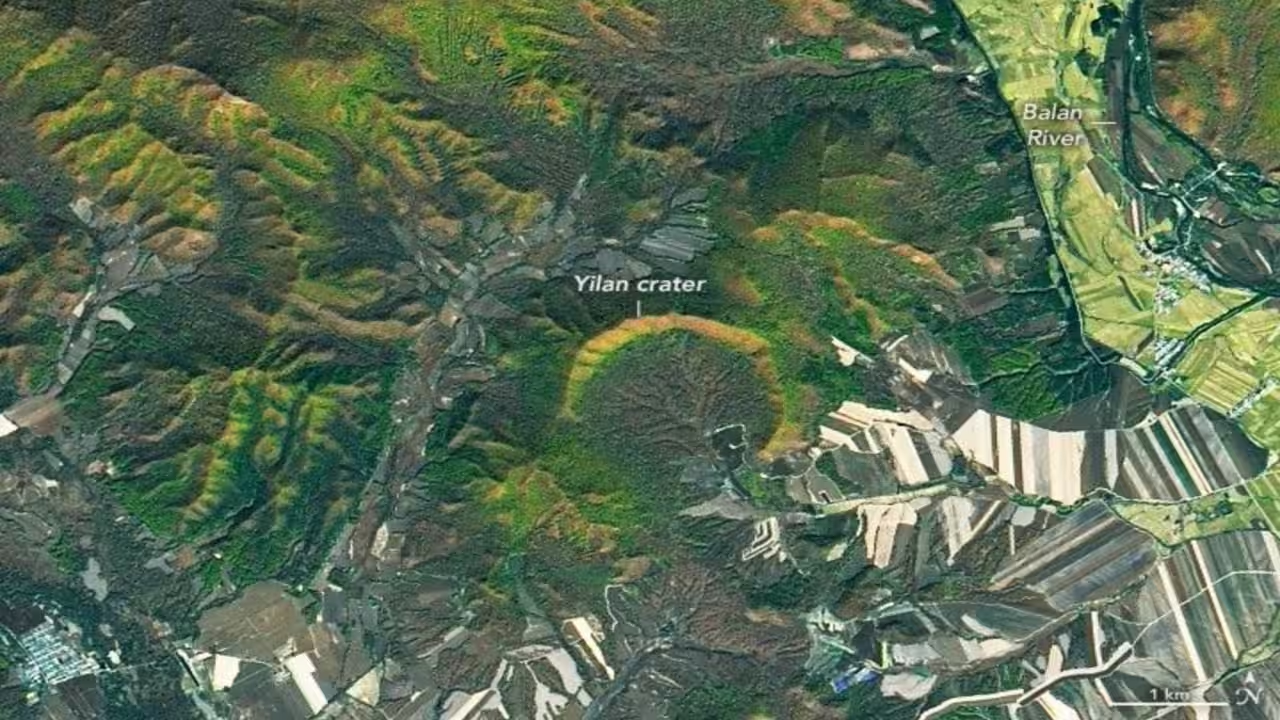
The Lesser Xingan mountain range in northeastern China is covered in deep forest, a type of landscape that can conceal geological characteristics so well that even remarkable landforms may go undiscovered by scientists for generations. Locals in the Heilongjiang Province's city of Yilan had long been aware of an odd circular ridge in the forest that they called Quanshan, or circle mountain ridge. However, they had no reason to believe it was anything other than a peculiar feature of the area. This peaceful forest feature was actually the remnant of a cataclysmic collision from Earth's distant past, as discovered after a rigorous drilling operation and a new examination of satellite photos.The origin of the ridge first came under suspicion in about 2021, when researchers re-examined satellite images showing its distinctive, almost horseshoe-shaped outline, a telltale indicator to geologists who study impact formations. The southern part of the rim was missing altogether, but the remaining arc rose as high as 150 metres above the crater floor, unusually well preserved for a feature of its age. NASA Earth Observatory later shared Landsat 8 satellite imagery from October 8, 2021, showing the scalloped edge of the crater highlighted by autumn foliage, a striking visual record of the same shape that had first raised researchers' suspicions.Drilling for evidence beneath the treesJust having the right shape wasn't enough to prove it was from an impact, so a study team led by Ming Chen of the Guangzhou Institute of Geochemistry at the Chinese Academy of Sciences dug 438 metres into the core of the structure to see what lay beneath the forest floor. The core they brought out had a dramatic story to tell. Underneath more than a hundred metres of old lake sediment lay a thick layer of broken granite, with evident traces of tremendous shock.The scientists identified shocked quartz crystals with the parallel planar deformation patterns that only occur under the severe pressures of a hypervelocity impact and pockets of melted granite, glass riddled with gas bubble holes and teardrop-shaped glass fragments that had clearly cooled from a molten state. Their full findings were later documented in Meteoritics and Planetary Science, the journal that carried the original study.The evidence combined to leave few options. Normal volcanic or erosional processes simply cannot produce shocked quartz with these particular crystal orientations, a fingerprint that geologists consider close to solid evidence of a meteorite strike. The granite of the bedrock itself is around 200 million years old, laid down in the Early Jurassic.An old planet with a new scarRadiocarbon dating of charcoal and lacustrine silt in the crater fill constrains the impact to between around 47,000 and 53,000 years ago. The 1.85-kilometre-wide Yilan crater is the largest confirmed impact feature on Earth younger than 100,000 years. The young age of the crater is one reason this find is so noteworthy. About 190 impact craters have been confirmed worldwide, but most are so badly eroded or buried that it’s hard or impossible to recreate specifics of the original strike. Ironically, the same thick forest cover that kept Yilan hidden for so long makes its survival more surprising still, since most craters this old have long since been worn away by exactly this kind of dense vegetation and root growth. The Astrophysics Data System, maintained by Harvard and the Smithsonian, also archives a detailed abstract of the study.The find is only the second confirmed impact crater ever discovered in China, after a previous discovery in Liaoning province. Scientists think the impactor was about 100 metres wide, and because the crater is relatively young, it is probable that anyone living in Siberia and northern Asia at the time would have seen it, despite there being no direct record of it. It’s a reminder that, even on a world as well-mapped as ours, forests and far-flung landscapes may hide secrets of truly cosmic proportions.Catch the latest World News and Live updates. Download the TOI app.
Topics in this story
Gathered from external sources. Rights to this text belong to whoever originally published it.