A 5-foot-6-inch moai was discovered in Easter Island's dried-up crater lake after a two-year drought; researchers say it is the first of the island's famous statues ever found in a lake
A moai was found in a lakebed on Easter Island, the first ever found in a lake.
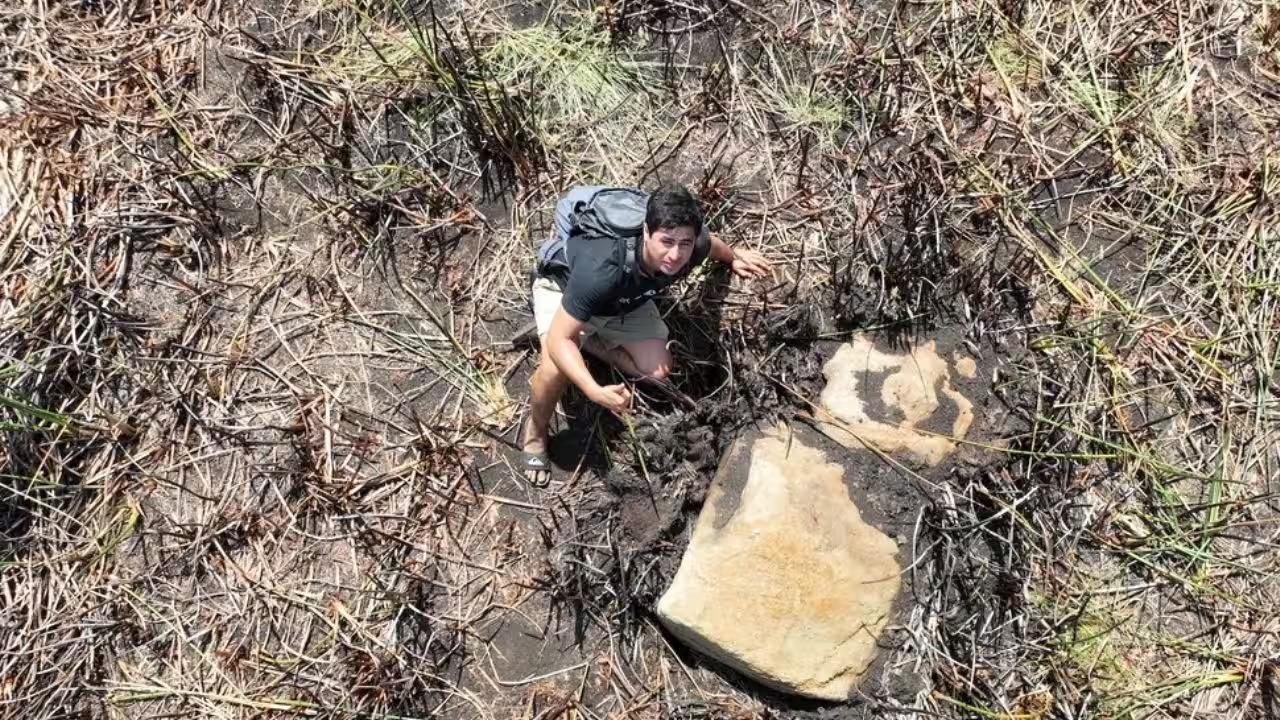
A moai was found in a lakebed on Easter Island, the first ever found in a lake. The five-foot-six-inch figure was found on February 24 in the dried crater lake of Rano Raraku.Terry Hunt, a professor at the University of Arizona’s School of Anthropology, was among the first to see the newly discovered statue. He arrived one day after the discovery. According to the University of Arizona (2023), members of Comunidad Indígena Ma ́u Henua, which manages Rapa Nui National Park, found the statue after drought slowly evaporated the lake over two years. Hunt said climate change had exacerbated the drought. The statue’s precise age remains unknown, but its small size suggests it might date closer to the island’s colonisation around 1200 than the arrival of Europeans in 1722.Newly discovered moai was found in a dried-up crater lake on Easter IslandThe statue was discovered on February 24 in the bed of Rano Raraku, a crater lake on the south-eastern side of Rapa Nui, also known as Easter Island. It was lying face up and measured 5 feet, 6 inches long. Members of Comunidad Indígena Ma ́u Henua made the find. The organisation managed Rapa Nui National Park, and the statue had not previously been known to islanders.Hunt said the discovery was unusual because a moai had never before been found in a lake. The lake had dried over the preceding two years during a prolonged drought. He said climate change had made the drought worse, allowing the lakebed to become exposed.What did the statue’s carvings reveal about its age and purposeHunt said the statue was made from rock taken from the island’s quarry, rather than brought from elsewhere. He believed it was probably displayed in the lake or crater, not being moved from one place to another. Its eye sockets had been carved, which is historically the final step in making a moai before it is put on display.The base was flat rather than sloped, a feature that helped the statues to be walked into position. Researchers did not know how old this moai was. Its relatively small size suggests it might have been made nearer to the Polynesian colonisation of Rapa Nui around 1200 than to the arrival of Europeans in 1722.Hunt’s research documented 981 moai across Easter IslandHunt first visited Rapa Nui in 2000 and began fieldwork there in 2001. For more than a decade, he, his colleagues and students had worked on an inventory of 981 moai, recording GPS locations and measurements. It was the largest database of the statues. Their work was carried out with Comunidad Indígena Ma ́u Henua, and the team shared its findings and data with the organisation.Hunt’s research had also examined how the statues were made and moved. In work with anthropologist Carl Lipo, he helped demonstrate how islanders could have moved moai using ropes. A 2019 study by Hunt and Lipo found that the statues were built near freshwater sources.Researchers planned to study how islanders survived with limited freshwaterHunt did not plan to take a formal role in further research on the newly found statue, although he planned to return to Rapa Nui in June for more fieldwork. Grants from the National Science Foundation and the National Geographic Society would support research into how the island’s earlier inhabitants survived with limited resources and built monuments.The work would focus on hydrology and build on the study showing that moai were constructed near freshwater sources. Hunt also used cell phones and drones to create 3D images of the statues. He was considering ground-penetrating radar to look for moai or structures underground in the Rano Raraku lakebed.You use AI every day. Now get your AI Quotient. Take the AIQ test.
Topics in this story
Gathered from external sources. Rights to this text belong to whoever originally published it.