‘Almost like a constitution’: Trump, top US tech CEOs sign AI safety pact
US president Donald Trump and the heads of some of the biggest US technology and artificial intelligence companies have signed a voluntary “morally
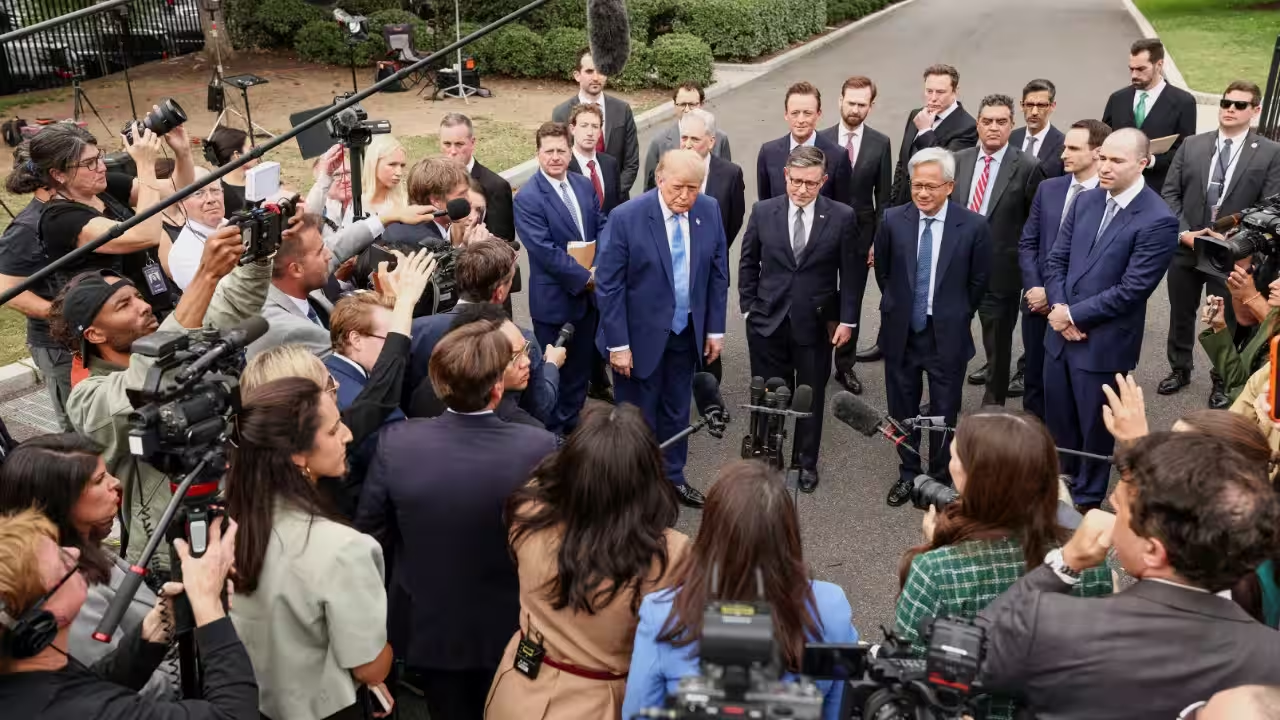
US president Donald Trump and the heads of some of the biggest US technology and artificial intelligence companies have signed a voluntary “morally binding” accord aimed at putting stronger safety controls around the development and deployment of AI.Trump announced the Joint Commitment On Frontier Responsibilities after a White House luncheon with leading tech executives, describing the agreement as “almost like a constitution”. The one-page accord lays out four layers of internal and external controls, including independent audits and board-level oversight of AI safety systems.The agreement comes as the Trump administration continues to promote rapid AI development while facing growing concerns over the technology’s potential risks. Trump has repeatedly rejected calls for broad “guardrails”, arguing that restricting AI would undermine US economic growth and its race with China. ‘Almost like a constitution’“It’s almost like a constitution in a way, and the biggest ?people in the world signed that, and ?I signed it as president, and it really ?is a form of protection,” Trump said.The accord was signed by Trump, Anthropic CEO Dario Amodei, Google CEO Sundar Pichai, Meta CEO Mark Zuckerberg, OpenAI President Greg Brockman, Nvidia CEO Jensen Huang and Elon Musk, founder of xAI, which is now part of SpaceX.Trump said the agreement would allow for “tremendous self-policing” within the industry and described it as “morally binding”. He said about 10 people would be named to a committee to “watch over the whole enterprise”, with a person also expected to be appointed to oversee the agreement after consultations with industry.The document does not impose legal requirements or specify penalties for companies that fail to comply. Instead, it sets out voluntary commitments and leaves open the possibility of future regulation.“Over time, it may make sense to codify these steps into laws and regulations,” the accord said.The participating companies also agreed to meet regularly to establish safety standards and best practices for their AI systems.Four layers of AI safeguardsThe accord calls for companies to establish “robust internal controls” to monitor AI models during training and deployment, particularly in areas involving cybersecurity, biosecurity and chemical threats. The controls are also intended to ensure models do not hack or access technical systems in unintended ways.A second layer requires internal teams to verify that the companies’ monitoring, detection and other safety controls are functioning as intended.The third layer involves an “independent external auditor” assessing whether those controls are actually working. The fourth calls for an independent committee of each company’s board of directors to review reports from internal teams and external auditors.Some of the measures are already being used by major AI companies or resemble previous commitments made by them.The voluntary nature of the accord has drawn scepticism from some experts. Robin Jia, an assistant professor of computer science at the University of Southern California, questioned whether enough faith should be placed in companies policing themselves, saying it was important to ensure the leading AI labs’ intentions were “well-aligned with the broader interest of the American public.”Alex Pascal, executive director of the Berkman Klein Center for Internet and Society, criticised what he described as the agreement’s broad and vague language, arguing that reducing AI risks would require stronger legal liability and regulation.Amodei, who has been among the more outspoken voices warning about the risks of rapid AI development, also struck a cautious note at the White House.“The technology has very real risks.”“And, you know, the mechanism, how we address those risks is still under discussion,” Amodei said.Trump pushes ‘super intelligence’The agreement was announced alongside a broader White House push to accelerate AI development. Trump has insisted that the US should not impose restrictions that could slow its progress against China.“I will never stifle the growth of a technology that will be bigger than the industrial revolution,” Trump said at the unveiling of America.gov, an AI chatbot designed to help Americans navigate government services. “We can't stifle it, and we're leading by a lot.”Trump also signed an executive order directing the executive branch to replace the term “artificial intelligence” with “super intelligence”, or “SI”, in official communications and policy documents.“The Order directs all departments and agencies to use the terms ‘Super Intelligence’ and ‘SI’ in official correspondence, public communications, policy documents, and non-statutory documents within the executive branch and to no longer acknowledge the terms ‘Artificial Intelligence’ or ‘AI’,” the order declared.You use AI every day. Now get your AI Quotient. Take the AIQ test.
Topics in this story
Gathered from external sources. Rights to this text belong to whoever originally published it.