In 1874, sailors released rabbits on the Kerguelen Islands as emergency food; the invasion reshaped coastal vegetation and later altered plant communities on the central plateau
Rest of World News: Discover how the accidental release of rabbits on Kerguelen Islands in 1874 led to a rapid decline in native plant diversity and ecosystem collapse, as revealed by recent studies.
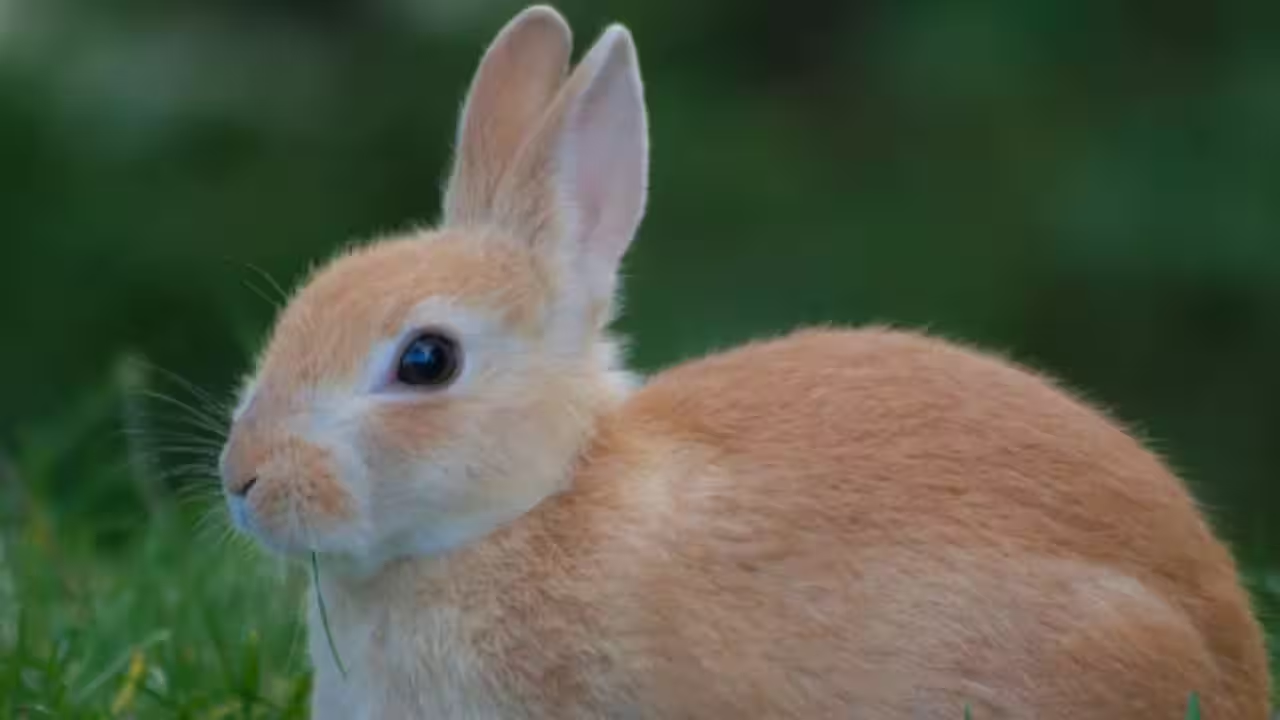
Kerguelen is one of the most remote places on the planet, an archipelago in the Indian Ocean with a few dozen native vascular plant species and almost no mammals native to its shores. In 1874, visitors on an expedition to observe that year's transit of Venus released a few rabbits from Europe on Grande Terre, the archipelago's main island, intending them as a future food source for later expeditions. Whether or not any visitors ever returned to eat them, the rabbits themselves were anything but forgotten: freed from predators and competitors, they multiplied into a population that would go on to reshape the islands' ecosystems.Coastal vegetation was the first to give wayAccording to Sicard et al. (2019) in Science Advances, rabbits introduced on Grande Terre quickly spread to the archipelago's other islands. In all the areas where rabbits established themselves near the shoreline, the impact on native vegetation was severe. According to Jean-Louis Chapuis, Yves Frenot, and Marc Lebouvier in "Implications for conservation" in Biological Conservation, two highly vulnerable native species, the Kerguelen cabbage (Pringlea antiscorbutica) and the cushion-forming plant Azorella selago, became locally extinct in the grazed coastal areas. In their place, the tenacious creeper Acaena magellanica became widespread, forming nearly unbroken stands along much of the shoreline; the area's inherently limited, low-diversity flora had no defense against it.The same team later examined the process of ecological recovery after removing rabbits by poison from two small islands, Île Verte in 1992 and Île Guillou in 1994, as described in their study 'Recovery of native plant communities after eradication of rabbits from the subantarctic Kerguelen Islands, and influence of climate change,' published in Biological Conservation. Rabbit density on these islands had been around nine per hectare before removal. After the rabbits were eliminated, the number of plant species increased, but the recovery was uneven and incomplete: cover of the rabbits' preferred food, Acaena magellanica, declined, while the non-native dandelion Taraxacum officinale spread to fill the space it left behind, meaning rabbit removal alone did not restore the original native vegetation.The central plateau held out for decades, then collapsedThe coastal story is only part of the picture. In a later study, Sicard and colleagues examined lake sediment cores from the central plateau of Grande Terre to reconstruct roughly 600 years of ecosystem history, combining environmental DNA, coprophilous fungi, and sedimentology. Their results, published as DNA from Lake Sediments Reveals Long-Term Ecosystem Changes after a Biological Invasion in Science Advances, showed that the high-altitude interior remained stable and dominated by Azorella selago for decades after the 1874 coastal introduction, undisturbed until rabbits finally reached the interior. Plant communities on the plateau had been stable since about AD 1400, the study found, and remained so until rabbits arrived there in the 1940s.Rabbit DNA first appears in the sediment record at that point, marking a turning point: native plant diversity declined and soil erosion increased. The authors suggest these two changes may not have occurred independently but were linked, driven by rabbit impacts that outweighed the effects of 20th-century climate change alone. The authors describe the plateau ecosystem as being in a "new equilibrium" state.A lesson in how fast invasions can take holdIn brief, the same invasion looks different depending on where you stand on the island: rabbits introduced in 1874 transformed the coastal vegetation within a few decades, and by 1940 they had also reshaped the plateau ecosystem. This is the conclusion reached by both research groups and by many invasion biologists: distance and elevation may slow an invasion, but they do not necessarily prevent it, and its impacts may last much longer than its duration.Catch the latest World News and Live updates. Download the TOI app.
Topics in this story
Gathered from external sources. Rights to this text belong to whoever originally published it.