Germany turned an abandoned steel factory into a 180-hectare public park; its old gasometer became a diving centre and former ore bunkers now serve as climbing gardens
An abandoned steelworks in Duisburg, Germany, might seem an unlikely place to spend a day walking, cycling or swimming.
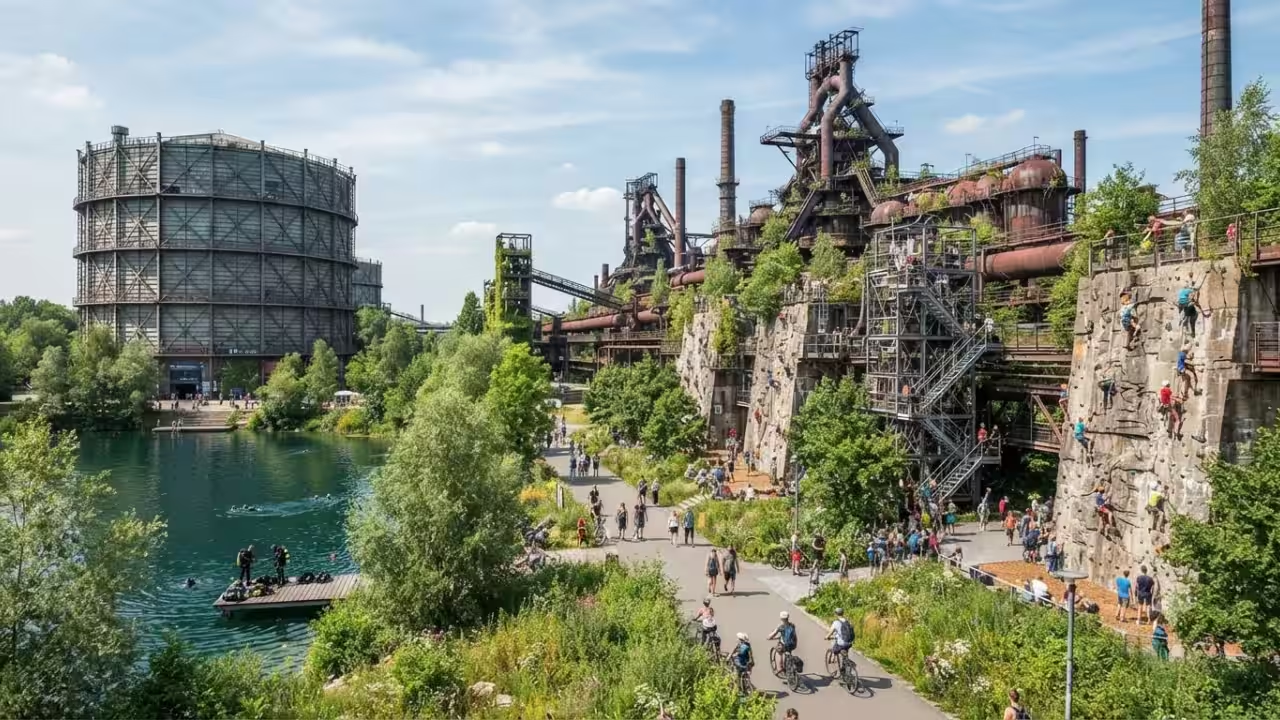
An abandoned steelworks in Duisburg, Germany, might seem an unlikely place to spend a day walking, cycling or swimming. Yet the vast industrial site has found a second life as a public park, where remnants of its manufacturing past sit alongside gardens, waterways and outdoor recreation facilities. Spread across 180 hectares, Landschaftspark Duisburg-Nord has turned structures once used for iron production into spaces for leisure and adventure. An old gasometer now houses a diving facility, former ore bunkers have become climbing areas, and visitors can climb a disused blast furnace for views across the surrounding landscape. The transformation began in the 1990s, giving the former industrial complex a new purpose without erasing its history.Germany's abandoned steel factory becomes a 180-hectare public parkLandschaftspark Duisburg-Nord occupies the grounds of a former ironworks in Duisburg, in Germany's North Rhine-Westphalia region. Rather than clearing the industrial structures after production ended, the redevelopment retained much of the existing complex and incorporated it into a large recreational landscape.The park opened in 1994 and brought together industrial architecture, natural spaces and facilities for public use. Its old buildings and machinery remain visible throughout the grounds, providing a record of the site's manufacturing history. Over time, the former steelworks developed into a destination that attracts around one million visitors annually. It has also received international recognition, including a place on The Guardian's list of the world's ten most beautiful urban oases.An old gasometer becomes a diving destinationOne of the most unusual features of the park is its diving centre, housed inside a former gasometer. A structure that once served an industrial purpose has been converted into a large underwater training and recreation facility, described by the park's operators as Europe's largest artificial diving centre. The facility gives diving enthusiasts an opportunity to practise in an enclosed environment rather than travelling to a natural lake or coastal location. Its setting is also a reminder of how the site's industrial infrastructure has been adapted for activities far removed from its original function.Former ore bunkers are now climbing gardensThe park's former ore storage bunkers have also taken on a different role. These imposing concrete structures, once used to store raw materials for iron production, now form an alpine-style climbing garden. Their existing walls and surfaces provide the setting for climbing routes, bringing an outdoor sporting activity into the heart of the old industrial complex.Elsewhere, a former casting house has been adapted to accommodate a high ropes course. Visitors can take on elevated challenges within a building that was once part of the steelmaking process. The park also has a large tube slide running through two ore bunkers, making the industrial structures part of a play area for younger visitors.Blast furnaces offer views across the siteSome of the park's most recognisable structures have been retained as viewing points. A disused blast furnace has been fitted with a viewing platform, allowing visitors to climb up and look across the grounds and surrounding parts of Duisburg.Blast Furnace 5 is among the attractions visitors can explore. The elevated viewpoints provide a different perspective on the scale of the former ironworks, with its network of industrial buildings, open spaces and surviving structures visible from above.The grounds themselves are open to people who prefer a slower visit. Gardens, meadows and water features have been incorporated into the landscape, with walking and cycling routes connecting different sections of the park. Visitors can bring their own bicycles or use the available hire facilities. An e-bike charging station is also provided.Guided tours offer another way to understand the site. These visits explain the history of the ironworks and the industrial processes once carried out there, giving context to the buildings that now accommodate recreational activities.A park designed for families and evening visitorsLandschaftspark Duisburg-Nord is not limited to climbing and diving. Children and families have access to play areas, a children's farm and other attractions spread across the former factory grounds. The combination of open spaces and repurposed industrial structures means that different age groups can explore the site in their own way.After dark, the park takes on a different appearance. British artist Jonathan Park created a lighting installation that illuminates the old ironworks with changing colours. The evening display highlights the outlines of the industrial buildings and machinery, turning the structures into a prominent feature of the night-time landscape.For first-time visitors, the park's visitor centre is a useful starting point. Maps and information about the grounds, activities and guided tours are available there, helping people plan their route through the extensive site.Preserving industrial history through reuseLandschaftspark Duisburg-Nord demonstrates an approach to redevelopment in which former industrial buildings are retained and given new uses instead of being removed altogether. The gasometer, ore bunkers, casting house and blast furnace continue to define the character of the grounds, even though their functions have changed.The site is operated by Duisburg Kontor Hallenmanagement GmbH. More than three decades after opening as a public park in 1994, it remains a place where Duisburg's industrial past and present-day recreational life occupy the same landscape.You use AI every day. Now get your AI Quotient. Take the AIQ test.
Topics in this story
Gathered from external sources. Rights to this text belong to whoever originally published it.