In 2017, four artists paid $95,000 to save Nina Simone's deteriorating childhood home in North Carolina; eight years later, the three-room house where she learned piano was fully restored
A small three-room house in Tryon, North Carolina, once stood close to demolition.
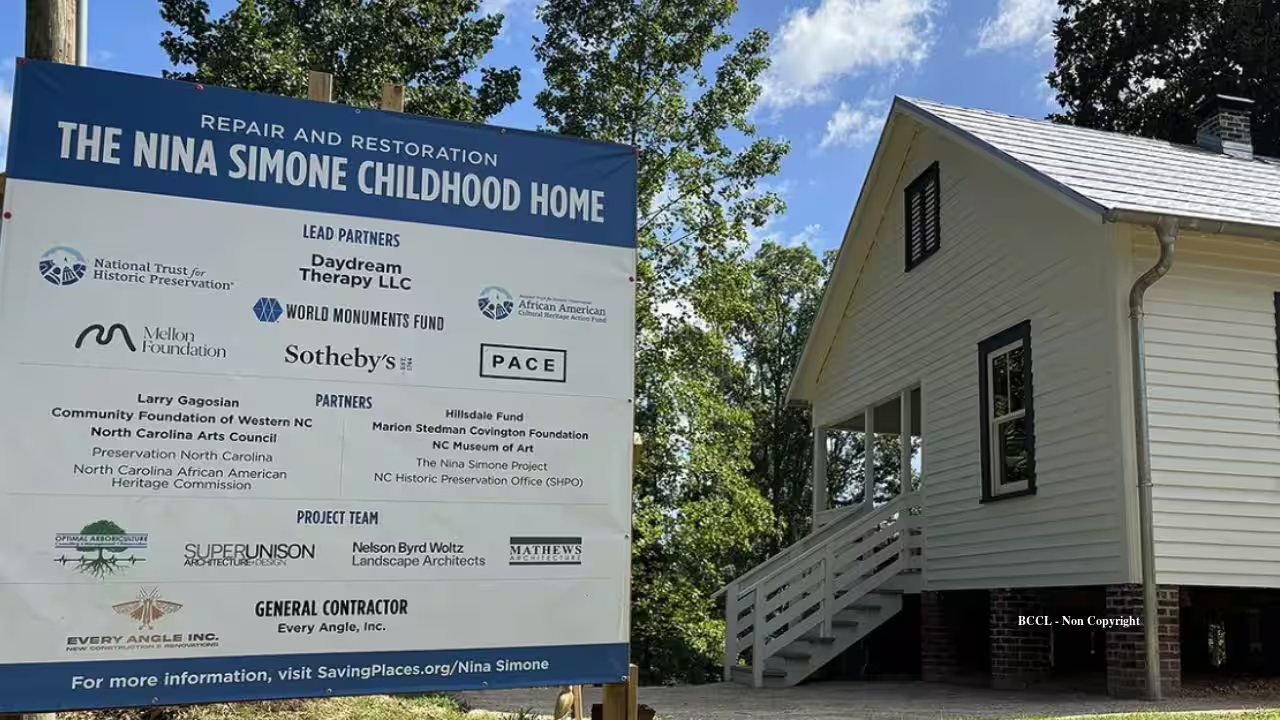
A small three-room house in Tryon, North Carolina, once stood close to demolition. It was the childhood home of Nina Simone, the powerful singer, pianist and civil rights activist born Eunice Waymon. In 2016, the deteriorating clapboard house was placed on the market, prompting four artists to act. Adam Pendleton, Rashid Johnson, Ellen Gallagher and Julie Mehretu formed Daydream Therapy LLC and purchased the property for $95,000. The National Trust for Historic Preservation’s African American Cultural Heritage Action Fund later became the lead partner in the restoration effort. Eight years after the artists’ intervention, the 650-square-foot home was fully rehabilitated in autumn 2025. The completed project preserves the place where Simone spent her early childhood and began learning piano, although the house is not yet open to the public.A modest home with a major historyNina Simone’s childhood home is a small, early-20th-century clapboard house in Tryon. It contains only three rooms and covers approximately 650 square feet.At first glance, it may not resemble the sort of grand property typically associated with a world-famous musician. There is no concert hall, elaborate studio or mansion. Instead, the house reflects the ordinary setting in which Simone’s extraordinary talent first developed.Simone was born Eunice Waymon in Tryon in 1933 and lived in the home from 1933 to 1937. Her early years there were shaped by family, church, community and music.The size of the house makes its history more intimate. The rooms were part of the everyday environment in which Eunice grew up. They were not designed as a monument, but they became connected to the origins of one of the most distinctive voices in American music.When the house later fell into severe disrepair, preserving it became a way to protect the beginning of Simone’s story, not just the memory of her international career.The threat of demolitionBy 2016, the house was in poor condition and had been put up for sale.The National Trust for Historic Preservation says the property faced the threat of demolition. Although Simone had become internationally known, little public attention had been paid to her childhood home in Tryon.Historic buildings often disappear quietly. Roofs fail, foundations weaken, weather damages exterior boards and maintenance becomes increasingly expensive. When a property lacks formal protection or public support, demolition can appear easier than restoration.In Simone’s case, losing the house would have removed a tangible link to the earliest part of her life. Photographs, recordings and written accounts can preserve memories, but a physical place offers a different kind of connection.The house contained the setting in which Simone’s family lived and where her musical ability first began to emerge. Its loss would have left a gap in the history of an artist whose music and activism influenced generations.Four artists step inFour African American artists responded to the threat.Painter Adam Pendleton, sculptor and painter Rashid Johnson, collagist and filmmaker Ellen Gallagher, and abstract artist Julie Mehretu formed Daydream Therapy LLC and collectively purchased the home for $95,000.Their decision was significant because they recognised the property’s cultural importance before a large preservation organisation had taken control of it.The purchase prevented immediate demolition and created time to develop a long-term rehabilitation plan. It also reflected the artists’ personal connection to Simone’s creative legacy.The four artists did not simply acquire a piece of real estate. They helped protect a place associated with artistic formation, racial history and civil rights activism.Adam Pendleton described the restoration as an act of respect and imagination. He said the small house held a vast legacy and was where Simone first dreamed and began shaping the voice that would later change the world, as per reports.The preservation partnershipThe restoration became a collaborative project involving national organisations, local residents, family members, churches, architects, builders and funders.The African American Cultural Heritage Action Fund, a division of the National Trust for Historic Preservation, served as the lead partner. The project also involved residents of Tryon’s East Side neighbourhood and Simone’s brother, Dr. Samuel Waymon.St. Luke CME Church, where Simone’s mother was a minister, also participated. The church stands across the street from the home and forms part of the cultural landscape connected with Simone’s childhood.Architectural and construction partners included Mathews Architecture, Every Angle Inc., Nelson Byrd Woltz Landscape Architects and Superunison. Additional support came from organisations including the Mellon Foundation, Pace Gallery, Tejemos Foundation and the Ford Foundation.The range of partners shows that historic preservation is rarely completed by one person or institution. It requires fundraising, legal protection, technical expertise, local knowledge and a shared commitment to the site’s meaning.Protecting the home permanentlyIn September 2020, the African American Cultural Heritage Action Fund helped ensure that Simone’s home was protected in perpetuity through a preservation easement.A preservation easement is a legal agreement that protects a historic property from changes that could damage its character. It can remain in effect even if ownership changes in the future.This protection gave the restoration project a secure foundation. The work was not simply intended to repair the home for a short period. It was designed to preserve the property’s historic integrity for future generations.The easement also recognised that the value of the home extends beyond its physical condition. The building’s form, setting and relationship with the surrounding neighbourhood all contribute to its significance.Preserving a historic place means protecting the context in which its story unfolded. The house, the swept dirt yard, the nearby church and the surrounding community help visitors understand the world in which Simone grew up.Fundraising through artThe restoration received an important boost in 2023, when the Action Fund partnered with tennis champion and philanthropist Venus Williams and Adam Pendleton.They co-curated an auction and fundraising gala dedicated to the project. The event was hosted by Pace Gallery in New York and helped raise money for the comprehensive renovation.Additional support from the Mellon and Tejemos foundations helped fund the work, which began in June 2024.The fundraising approach linked Simone’s legacy to contemporary art and philanthropy. It also reflected the way artists and cultural figures can help preserve places connected with Black history.Venus Williams said Simone’s legacy represented strength, artistry and the power of speaking truth. She added that women such as Simone had broken barriers and created paths for later generations.The project therefore brought together music, visual art, sport, philanthropy and historic preservation. Each field contributed to protecting a place that represented creativity and resistance.Restoring the original characterThe rehabilitation team used historically accurate materials and preserved sections of original materials, paint and stain colours that reflected the home’s appearance during Simone’s time there.The goal was not to convert the house into a modern luxury residence or fill it with unrelated objects. The restoration aimed to respect the building’s period and character.That distinction matters in historic preservation. A complete replacement can make a structure look new but erase evidence of its history. Preserving original elements allows visitors to see the materials, craftsmanship and wear connected to the people who lived there.The home will not be reopened as a traditional house museum filled with Simone’s personal belongings. Instead, the rehabilitation presents the structure and its setting as the primary historical evidence.The building itself becomes the storyteller. Its rooms, porch, yard and relationship to the street can help communicate the scale and circumstances of Simone’s early life.Making the home accessibleThe restored property includes a preservation-compliant ADA ramp that enables visitors of different abilities to reach the front porch and enter the home.The ramp was designed so that it could be removed in the future without damaging the essential historic form and integrity of the property.This approach balances access with preservation. Historic buildings can be difficult to adapt because modern accessibility features must be added without overwhelming or damaging the original structure.The ramp ensures that eventual visitors will not be excluded because of mobility limitations. It also reflects a wider understanding of preservation as a public responsibility.A historic site has greater meaning when people can experience it directly. Making the home accessible allows more visitors to stand in the same rooms, view the same setting and engage with Simone’s early story.The design demonstrates that accessibility and historic authenticity can work together when improvements are carefully planned.Quiet technology inside the houseThe restoration also includes a minimally invasive geothermal heating and cooling system.The system is designed to maintain comfortable conditions inside the home without bulky or noisy equipment dominating the property.That matters because the house is small. Large mechanical units could change the appearance of the exterior or disrupt the quiet atmosphere that the project aims to preserve.A geothermal system uses underground temperature conditions to help heat and cool a building. In this project, the technology supports long-term care while remaining visually restrained.The system may also help protect the building and its contents from damaging temperature and humidity changes. Historic structures can suffer when extreme conditions are allowed to persist.The choice reflects the restoration’s broader approach: use modern solutions where necessary, but introduce them carefully so the historical character remains visible.Recreating the historic settingThe project preserved more than the house itself.Landscape architects worked to retain the visual relationship between the home and the street, recreate the historic swept dirt yard and reveal the trace of a vegetable garden.These elements help explain how the Waymon family’s home fit into its neighbourhood. A yard is not simply empty space. It can show how families moved through daily life, grew food, welcomed visitors and interacted with nearby homes and institutions.The restoration also preserved the foundations of a work shed and outhouses discovered through archaeological investigation. Those remains provide information about African American life and traditions in the rural South.The setting gives the house a deeper context. Visitors will not see only a building associated with a famous performer. They will encounter a modest domestic landscape connected to family work, community life and cultural history.The magnolia tree named Sweetie MaeA nearly century-old magnolia tree known as “Sweetie Mae” has also been preserved on the property.The tree has stood there since Simone’s childhood and forms a living connection between the present restoration and the period when the Waymon family lived in the house.Historic trees can carry memories in a way that architecture alone cannot. They grow through decades, remaining in place as families move, neighbourhoods change and buildings are repaired.The magnolia may have been part of the visual world Simone knew as a child. Preserving it helps maintain the atmosphere of the property and protects an element that cannot be recreated once lost.Together, the house, tree, yard and archaeological remains create a more complete picture of the site. Each feature adds information about the environment in which Simone’s early life unfolded.Where Simone’s music beganSimone’s musical development was closely tied to Tryon and its community.As a young girl, she attended her mother’s sermons at St. Luke CME Church and began playing piano during services. After hearing her accompany a community choir at the Tryon Theater when she was six, piano teacher Muriel Mazzanovich recognised her ability and encouraged her mother to support formal lessons.Mazzanovich taught Simone at her own home and organised the Eunice Waymon Fund to help finance her education through high school.At age 11, Simone gave her debut recital at the Tryon Library. The event revealed the racial realities of the segregated South. When Simone and her parents arrived, her parents were required to give up their front-row seats for white audience members. Simone refused to perform until her parents were returned to their rightful places.That moment foreshadowed the courage and insistence on justice that later became central to her public life.From Eunice Waymon to Nina SimoneAfter graduating from high school, Simone moved to New York City in 1950. She attended a summer programme at Juilliard and applied for a scholarship at the Curtis Institute of Music in Philadelphia.Curtis rejected her application, reportedly because of her race, although the institution has not publicly confirmed that as the official reason. She worked various jobs before playing piano and singing at a bar in Atlantic City.It was there that she adopted the stage name Nina Simone.The name marked the beginning of a professional career that would eventually take her around the world. She became known for her command of classical technique, blues feeling, gospel intensity and emotionally direct songwriting.Her childhood home represents the period before that transformation. It is the place associated with Eunice Waymon, the gifted child learning music, attending church and developing a sense of identity.Preserving it helps show that legendary careers begin in ordinary places through family support, community encouragement and years of disciplined work.Music and civil rightsDuring the 1960s, Simone became both a celebrated musician and a forceful civil rights activist.She maintained personal friendships with Dr. Martin Luther King Jr. and Malcolm X. Violence during the civil rights era, including the bombing of the 16th Street Baptist Church, influenced her writing and performances.Songs such as “Mississippi Goddam” and “Four Women” expressed anger, grief and resistance. Her acclaimed performances of songs such as “I Wish I Knew How It Would Feel to Be Free” also connected her music to the struggle for equality.Simone’s artistic legacy cannot be separated entirely from her political convictions. Her voice carried both musical sophistication and a demand for justice.The restored childhood home gives that legacy a physical beginning. It shows where the person behind the public figure was born and where the foundations of her talent first emerged.What the restoration meansBrent Leggs, executive director of the African American Cultural Heritage Action Fund, said preservation expresses what society chooses to honour. He described Simone’s childhood home as an essential landmark in the nation’s artistic and cultural landscape.The project has significance beyond music history. It represents African American history, women’s history, civil rights history and the history of the rural South.Many places connected with Black achievement have been neglected, altered or demolished. Preserving Simone’s home helps correct that imbalance by protecting a site connected to a nationally important Black woman whose work influenced culture and politics.Her brother, Dr. Samuel Waymon, said the house preserved memories of Nina, their parents and siblings. He described the piano lessons, joy, discipline and discovery that were recorded in the walls.Those memories show why historic preservation can feel personal even when a site has national significance. The house matters because it held family life before it became a landmark.Not yet open to visitorsAlthough the restoration was completed in autumn 2025, the home is not currently open to the public.The Action Fund and Daydream Therapy LLC are working with the Tryon community and East Side residents on the next phase. That phase will involve developing creative programming, ethical interpretation and a plan for eventual cultural heritage tourism.Keeping the house closed during this planning period allows the partners to decide how the story should be presented responsibly.A future visitor experience must balance public interest with the home’s scale, the neighbourhood’s needs and the history of the people connected to the property. It should avoid reducing Simone’s life to a collection of famous songs or treating the house as a theatrical backdrop.The eventual programme may help visitors understand her childhood, musical education, family, church and the racial conditions that shaped her life.For now, people interested in the project are encouraged to follow updates from the National Trust and the Action Fund.A house saved for the futureThe restoration of Nina Simone’s childhood home began with four artists spending $95,000 to prevent its loss.It continued through legal protection, fundraising, architectural planning, community involvement and years of construction. The completed work preserves the three-room house, its historic setting, the magnolia tree and evidence of the family’s daily life.The building remains modest, but its meaning is immense. It marks the place where Eunice Waymon spent her earliest years and began the musical journey that would make her Nina Simone, the High Priestess of Soul.The restored home will not simply celebrate fame. It will preserve the ordinary surroundings that helped shape extraordinary talent.When the site eventually welcomes visitors, they will encounter more than a repaired house. They will enter a place connected to discipline, creativity, racial injustice, family support and artistic courage.For a property once threatened with demolition, that survival is itself a powerful part of Nina Simone’s legacy.You use AI every day. Now get your AI Quotient. Take the AIQ test.
Topics in this story
Gathered from external sources. Rights to this text belong to whoever originally published it.