Fine Gael: Irish unity forum proposed in party conference
The plans come as part of Fine Gael's "blueprint" on Irish unity, which was published at their ard fheis.
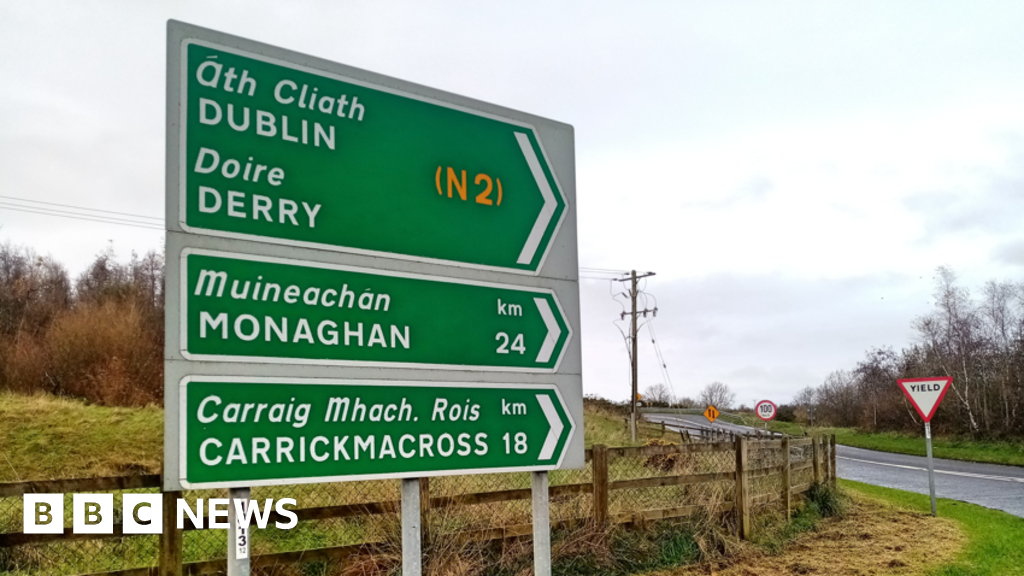
Fine Gael has proposed appointing a junior minister in the Irish government for "north south relations" as well as establishing a forum on Irish unity.
The plans come as part of the party's long awaited "blueprint" on Irish unity, which was published at Fine Gael's ard fheis (party conference) in Cork on Saturday.
It comes just days after Taoiseach (Irish prime minister) Micheal Martin, the leader of Fianna Fáil, put forward his own proposals on Irish unity to his parliamentary party.
He proposed setting up a new "initiative" on the constitutional future of the island of Ireland.
The two parties are both in a coalition government together, supported by a number of Independent TDs (members of the Irish parliament) in Dublin.
Fine Gael party leader and Tánaiste (deputy prime minister) Simon Harris is due to become taoiseach in November 2027, under the coalition's rotating taoiseach agreement.
His party has now proposed setting up an "independent, government-supported, inter-party and consultative forum" as part of preparations for reunification of the island.
It would be underpinned by law and operate for five years, with the option for a two year extension.
It would be led by an independent chair appointed by the Irish government and have its own secretariat as well as a budget, the party said.
The forum would publish research, reports and recommendations on Irish unity.
Membership of the forum would be open to representatives of all political parties who have elected politicians across the island, who "advocate exclusively through peaceful means".
It would have a panel of academics and other experts to support its work.
"The Forum would commission research, examine constitutional and institutional options, identify areas of agreement and disagreement, and provide recommendations to help build the basis for a Unified Island," Fine Gael's policy paper states.
Fianna Fáil's "initiative" on Irish unity said it would specifically explore three scenarios - a single united Ireland, without devolved governments; a united Ireland with a devolved republic and a third scenario, with no constitutional change.
However, Fine Gael's proposal does not go so far, stating only that the forum would "examine different constitutional models which are compatible with different economic approaches".
The forum would, however, look at the "future" of the institutions in Northern Ireland and the "possible subsequent reform of local and regional government on an all-island basis in line with the European principle of subsidiarity".
It would also examine the changes needed in Ireland's institutions, as well as public taxation, healthcare, education and other public services and practical requirements.
The forum would also look at "protections for British identity" which includes citizenship, cultural expression, rights and political representation as well as "the rights and identities of all communities – flags, emblems and anthems".
It would also examine security and defence as currently there are different policies both in the Republic of Ireland and in Northern Ireland.
In one of the first hints as to what Harris' second tenure as taoiseach may look like as he takes on the role this time next year, Fine Gael also proposes to appoint a junior minister for "north south relations".
The appointment would be made by the taoiseach and the party wants to transfer responsibility for "long term constitutional planning" from the Irish Department of Foreign Affairs to the Department of Taoiseach.
In his speech at the party conference on Saturday, Harris said "Fine Gael's commitment to a united Ireland is enduring"
"We are the United Ireland party," he continued.
"But that commitment must be matched by serious preparation, practical proposals and a willingness to engage with people of all traditions on this island."
How much could a United Ireland cost to Irish taxpayers?
On the question of the cost of a united Ireland, Fine Gael has tasked Stephen Kinsella, an economist who is an adviser to Harris and a professor at the University of Limerick, to examine the issue.
He undertook findings which have been published alongside the party's Irish unity "blueprint".
Kinsella suggests that the first-year cost of reunification ranges from about €3bn (£2.5bn) to €25bn (£20.8) to the Irish exchequer, depending on what Irish unity looks like, what is agreed with the UK and how much it costs to bring Northern Ireland pay and welfare to the same levels as that in the Republic of Ireland.
In a scenario he calls "managed integration", he said year one of a united Ireland could cost between €4bn (£3.3bn) and €4.7bn (£3.9) to the Irish taxpayer if the UK keeps pensions and debt interest.
Kinsella said this could rise to between €13.6bn (£11.3bn) and €14.2bn (£11.8bn) if Dublin has to pay pensions and debt interest.
Taoiseach to set up initiative on constitutional future of the island
Taoiseach says greater clarity needed over border poll call
Irish government has put up 'artificial barrier' to united Ireland poll
Topics in this story
Gathered from external sources. Rights to this text belong to whoever originally published it.