19-year-old student left with no sperm after chemotherapy undergoes UK’s first testicular tissue transplant: Doctors will assess sperm production in eight months; 3,100 worldwide have tissue stored
Doctors in Edinburgh have performed the first testicular tissue transplant in the UK, marking a potential breakthrough in fertility preservation for boys
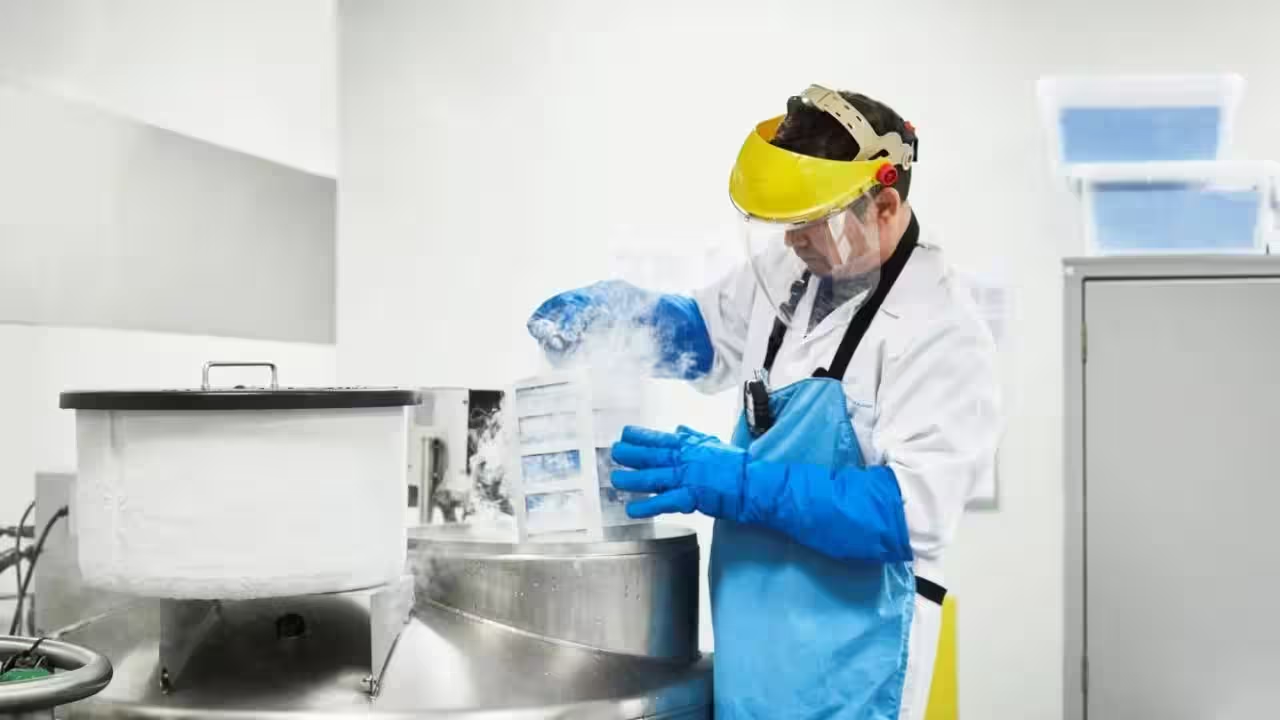
Doctors in Edinburgh have performed the first testicular tissue transplant in the UK, marking a potential breakthrough in fertility preservation for boys and young men who undergo treatments that can permanently damage their ability to produce sperm.According to ITV News, the procedure was carried out on a young man who had his testicular tissue removed and frozen before undergoing intensive chemotherapy as a child. The tissue has now been transplanted back into his body in the hope that it will restore sperm production. The procedure is reportedly only the second such case in the world.Patient left with no sperm after bone marrow transplantThe 19-year-old student, who has chosen to remain anonymous, was left with no sperm in his semen after undergoing a bone marrow transplant to treat a serious blood disorder in 2023. His testicular tissue had been preserved before treatment because chemotherapy can permanently damage the cells responsible for sperm production.Speaking about the procedure, the patient said fertility had been a personal struggle for him for years. He had always hoped to have children of his own but had gradually begun accepting that it might not be possible.“Having this procedure has given me genuine hope for the future. We don’t know yet whether it will work, but knowing that there is now even a possibility means more to me than I can really put into words,” he said.The patient has recovered well and will now be closely monitored. After eight months, doctors plan to remove some of the transplanted tissue and examine it to determine whether sperm production has resumed.How the testicular tissue transplant could restore fertilityThe procedure could eventually provide a fertility option for boys whose testicular tissue has been preserved before they undergo cancer treatment or other therapies that can severely affect fertility.Professor Rod Mitchell, Study Lead and Professor of Developmental Endocrinology at the University of Edinburgh’s Institute for Regeneration and Repair, explained that the preserved tissue can be transplanted either back into the patient's remaining testicle or placed underneath the skin.“The cells that know how to make sperm will start doing that, and we can then take out those sperm and freeze them for the patient,” Mitchell said.However, even if sperm production is successfully restored, patients would still need assisted reproductive treatment. “It means that we would still need to do IVF with the sperm that we created but it would mean that there would be an option for them,” he added.A potential first fertility option for boysFor nearly three decades, ovarian tissue freezing has offered girls undergoing chemotherapy a potential route to preserving their future fertility. Until now, however, boys who undergo fertility-damaging treatment have had considerably fewer options.Mitchell said fertility is often not a priority for children undergoing serious medical treatment. Doctors may discuss the potential impact of chemotherapy with families, but historically there has been little that could be offered beyond preserving the tissue.“When they are young, even if they understand, it's not normally a priority for them at all,” he said.“Then when they come back, five or 10 years later they are suddenly very interested in it and they can then see the benefit of what happened.”The Edinburgh testicular tissue project was established in 2015 with funding from Children with Cancer UK and has since developed into a national programme.Doctors call procedure ‘game changing’Consultant urologist C J Shukla, who carried out the first transplant in Edinburgh during the summer, described the procedure as a privilege but acknowledged that the most important question is whether it will successfully restore sperm production.“I felt privileged that I was able to do the first transplant,” Shukla told ITV News.He said the patient had recovered well without complications, but doctors are now waiting to see whether the transplanted tissue functions as hoped.“What remains now to see is whether it has worked and that's probably a little more nerve wracking,” he said.Shukla also highlighted the pressure involved because the amount of preserved tissue available for each patient is limited.“We have limited tissue per patient and the stakes for the patients are quite high, so you have that one chance of getting it right,” he said.If successful, the treatment could transform fertility prospects for patients who previously had no such option.“The ability to potentially restore their fertility, if it works, this would be game changing for all the patients,” Shukla added.More than 1,200 UK patients have had tissue preservedThe development could potentially benefit a significant number of patients. More than 1,200 people in the UK and around 3,100 worldwide have had testicular tissue stored for possible future clinical use.One of them is Lewis Stevenson from Fife, who was just 11 when he underwent intensive chemotherapy before receiving a bone marrow transplant.Doctors removed and preserved some of his testicular tissue before treatment began. If his fertility has been affected, Stevenson could eventually become eligible for a testicular tissue transplant.Now 20 and a student, Stevenson recalled that fertility was not something he was thinking about while undergoing treatment as a child.“You don't really have an idea of what that intensive treatment is going to be like, so I think my family did a great job of protecting me,” he said.“But it was still a frightening ordeal. Fertility was not on my mind at that age. You're going through the whirlwind of everything that's going on and you're more focussed on just wanting to get better and back to seeing your friends.”‘Now, knowing we have this option to move forward, it’s incredible’As Stevenson grew older, however, the possibility of infertility became increasingly important to him.“It's something you need to think more about. Family becomes really important when thinking about your future. Even having the illness in the first place, then later on you have to worry about your fertility, it's quite distressing,” he said.For Stevenson, the availability of testicular tissue transplantation represents a significant shift from the uncertainty faced by boys who underwent fertility-damaging treatment in the past.“But now, knowing we have this option to move forward, it's incredible,” he said.The Edinburgh procedure is still at an early stage, and doctors will need to establish whether the transplanted tissue can successfully produce sperm. But if it does, the development could mark a major step forward in fertility preservation, giving boys treated for serious illnesses during childhood the possibility of having biological children in adulthood.You use AI every day. Now get your AI Quotient. Take the AIQ test.
Topics in this story
Gathered from external sources. Rights to this text belong to whoever originally published it.