Dallas built an underground freight railway in 1924 to move goods through downtown; the Santa Fe tunnels later became disconnected from the main rail line
Beneath downtown Dallas lies a little-known chapter of the city’s transportation history: a network of railroad tunnels built to move freight through the
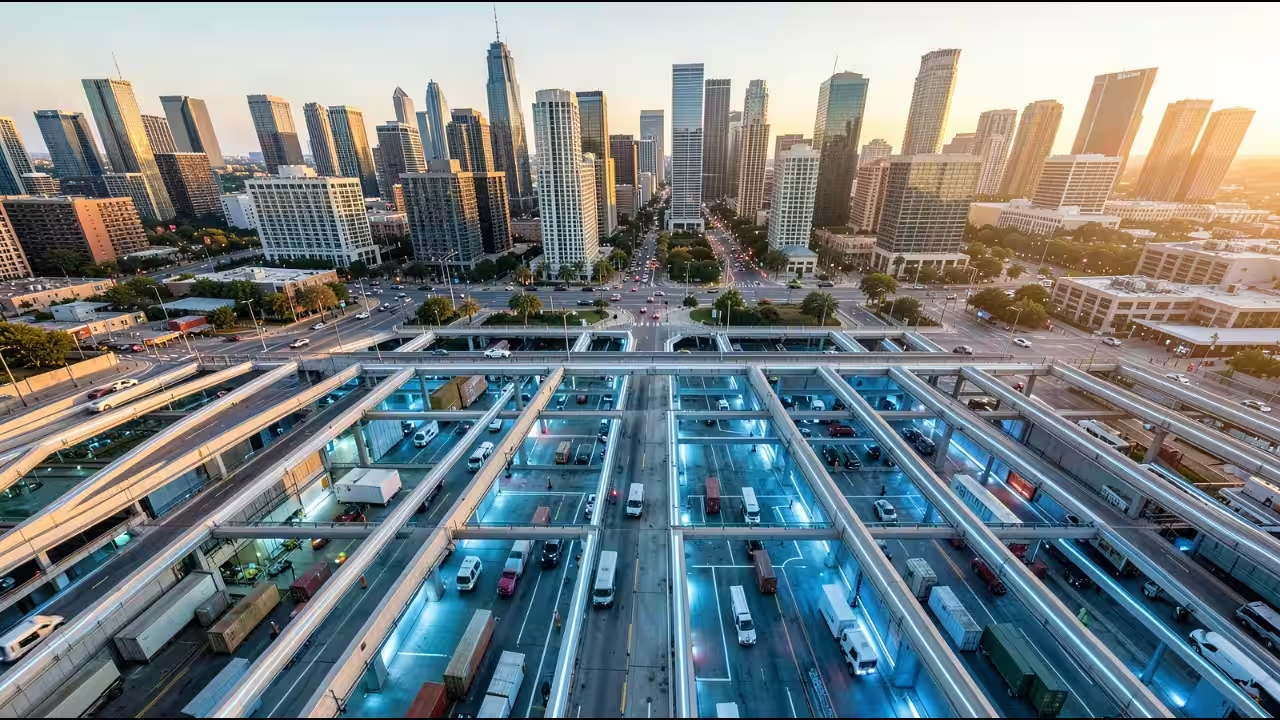
Beneath downtown Dallas lies a little-known chapter of the city’s transportation history: a network of railroad tunnels built to move freight through the central business district without relying on a maze of surface tracks. Beginning in 1924, the Gulf, Colorado and Santa Fe Railway developed a complex of 4 freight-terminal buildings connected by underground tracks. The arrangement allowed freight to reach warehouses in the heart of the city while reducing the surface railroad lines that had obstructed downtown traffic. The freight operation eventually fell into disuse after World War II, and construction of the Dallas Convention Centre later severed the tunnels from the main rail line. Records maintained by the City of Dallas and the National Register of Historic Places document the complex, which formed part of a broader effort to reorganise transportation and commercial activity in a rapidly growing city.Dallas freight tunnels and the Kessler PlanBy the early 20th century, Dallas was served by multiple railroads, each operating its own stations, tracks and freight facilities. The resulting network created congestion in the downtown street grid, where railroad lines competed with road traffic and pedestrians for space. George Kessler’s 1910 city plan proposed reorganising the railroad system, removing troublesome tracks and improving the city’s streets and circulation. Dallas Union Terminal, now known as Dallas Union Station, opened in 1916, although some later Dallas landmark documentation gives 1917 as the year of its completion. The consolidated station replaced the need for several separate passenger depots. The National Register record for Dallas Union Terminal identifies 1916 as a significant year in the station’s history.With passenger services consolidated, the Gulf, Colorado and Santa Fe Railway developed a new freight complex on adjoining downtown blocks. Construction began in 1924, according to the City of Dallas’s historic preservation record for Santa Fe Building No. 1. The complex was designed to centralise the railroad’s transfer and warehousing operations while removing the need for an extensive network of surface tracks. The buildings combined offices, warehouses and freight-related facilities. Designed by Dallas architect Lloyd R. Whitson, the buildings served businesses that relied on rail transport to receive, store and distribute merchandise. The project reflected Dallas’s role as a major commercial centre in the Southwest.How the Santa Fe freight tunnels workedThe Santa Fe complex comprised 4 buildings arranged across several downtown blocks, extending from the area around Commerce Street south toward Young Street. Underground railroad tracks connected the buildings to a central line that emerged farther south and linked the freight operation to the main railroad connection. The tunnels allowed freight cars to reach the warehouses below street level rather than moving through a sprawling arrangement of surface tracks. The City of Dallas’s record for the Santa Fe II Freight Terminal and Warehouse confirms that an underground tunnel connected the 4 buildings and that a special steamless locomotive was devised for the system. The underground arrangement made it possible to move freight within the complex while reducing disruption to streets above. The Santa Fe Terminal Buildings No. 1 and No. 2 National Register documentation records the complex’s architectural and transportation significance. The tunnels were not simply pedestrian passages: they formed part of a working freight railway designed to connect warehouses and facilitate the transfer of goods.Why the freight tunnels fell into disuseThe underground freight operation did not remain in service indefinitely. The One Main Place landmark nomination prepared for the Dallas Landmark Commission states that the Santa Fe terminals fell into disuse after World War II. Construction of the Dallas Convention Centre eventually severed the tunnels from the main rail line, leaving the underground freight system disconnected from the railway network it had served. The nomination is available through the City of Dallas’s historic preservation records. The buildings subsequently followed different paths. Building No. 3, which housed cold-storage facilities, was demolished in 1988, according to accounts of the Santa Fe complex. Building No. 4, the smallest of the four structures, was left abandoned for years before being converted into an Aloft hotel in 2009, according to published accounts of the complex. Other surviving buildings have been adapted for new uses, while remnants of the underground railway remain associated with the surviving structures.Records differ on the address and designation history of the Santa Fe complex’s second warehouse. The National Register documentation identifies Building No. 2 at 1118 Jackson Street, while the City of Dallas identifies Santa Fe II at 1122 Jackson Street and records its landmark designation in 1998 and National Register listing in 2004. The city’s Santa Fe II landmark nomination also identifies Warehouse No. 2 at 1118 Jackson Street, suggesting that the records may refer to the same building despite the conflicting addresses and listing dates. The discrepancy should not be resolved by treating them as separate buildings.Other underground passages beneath downtown DallasThe Santa Fe freight tunnels were part of a wider history of efforts to move certain activities below street level. A tunnel constructed beneath Main Street in 1913 connected the Adolphus Hotel and the Busch Building, primarily to link the hotel’s large power plant with the neighbouring building. At Union Station, an underground passage replaced an overhead walkway in 1947. These projects served purposes different from the Santa Fe freight railway, illustrating the range of functions that underground connections served in downtown Dallas.Another example emerged with the Mercantile complex. The Mercantile National Bank building, completed in 1943, was a major addition to the downtown business district. The City of Dallas’s preservation record documents the bank building’s history. A later landmark nomination for One Main Place describes an underground pedestrian connection associated with the Mercantile complex, alongside underground parking and freight facilities. Historic records differ on the parking structure’s precise date and configuration, so those details should not be treated as settled.The private Main Place superblock projectIn the 1960s, developers pursued a more ambitious vision for downtown Dallas through the Main Place superblock project. It was a private development rather than a municipal tunnel proposal. The project was initially conceived by Columbia University’s School of Architecture and refined into a buildable design by Skidmore, Owings & Merrill. Its plans envisioned a large development combining office buildings, retail areas, pedestrian connections, freight facilities, roadways and plazas. One Main Place, built between 1965 and 1968, was the only building completed from the proposed three-phase development. The remaining phases were abandoned because of a lack of financing, according to the City of Dallas’s landmark record and its One Main Place landmark nomination.You use AI every day. Now get your AI Quotient. Take the AIQ test.
Topics in this story
Gathered from external sources. Rights to this text belong to whoever originally published it.