In 1996, a German psychotherapist gave away her possessions and began living without money; what began as a one-year experiment lasted 17 years
Discover the inspiring story of Heidemarie Schwermer, a psychotherapist who lived without money for 17 years, exploring the possibilities of a moneyless life and the implications of trust and community.
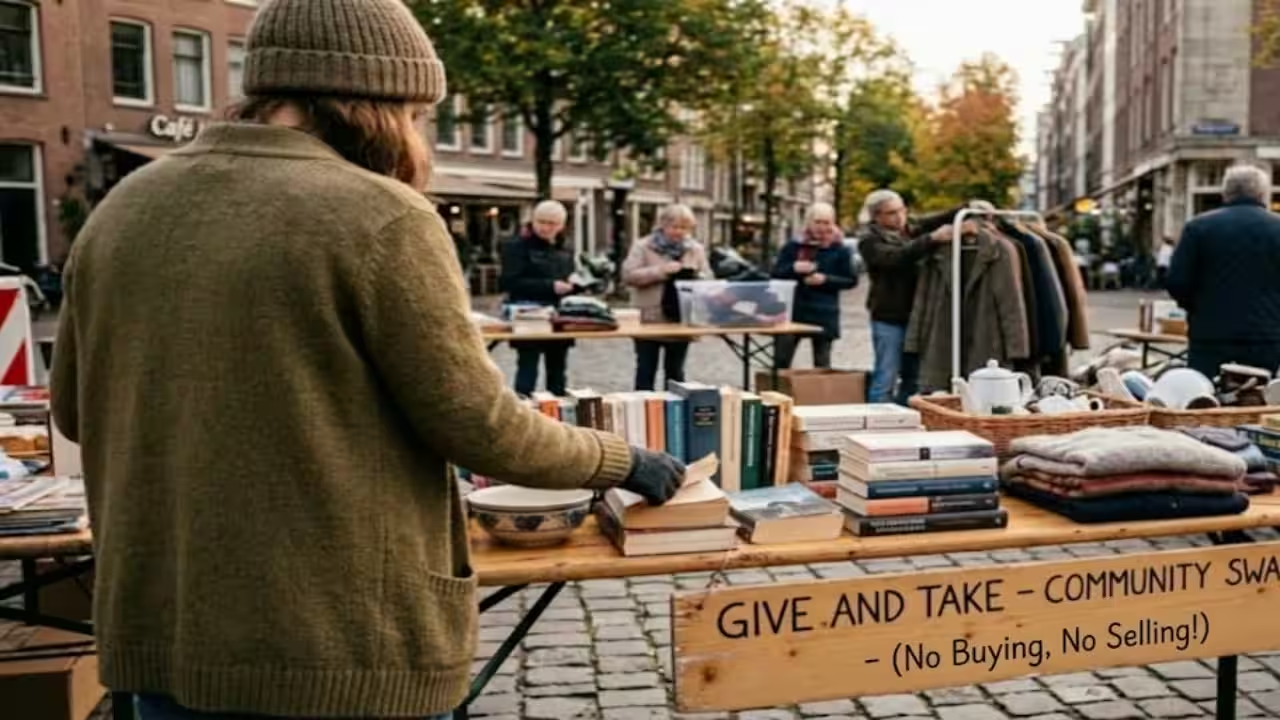
Most of us would find it hard to get through a weekend without spending. Bus fares, groceries, phone credit and rent are so ingrained into daily life that to imagine living without them seems like a stunt. But in the 1990s a psychotherapist in the German city of Dortmund decided to test the idea properly. In 1996, Heidemarie Schwermer gave away most of her belongings, gave up her flat and stopped using money, initially for a single year. The year went by, and she carried on. Her story is told in Living Without Money, a 2010 documentary by Norwegian filmmaker Line Halvorsen. By then, Schwermer was 68 and 14 years into the experiment, though the film says she lived almost without money, not entirely without it.How a swap shop gave birth to the experimentBorn in Memel, East Prussia, in 1942, Schwermer fled west with her family at the age of two. She started out as a primary school teacher in Kiel in 1965. In 1982 she left the classroom, studied psychology and sociology, trained as a Gestalt psychotherapist and set up a practice in Dortmund. She observed the number of people living in poverty on the streets. In 1994 she established a swap centre called Gib und Nimm, or Give and Take, where people could swap goods and skills without using cash. It was one of the first exchange circles of this kind in Germany.Money, she has said, made her uneasy and could come between people. As the swap centre grew, she needed less cash herself, and two years after opening it she decided to find out what life would be like with none.Life without a purseAfter 1996 she had no home of her own. She house-sat for friends who were away, later stayed with members of the swap circle and took on jobs such as gardening, babysitting, cleaning and cooking. At one point she was offered a bed, shower and computer access at a student residence in return for cooking for the young people who lived there. She kept only a few clothes and personal items, and she travelled, speaking about how she lived. She summed up her outlook as having nothing yet being a great deal, according to the organisation Moneyless.org. After four years she felt richer than she had ever been. Not everyone bought it. The film itself says that some people who met her called her a parasite and got furious, while others called her a visionary. She relied entirely on host generosity for her way of life, which is what made it inspiring to some and uncomfortable to others.What she left behindShe wrote about the experience in Das Sterntalerexperiment (2001), a book named after the Grimm fairy tale about a girl who gives away everything she owns. Her German publisher characterises the book as an example of hope rather than a rule for all. According to Books on Demand, which publishes an English edition of her story, she received the Tiziano Terzani Peace Prize in 2008 for the Italian translation.Accounts of how long the experiment ran differ. A 2015 interview with Der Freitag put it at almost 19 years, while the publisher of her book says she lived without money from 1996 until her death in 2016. Either way, it was far longer than the one year she had planned.Her swap-shop idea, though, was easy to copy, she told the German weekly Der Freitag in 2015, citing a friend who had launched a Give and Take shop in Mainz. Perhaps that’s the more valuable legacy. Schwermer showed how much of ordinary life may be arranged by trading and trust, and she made the case by living it far longer than anyone expected.You use AI every day. Now get your AI Quotient. Take the AIQ test.
Topics in this story
Gathered from external sources. Rights to this text belong to whoever originally published it.