In 2026, a deep-sea robot filmed a black swallower off Trinidad and Tobago with a distended belly after it gulped prey up to 10 times its weight
Explore how a black swallower, a deep-sea predator, captured on film by SuBastian, swallowed prey ten times its weight during a groundbreaking marine expedition by the Schmidt Ocean Institute.
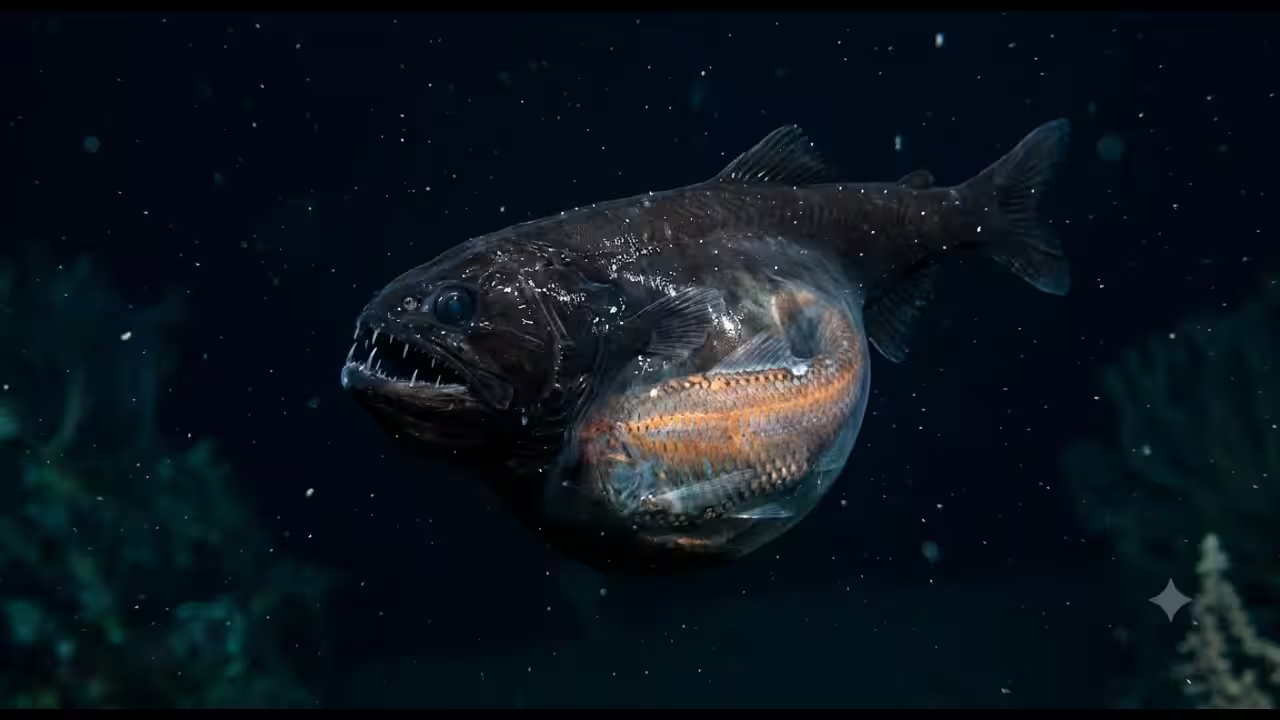
The deep ocean is home to animals with unusual ways of finding and consuming food. Some predators have evolved to swallow prey much larger than themselves, an adaptation that can be especially useful where meals are difficult to find. During a deep-sea expedition off Trinidad and Tobago in 2026, researchers captured footage of a black swallower with a remarkably distended stomach after consuming a large meal. The encounter involved the black swallower (Chiasmodon niger), a deep-sea fish known for swallowing prey far larger than itself. The video recording was made as part of a survey led by Trinidadian marine biologist Diva Amon.ROV SuBastian filmed the black swallower during the June 29 to July 28, 2026 expeditionThe sighting took place during the Schmidt Ocean Institute’s Deep Wonders of Trinidad and Tobago expedition, which ran from June 29 to July 28, 2026, as the institute’s cruise page lists. The month-long survey was conducted aboard the research vessel Falkor (too), with researchers using the remotely operated vehicle SuBastian to explore underwater habitats. The Schmidt Ocean Institute describes the expedition as the first locally led and most comprehensive deep-sea survey of Trinidad and Tobago’s surrounding waters, and its announcement confirms that the team captured footage of a black swallower with a distended stomach after it had eaten a meal much larger than itself.The fish can swallow prey up to ten times its own weightThe black swallower is a small deep-sea predator with an unusual feeding strategy. Its large mouth, elongated lower jaw and expandable stomach allow it to engulf fish much larger than itself. The Woods Hole Oceanographic Institution’s black swallower profile explains that the species can swallow prey weighing up to ten times its own mass. Its backward-pointing, interlocking teeth help hold prey in place and prevent it from escaping once swallowed. This feeding behavior is especially advantageous in the deep sea, where food may be scarce and finding food sources might be random. Eating much in a single hunt gives the fish much energy without having to hunt for food continuously.Its distended stomach revealed an unusual adaptationWhat stood out in the video was the extreme swelling of the fish’s abdomen. The fish’s stomach had swollen to hold a meal much larger than it could normally carry. The black swallower was one of many observations made during the survey. The team documented 25 cold seeps and the institute’s announcement says the mapping covered about 13% of Trinidad and Tobago’s marine territory.Cold seeps are areas where there is emission of methane and other substances from the seabed, providing a habitat for organisms that have adapted to the chemically rich environment. Such records helped scientists establish the distribution of deep-sea organisms and pinpoint areas that might require further investigation. The project showed the value of local scientists using ROVs, seafloor mapping and specimen collection in marine research.You use AI every day. Now get your AI Quotient. Take the AIQ test.
Topics in this story
Gathered from external sources. Rights to this text belong to whoever originally published it.