The new sanctions bill is aimed at the wrong Russia
While the Senate passed the Graham sanctions package to penalize Russia’s war economy, critics argue that true peace requires explicitly weakening Moscow’s military capacity through direct support for Ukraine’s defense.
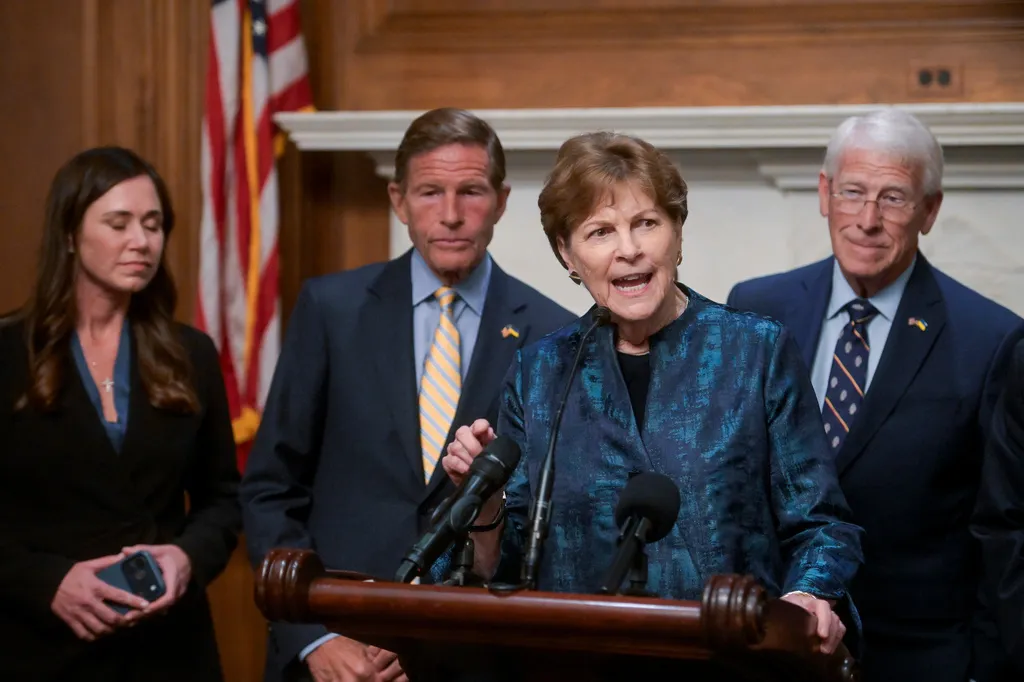
The Senate passed the Graham sanctions package 86-11 this month, the most substantial move this year to shift the dynamic of Russia’s war on Ukraine.
Should it pass the House, the bill will give the Trump administration sharper tools to penalize countries that keep buying Russian oil and gas, to target the shadow fleet of reflagged tankers and hit Russian banks and energy projects. “Today we say to Vladimir Putin: You will not conquer Ukraine,” Sen. Richard Blumenthal (D-Conn.) said from the Senate floor.
Economic pressure can make a real difference. But sanctions are a means to an end, and Washington has yet to articulate it. Words like “settlement,” “peace deal” and even “with Ukraine as long as it takes” leave the central questions unanswered: How do we break Moscow’s appetite for war-making? Why is Putin refusing to quit a campaign of terror? How many elderly Ukrainians must Russian troops hunt in the streets with killer drones, in what has been termed a human safari , before America recalls what it promised Ukraine in the Budapest Memorandum ?
The theory of halting Russian aggression buried inside the bill goes like this: drain the revenue, raise the cost, let the pain accumulate until Moscow decides the war is no longer worth it. Sen. Jeanne Shaheen (D-N.H.) said the pressure will push Putin to revisit peace negotiations seriously.
We know that the Kremlin doesn’t answer to the people it governs, but the bill’s logic naively assumes it cares for them. Moscow has spent five centuries proving otherwise. Under tsars, commissars and now kleptocrats, the Kremlin has readily sacrificed the lives of Russians to preserve its grip on its colonial possessions from Kamchatka to Kaliningrad.
In July alone, Russia suffered an estimated 42,860 soldiers killed or wounded , nearly twice as many casualties in one month as the U.S. military sustained over two decades of war in Afghanistan. Total Russian casualties may now be approaching 1.5 million.
Surely, our lawmakers are thinking, there must come a point when too many men have died, too much treasure has been wasted for too little gain, and Moscow grows desperate to sue for peace.
And this is their faulty assumption. The Kremlin is pushing in the exact opposite direction from what conventional logic would dictate. Having rejected every overture since March of last year, when Ukraine promptly agreed to the unconditional ceasefire the Trump administration put on the table, Moscow also scoffed at a limited Black Sea truce suggested by Ankara just this month.
America’s foreign policy has for decades been calibrated to a Russia that does not exist. Our collective imagination still conjures a nation with national interests, but the Frankenstein polity stretching across 11 time zones is decidedly not that. Lenin called the tsarist realm a “prison of nations” in 1914, and so Russia remains a century later.
The Russian Federation is an empire in the most literal sense — a predatory leviathan built on subjugation, extraction and dispossession. The Kremlin loots oil from Siberia, diamonds from Sakha and conscripts soldiers from dozens of subjugated nations, feeding the colonized into the furnace of yet another colonial conquest.
The Financial Times reported in February that men from Buryatia and Tuva were 25 times more likely to perish in Ukraine than men from Moscow. Michael Kofman of the Carnegie Endowment observed that Moscow had built a pipeline for assault troops and “largely didn’t care about expending these people.”
Sanctions restrict Moscow’s cash flow and, if effectively enforced, could make its war-crimes machine sputter. But using pain to coax the Kremlin toward negotiations is a fool’s errand — and so is waiting for the Russian people to grow tired of war. Rather, the strategic purpose of economic pressure must be to weaken and ultimately remove Moscow’s capacity to wage war.
The U.S. must therefore be explicit about the outcome that will give peace a chance. That means supplying Ukraine with the long-range weapons needed to destroy enemy missile production sites and military airfields. The shadow fleet is not something for America to name and shame; sanctioned vessels should be boarded and seized.
Starving Moscow of energy revenues and investing heavily in Ukraine’s defense industry are obvious next steps. Peace secured by leaving Russia capable of another war will lead, at best, to an intermission. But if history taught us anything, it’s more of a red carpet for World War III.
Article Five has been invoked only once in NATO’s history, in defense of the U.S. after 9/11. Washington should consider what its European allies would expect if the next test came in reverse. What if Romania had failed to intercept an explosive-laden Russian naval drone in the Black Sea? What if the drone that U.S. intelligence linked to Moscow at a German airport had struck its intended target? If one of these provocations crosses the line, the White House will face a choice between abandoning the alliance and entering a war with Russia.
Unpunished evil spreads and grows; every high schooler knows that. Does Washington? American security and credibility will not be restored while, for 12 long years, Russia is given a free hand to wage its horrific, terrible war; while it supplies the ayatollahs in Iran with intelligence to target U.S. forces.
A recent Pew Research Center poll finds that two-thirds of Americans lack confidence in President Trump’s handling of Russia’s war. Only 20 percent say Ukraine is receiving too much support, and 83 percent view Russia unfavorably. With the midterms approaching, it is a small wonder that lawmakers are eager to pass the Graham Act . But sanctions accomplish little without a clear purpose. That purpose must be to render Moscow’s grievance-fueled predation impotent.
Andrew Chakhoyan is an academic director at the University of Amsterdam. He previously served in the U.S. government at the Millennium Challenge Corporation and studied at Harvard Kennedy School and Donetsk State Tech University.
Topics in this story
Gathered from external sources. Rights to this text belong to whoever originally published it.