Quote of the day by Aristotle: "Man is by nature a political animal."
Rest of World News: Two people can think about human nature and reach very different conclusions about what a person fundamentally is. One imagines a self-contained indiv.
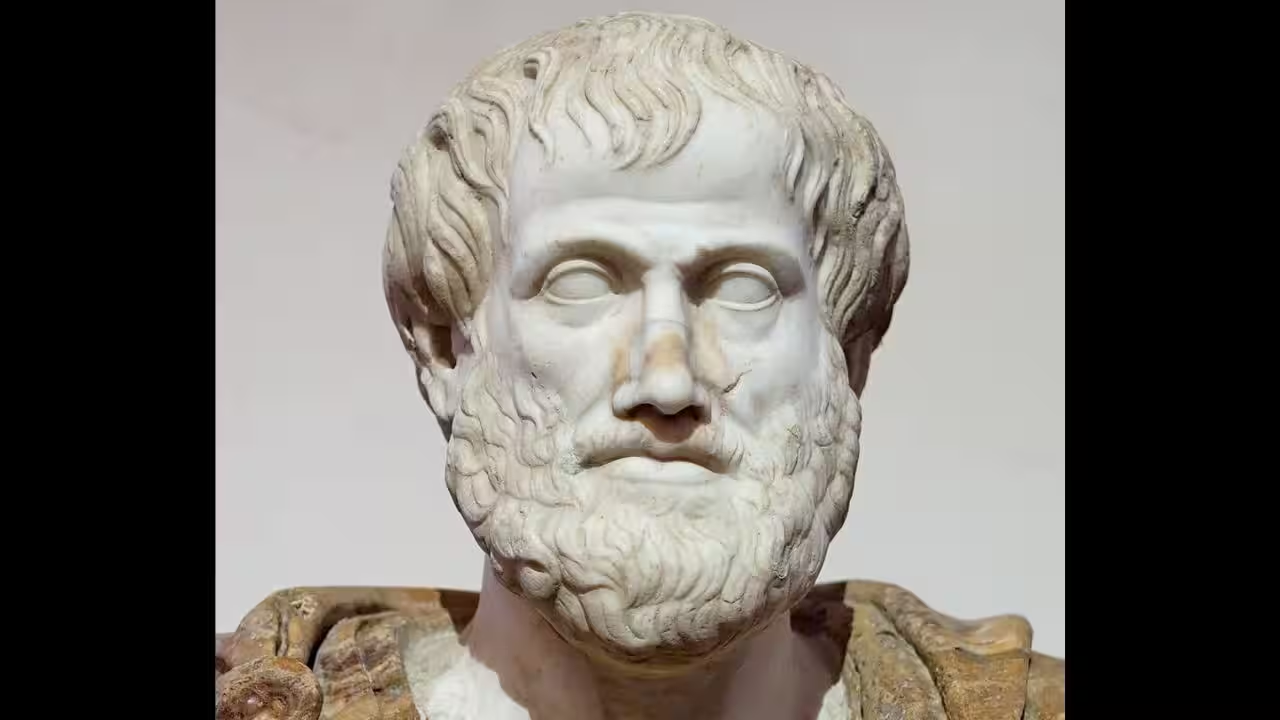
Two people can think about human nature and reach very different conclusions about what a person fundamentally is. One imagines a self-contained individual who happens to live near other people out of convenience or necessity, but who could, in principle, be fully themselves alone. The other insists that living within a community isn't an optional add-on to human nature but part of its actual definition, that a person cut off entirely from society isn't simply a lonelier version of a complete human being, but something meaningfully incomplete. Aristotle, writing in his Politics, argued directly for the second view. The Greek term usually rendered "political animal," zoon politikon, doesn't mean political in the narrow, modern sense of elections and government. It means an animal whose nature is to live in a polis, an organised community, the way it's in a bee's nature to live in a hive. For Aristotle, humans outside of organised community life weren't simply unusual. He wrote that such a being would have to be either a beast or a god, since only creatures below or above the human condition could genuinely live self-sufficiently, alone.Quote of the day by Aristotle"Man is by nature a political animal."Written by a philosopher who never held citizenship in the city he analysedWhat gives this line an unexpected layer of complexity is Aristotle's own position within Athenian society while he wrote it. Though he spent decades teaching and working in Athens, first as a student at Plato's Academy for roughly twenty years and later founding his own school, the Lyceum, Aristotle was born in Stagira, in northern Greece, and as a foreign-born resident, a metic, he was never granted full Athenian citizenship, meaning he could never vote, hold office, or participate directly in the very political life his philosophy described as central to human flourishing. He built one of history's most influential theories of political community from a position permanently outside full membership in the specific community he lived and worked within.That outsider status became sharply relevant near the end of his life. After Alexander the Great, whom Aristotle had personally tutored, died in 323 BC, anti-Macedonian sentiment surged in Athens, and Aristotle, associated closely with Alexander, faced charges of impiety, the same accusation that had led to Socrates's execution decades earlier. Rather than stand trial, Aristotle left Athens for Chalcis, reportedly saying he did not want the city to "sin twice against philosophy." The philosopher who had argued communities were essential to human flourishing ultimately had to leave the community he'd spent most of his adult life in, to survive.A simple way to actually use this ideaThe useful move here is taking seriously the idea that isolation carries a real cost to human functioning, not simply an inconvenience but something closer to what Aristotle described: a departure from what humans are actually built for. Modern research on loneliness and social connection has repeatedly found measurable effects on both mental and physical health from prolonged isolation, a finding that lines up closely with Aristotle's much older claim, even though it arrives through entirely different methods.A fair test, when a period of isolation starts to feel normal or even preferable, is to ask honestly whether it's serving genuine needs or simply avoiding the harder, more demanding work of participating in a community. That question won't make community life easy. It usually clarifies whether withdrawal is a choice being made, or a habit that has quietly become mistaken for one.Other famous quotes by Aristotle"We are what we repeatedly do." "Knowing yourself is the beginning of all wisdom." "The whole is greater than the sum of its parts."Catch the latest World News and Live updates. Download the TOI app.
Topics in this story
Gathered from external sources. Rights to this text belong to whoever originally published it.