This tiny Egyptian object was mistaken for a copper awl for a century; researchers now say its six surviving leather coils reveal a 5,300-year-old bow-powered rotary drill
A small copper-alloy object in a Cambridge museum spent decades attracting little attention.
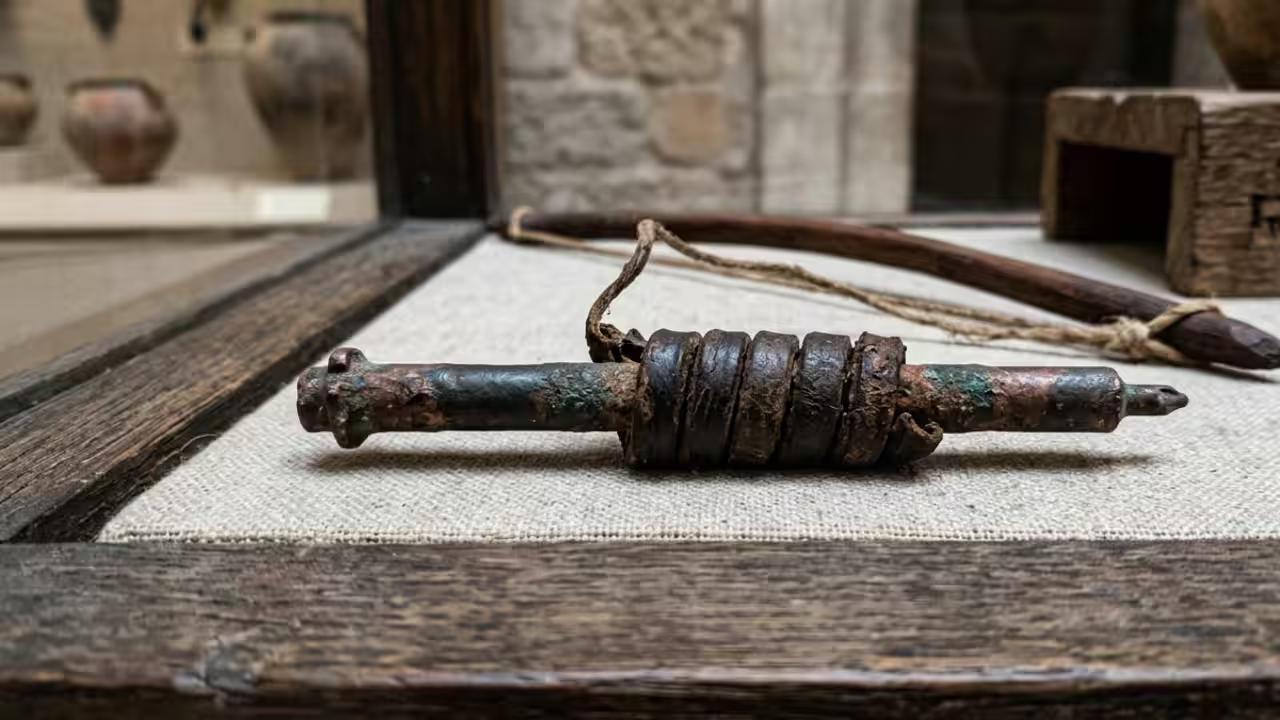
A small copper-alloy object in a Cambridge museum spent decades attracting little attention. It is only 63 millimetres long and weighs around 1.5 grams, hardly the sort of artefact that might alter the picture of early Egyptian technology.The piece was excavated from a cemetery at Badari in Upper Egypt about a century ago. Its original description was brief, calling it a small copper awl with a leather thong wound around it. That interpretation largely left the object sitting quietly in a collection. Now, close study of its worn surface and the remains of the leather has led archaeologists to identify it as something more specialised: a rotary drill operated with a bow, dating to the Predynastic period, roughly 5,300 years ago, as reported by Newcastle University.Badari artefact reveals early mechanical drilling in ancient EgyptThe artefact comes from a period when Egypt was still developing into the society later associated with pharaonic rule. Badari was part of this earlier landscape, when communities were already producing increasingly varied tools and objects from copper, stone, flint and organic materials.The newly identified drill predates the first pharaohs by centuries. It also pushes back the evidence for mechanically assisted rotary drilling in Egypt by a considerable margin. Tomb paintings from the New Kingdom, for instance, show craftsmen using bow drills to work materials such as wood and beads. The earliest known Egyptian depiction of such a tool had previously been dated to the Old Kingdom, around 2450 BCE, in the tomb of the official Ty at Saqqara.How the bow drill made ancient Egyptian drilling more efficientThe principle behind a bow drill is straightforward, although the effect is more efficient than an ordinary hand tool. A cord is wound around a narrow shaft, with the shaft carrying a pointed working end. The cord is attached to a bow, and moving the bow backwards and forwards makes the shaft spin alternately in opposite directions.That repeated movement allows the tip to rotate quickly without requiring the craftsperson to twist the tool directly by hand. It could be used for making holes in materials including wood, stone and beads. Similar arrangements were also used in some traditions to produce fire through friction.For early craftspeople, the difference would have been practical. A rotating tool could make controlled holes with less effort than an awl being repeatedly pushed or turned by hand. The newly examined object suggests that this principle was already being used in Egypt during the late fourth millennium BCE.The clues hidden in a 63-millimetre objectReportedly, the object is catalogued as 1924.948 A in the Museum of Archaeology and Anthropology at the University of Cambridge. Its original excavator had noticed the leather around it, but the description did not identify a complete mechanical system. Closer examination has changed that interpretation.The metal carries fine marks and rounded areas of wear, along with a slight curvature at the working end. Taken together, the researchers say these traces fit repeated rotary movement better than the use of a simple pointed awl.Even more revealing are six surviving coils of an extremely fragile leather thong. The team believes these are remnants of the cord that would have been wrapped around the shaft and attached to a bow.The work was carried out by Dr Martin Odler of Newcastle University and Jiří Kmošek, an archaeometallurgist and PhD candidate at the Academy of Fine Arts, Vienna. Their study was published in Egypt and the Levant.Ancient Egyptian drill reveals a complex mix of metalsThe researchers also examined what the drill was made from. Portable X-ray fluorescence analysis showed an unusual composition containing arsenic and nickel, along with significant amounts of lead and silver.The combination raises questions about how early Egyptian metalworkers selected and worked their materials. The researchers suggest that the unusual composition could reflect deliberate choices in alloying or the movement of particular materials and metallurgical knowledge through wider networks in the eastern Mediterranean during the fourth millennium BCE.Tool wear reveals the hidden technology behind ancient Egyptian craftsmanshipFor years, much of what was known about Egyptian tools came from their shapes, later written descriptions and scenes painted or carved on tomb walls. Those sources are useful, but they do not always reveal how an object was actually used. Wear on a tool can provide a different kind of evidence.That is the approach behind the UKRI-funded EgypToolWear project, which brings together archaeological, technological and scientific methods to study Egyptian metal tools. Rather than treating museum objects simply as examples of known tool types, the project examines physical traces left by use.In this case, that approach has made an object that once looked like an insignificant copper awl considerably more interesting. It also challenges the assumption that early Egyptian toolmaking developed in a slow or straightforward sequence. Mechanical combinations of wood, leather, cord, stone and metal could produce useful machines even when individual components were relatively simple.A century-old museum artefact reveals its hidden purpose decades laterThe drill was excavated roughly a century ago, catalogued and placed in a museum collection. Nothing about its small size suggested that it would become a major piece of evidence for the history of Egyptian technology. Its significance emerged only when its surface and surviving organic material were examined more closely.That is an important feature of archaeological collections. An artefact does not necessarily become more informative because it is newly excavated. Sometimes the change comes from asking a different question of something that has been sitting in a drawer for generations.Here, the leather coils helped connect the metal shaft to a mechanical arrangement, while the wear on the copper-alloy tip provided clues about how that arrangement may have been used. Together, those details support the identification of the object as the earliest known rotary metal drill from ancient Egypt.You use AI every day. Now get your AI Quotient. Take the AIQ test.
Topics in this story
Gathered from external sources. Rights to this text belong to whoever originally published it.