In 79 CE, Mount Vesuvius’ eruption buried Pompeii; today, that 2,000-year-old eruption is helping scientists date Earth’s history more precisely
When Mount Vesuvius erupted in 79 CE, it didn’t just wipe out entire Roman towns and traumatize generations; it also gave us an unexpected scientific gift.
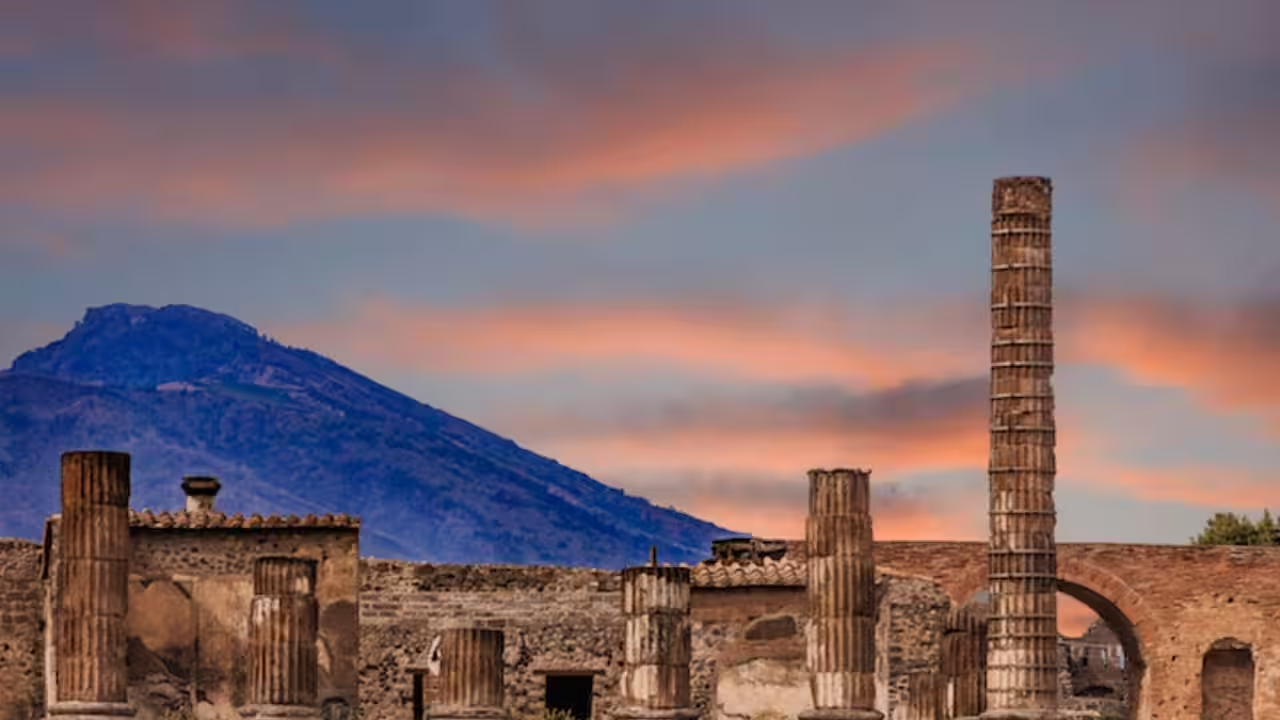
When Mount Vesuvius erupted in 79 CE, it didn’t just wipe out entire Roman towns and traumatize generations; it also gave us an unexpected scientific gift. After all this time, scientists are still pulling secrets from that fiery disaster. We all know how it buried Pompeii and Herculaneum in a matter of hours, freezing daily life in a moment’s ash-gray snapshot. But now, that very same eruption is giving researchers a sharper tool for measuring the deep past of the Earth: one that reaches far beyond the ancient streets of Pompeii.What exactly is happening?A new study published in Science Advances has used minerals formed in the Vesuvius eruption to fine-tune argon-argon dating. This isn’t just some academic tweak; arguably, it’s a game-changer. Argon-argon dating is a go-to method for scientists hunting the ages of rocks, volcanic eruptions, asteroid impacts, and even mass extinctions. If you want to know when the dinosaurs vanished or how fast the planet flipped through climate disasters, this clock is one of your best bets. But even good clocks need recalibrating from time to time, especially when the tick of each second could mean thousands or millions of years.What makes Vesuvius so special for scientists isn’t just the volcanic violence; it’s the fact that we know almost exactly when it happened. Pliny the Younger, a Roman teenager (just 17 years old at the time), watched the eruption, lived to tell the tale, and wrote two letters describing it. Historians have argued about whether he wrote them years later, glossing some details, but remarkably, those letters became one of the best time-stamped disasters we have from the ancient world. That certainty is gold for geologists. In science, it’s tough to find a rock whose birthday is written down in a literal eye-witness account.What did the researchers do?They picked apart the volcanic minerals, specifically, sanidine crystals from Vesuvius pumice. These minerals contain potassium-40, a radioactive element that slowly turns into argon-40 over time. It’s like an internal clock, marking the time since the mineral cooled from the eruption. Modern lab technology let the team measure the argon in those minerals more precisely than ever before, narrowing down the age of the eruption to just 1,938 ± 13 years from 2025. By geological standards, that’s impressively precise for a rock so young. The margin for error shrank to less than 1 percent, which matters when you’re comparing it to events millions or billions of years ago.Why does any of this matter for, say, the extinction of the dinosaurs or ancient climate shifts?The answer is calibration. Scientists use various radioactive ‘clocks’: uranium-lead, radiocarbon, and argon-argon, among others. But these clocks don’t always tell the same time. If a clock has drifted out of sync, your timeline of Earth’s history turns fuzzy. By using Vesuvius, with its well-known date, scientists were able to recalibrate the decay rate of potassium-40. The new measurement for its half-life is 12.044 billion years (with a super-tight error margin compared to past estimates), improving time-stamps everywhere this clock is applied.So now, when scientists look at massive volcanic eruptions, asteroid impacts, or extinction events preserved in stone, they can be more confident about which happened first. Did a volcano erupt and trigger a mass extinction before or after a meteorite strike? Questions like that are central to piecing together cause and effect in Earth’s past. Paul Renne, who led the research, has used this method to study the end of the dinosaurs and other pivotal moments in geological history. Every improvement in precision lets scientists trace that story more clearly.However, there’s a small twist: the exact date of Pompeii’s destruction isn’t 100 percent settled. Pliny’s account puts it on August 24, but some evidence, like ancient fruit, clothing, and even a charcoal scribble with a later date, suggests the eruption might’ve happened in the autumn. The new study took this into account, checking whether those uncertainties could throw off the recalibration. Thankfully, they don’t really matter for the geological dating. Whether Vesuvius blew its top in August or October, the method remains solid.The most striking part in all this?A cataclysm witnessed by a young Roman nearly two millennia ago is now helping scientists look far deeper into the past, reaching across the eons to help us understand not just Pompeii, but the history of the entire planet. It’s a strange, almost poetic twist: the ash that destroyed whole cities is now making the stories of our world and its past a little bit clearer.So, while the ruins of Pompeii keep astonishing archaeologists with new discoveries about Roman life, its volcanic legacy is busy solving much bigger, older mysteries. With every refinement, we get closer to answering the big questions: how our world changes, why life sometimes flourishes and sometimes crashes, and how every tick of the clock still echoes with the memory of an eruption almost 2,000 years ago.You use AI every day. Now get your AI Quotient. Take the AIQ testGet the latest Lifestyle News and more. Download the TOI app.
Topics in this story
Gathered from external sources. Rights to this text belong to whoever originally published it.