In 2024, California floods washed away a private access road twice; an appeals court upheld moving the easement across a neighbour’s land but reversed an order requiring riverbank stabilization
A California appeals court has ruled on the complex legalities surrounding easements after floods devastated private access roads, impacting rural properties. The decision highlights the balance of rights and responsibilities between property owners in flood-prone areas.
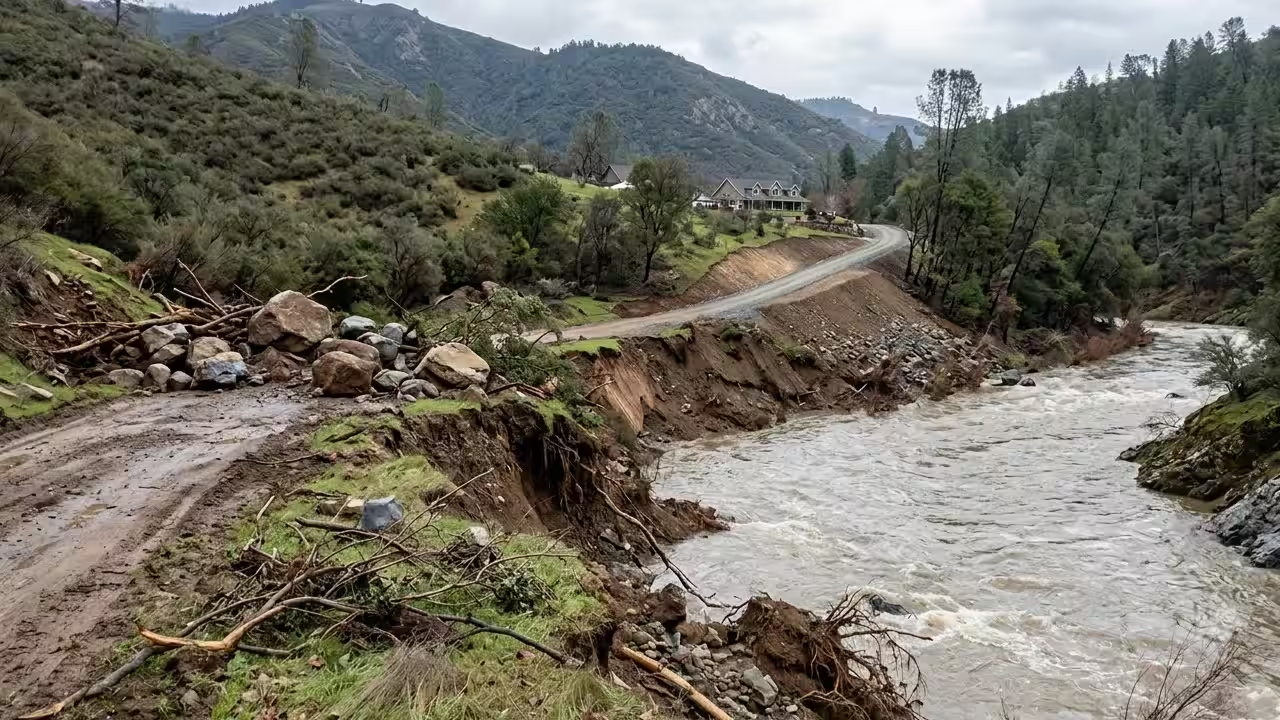
Roads built beside a river sit on ground that floodwater can reshape. In such a case, where the easement road is the only legal way to reach the adjacent land from the other end, all it takes is just one flood and the landowner will find themselves with legal access but no real access whatsoever. It falls to the courts to decide how to go ahead with that road and at whose cost. The problem is especially relevant for rural land with no connection to a public road, where the only access runs through an easement across a neighbor’s property. The owner of the land whose burden is to bear the easement will want the easement as narrow as possible, while the one with the easement would want a sturdy way through. A California appellate court addressed that issue after two floods destroyed the access road to a specific property.A landlocked parcel on the South Fork of the Trinity RiverThe California Court of Appeal, Third Appellate District, issued its partially published opinion in Judicial Branch of California on December 2, 2024, and modified it on January 2, 2025, without changing the judgment. Eberhard and Ursula Schneider and Karla Lane are the owners of adjacent properties on the north bank of the South Fork of the Trinity River. The Lane property is situated west of the Schneider property and would be landlocked without an express easement from the Schneider property to a county road on the east side. The easement ran over the existing road named River Road, located along the bank of the river. The flood that happened in 2002 caused damages to parts of the road. Lane filed her case in 2003 and the court in 2011 found that the easement encumbered the whole Schneider property and could be relocated to a permitted road at the southern edge of the property.The 2018 flood, the 2019 lawsuit and the trial court’s riverbank orderThe flooding in 2018 washed away the 2011 road and the Schneiders sued Lane in 2019, claiming that Lane failed to maintain the road as required by Section 845 of the Civil Code. After Lane’s motion for summary judgment based on the doctrine of res judicata in answer to their complaint was granted by the trial court, the court tried Lane’s cross-complaint. Lane offered three alternative paths farther inland, which were going to impact Schneider’s property increasingly. The court preferred the proposal made by the Schneiders themselves, since it had the least impact on their property. Under Section 845, the trial court held that Lane had to maintain the riverbank at her own expense. In Schneider v. Lane, the California Court of Appeal noted that the stabilization work would cover about 25 feet of riverbank located 30 to 50 feet from the road, with an expert estimating design costs of up to $250,000 and construction costs of up to $1 million.Why the panel reversed the stabilization order under Civil Code section 845Appeals were taken by all. The Acting Presiding Judge delivered for the court, which consisted of Judge Hull, Judge Krause and Judge Mesiwala. This decision affirmed in part and reversed in part. It found that the relocation was justified because the 2011 decision had already established that the easement can be moved. The panel reversed the order requiring riverbank stabilization. Civil Code section 845 tells an easement owner to “maintain it in repair,” and the panel reads that as keeping the easement itself in good and sound condition. The statute does not mandate that the owner build a new improvement apart from the right-of-way. The decision further states that there had been no reported California case law concerning whether the owner has the obligation to stabilize the adjacent riverbank. Both parties paid their own expenses on appeal.What flood modelling and streambank monitoring add to the disputeXingying Huang and Daniel Swain published Climate change is increasing the risk of a California megaflood in Science Advances on August 12, 2022, and their modeling suggests that climate change may have already roughly doubled the likelihood of an event capable of catastrophic flooding in the state. The authors’ simulations projected that a megaflood would bring much more rainfall than the historical 1861-62 event, with peak runoff up to five times greater than the 1996 to 2005 baseline. The authors note that the risk remains high even under a 2°C warming scenario.On the cost side, the study Quantifying Effectiveness of Streambank Stabilization Practices on Cedar River, Nebraska, published in Water, tracked 18 stabilized streambanks using aerial images from 1993 to 2016. Jetties succeeded in 70% of cases, produced the greatest deposition and were the most cost-effective approach. The authors identified gravel beaches and retaining walls as alternative shoreline protections, but said specific recommendations and use conditions still need to be defined. Six practices, among which there were jetties, rock vanes and retaining walls were considered. The study concluded that jetties had the highest percentage of success (70%) and the greatest amount of deposition, being the most cost-effective choice.What the ruling leaves in place for easement holders and neighboursThis ruling grants neither complete freedom of movement to easement owners nor unlimited rights for such movements. According to its ruling in Schneider v. Lane, the California Court of Appeal, Third Appellate District, stated that if the relocation of an easement is to be done, the court is supposed to ensure that the new route poses a minimum burden to the landowner in question. There might even be a provision for compensation in equity in the case of extra burden posed on the property. This court did not grant any form of compensation in this case, as the route selected was the least burdensome on the property of Schneiders, with it being said that the routes proposed by Lane called for compensation to be granted to her.You use AI every day. Now get your AI Quotient. Take the AIQ test.
Topics in this story
Gathered from external sources. Rights to this text belong to whoever originally published it.