Two Iowa farmers gave up pigs and started growing mushrooms; their abandoned livestock buildings became an artisan food business
Two Iowa farmers have transformed their family's former hog operation into a speciality mushroom business, turning infrastructure once built for thousands
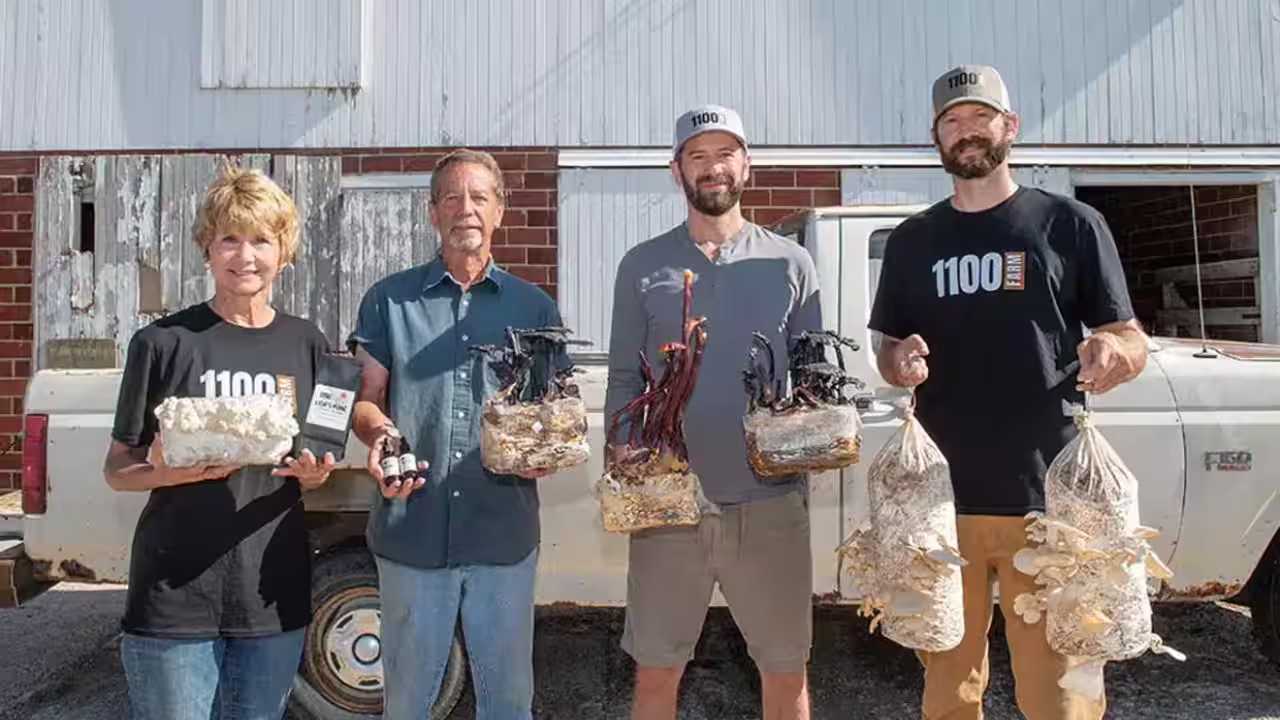
Two Iowa farmers have transformed their family's former hog operation into a speciality mushroom business, turning infrastructure once built for thousands of pigs into spaces for growing lion's mane and oyster mushrooms. The Faaborg family, which once raised about 8,000 hogs a year, ended its animal-farming contract in October 2022 after decades in the industry. Their operation, now called 1100 Farm, has repurposed half of a 200-foot hog barn into mushroom-growing and processing space, while a former manure pit has been converted into a freshwater pond. With support from the Transfarmation Project, the family has expanded into value-added products including mushroom tinctures, flavoured salts, coffee and hot chocolate.From pigs to mushrooms: Iowa farmers' big switchThe Faaborg family's move away from pigs followed decades of involvement in Iowa's livestock industry. Rand and Tammy Faaborg began raising pigs as a side business after buying their 25-acre farm. The operation eventually expanded through contract feeding, in which an integrator supplies animals and feed while farmers provide the buildings and labour.The family initially adapted existing structures to hold about 2,000 hogs. Later, they borrowed more than $400,000 to construct two larger hog barns. Rand said it took roughly 12 years to repay the debt.At its peak, the family operation was raising around 8,000 hogs annually. But the economics and demands of the business changed. Rand, who also worked as a welder, described periods when he worked 16-hour days and sometimes 24-hour stretches. He said that over 35 years, his income from his main job increased significantly, while his earnings from raising hogs declined by about two-thirds.Tanner Faaborg pushes for a new directionThe idea of changing the farm's direction gained momentum with the family's next generation. Their son Tanner Faaborg developed an interest in sustainability and climate issues while studying at college.After returning home, Tanner found himself caught between his interest in environmental issues and the realities of the family's hog operation. He began looking for ways to use the existing farm infrastructure without continuing to raise large numbers of animals.The family eventually began working with the Transfarmation Project in 2021, an initiative that helps farmers explore alternatives to intensive animal agriculture. The Faaborgs ended their animal-farming contract on October 23, 2022, according to the project's timeline.The mushroom experiment beginsMushrooms emerged as one possible alternative because they could be grown indoors using existing agricultural buildings. In 2023, the family received a $15,000 research and innovation grant to experiment with mushroom production and develop products.The family reported spending about $35,000 on site preparation, equipment and supplies, as well as branding and website development for the pilot.They began experimenting with speciality varieties, including lion's mane and oyster mushrooms. Instead of buying all their growing material, the family also learned to make its own mushroom blocks using soy hulls and hardwood pellets.The first mushroom crop was harvested and sold in March 2024, according to the Transfarmation Project's timeline.How an old hog barn became a mushroom farmThe family's new business is called 1100 Farm, a name linked to the capacity of the original hog barns.Rather than demolishing the old structures, the Faaborgs began converting them. By 2026, half of one approximately 200-foot-long hog barn had been transformed into a mushroom-growing facility.The renovated space includes specialised fruiting rooms where mushrooms grow under controlled conditions. Other areas are used for preparing growing substrate, developing mushroom spawn and processing the crop.The family has also discussed using the second hog barn for another agricultural venture. One possibility is growing microgreens, although that plan has not yet been implemented.From fresh mushrooms to artisan food productsThe Faaborgs have not limited the business to selling fresh mushrooms. They have developed a range of value-added products designed to give the crop a longer shelf life and create additional revenue streams.1100 Farm currently sells products including lion's mane and reishi tinctures, mushroom salt, lion's mane coffee and lion's mane dark hot chocolate.The family is also working towards expanding its fresh-mushroom sales as production grows. The approach means the former livestock operation is now serving a different type of food market, combining farming with small-scale food processing and direct-to-consumer sales. A 2025 feature in The New York Times significantly boosted 1100 Farm's sales, with the Transfarmation Project reporting nearly 1,000 orders in the days after publication.A manure pit becomes a wildlife pondThe transformation has extended beyond the buildings. A former manure pit that once stored roughly one million gallons of liquid hog manure has been remediated and converted into a freshwater pond.Funding from the US Department of Agriculture's Natural Resources Conservation Service helped support the work.The family says the pond has attracted frogs, ducks and other wildlife. They have also planted native grasses and wildflowers and added trees and shrubs around parts of the property.The change illustrates how the family has repurposed not only its buildings but also other infrastructure associated with the former livestock operation.The money behind the transitionThe Faaborgs' transition has involved several different sources of funding and financial commitments.The family received the $15,000 mushroom research grant in 2023 and reported spending around $35,000 on the pilot. Separately, Transfarmation has a $216,000 four-year contract with the family to document the transition, including costs, labour hours and product margins.The $216,000 is not the reported valuation or annual revenue of 1100 Farm. The family has not publicly disclosed a current business valuation or annual revenue figure.The original hog operation also involved significant borrowing. The family borrowed more than $400,000 to build its two larger hog barns, with Rand saying it took about 12 years to pay that debt.1100 Farm becomes a demonstration hubThe Faaborg farm has since taken on a role beyond its own business. In July 2026, it became the Transfarmation Project's second demonstration hub.The site is intended to show farmers how existing livestock infrastructure can be adapted for other forms of agriculture. It also provides an opportunity to gather information about the practical costs and challenges involved in changing a farm's business model. The family is continuing to develop the mushroom operation while considering additional uses for the remaining livestock infrastructure.You use AI every day. Now get your AI Quotient. Take the AIQ test.
Topics in this story
Gathered from external sources. Rights to this text belong to whoever originally published it.