On a Bedfordshire road in 2009, engineers mixed used cooking oil into asphalt; the test mix aged 20% less than standard bitumen, with no early damage seen after six months
Discover how engineers in Bedfordshire used recycled cooking oil in asphalt to create a road mix that ages 20% slower than standard bitumen, promising longer-lasting roads and a sustainable solution.
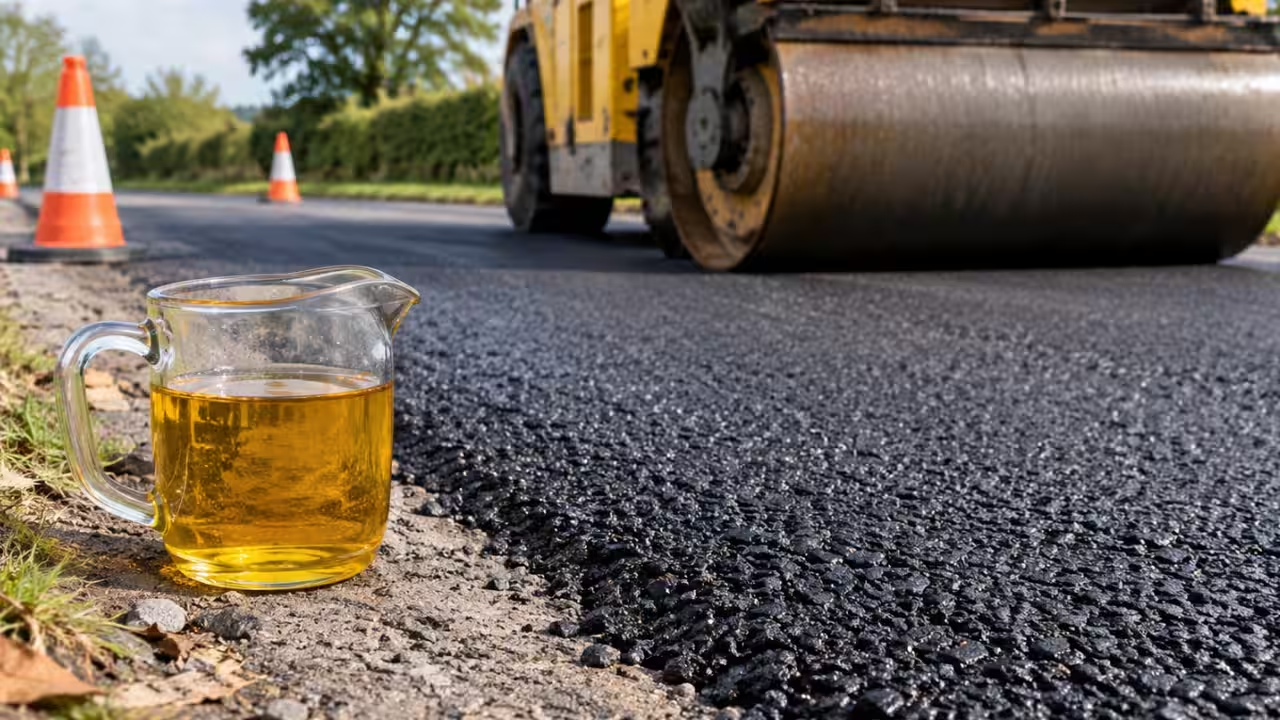
In October 2009, engineers on a road in Bedfordshire, England, mixed used cooking oil into asphalt. According to the technical paper by Helen Bailey and Salah Zoorob, presented at the 2012 Eurasphalt & Eurobitume Congress in Istanbul, the test mix aged 20% less than a mix made with standard bitumen. A visual check conducted six months after the placement showed no early signs of damage. It suggests that leftover kitchen oil can have a surprising second life.Why roads need slower ageing Roads are made of crushed stone held together by bitumen, a thick, black glue made from crude oil. With time, heat and air age the bitumen, making it harder. Hard bitumen then becomes more prone to cracking, through which water can get into the road. This can eventually end up creating potholes on the roads. For this reason, engineers take the ageing process of road material seriously. The mix that ages more slowly may last longer, and this idea was the basis for the Bedfordshire test.What happens on New Road The trial took place on 20 October 2009 on New Road, Clifton, Bedfordshire. The engineers made 40 tons of a control mix with standard bitumen and 40 tons of an oil mix. For the oil mix, they took a harder bitumen and softened it up with used vegetable oil until the grade was the same as standard. According to the paper's composition table, the oil was only about 0.1% of the mix. This is small because bitumen itself makes up only 5% of a typical asphalt mix, so the oil was a much larger share of the binder. Both mixes were placed on the same road so that samples could be compared.Samples from the site were then tested in a laboratory. Some were put in an oven to simulate long-term exposure, which the paper estimated to be equivalent to 7 to 10 years of service. The oil mix aged 20% less than the control mix. The average texture depth was 0.6 millimetres for both mixes, and the paper recorded no difference in texture or surface regularity. Six months after laying, a visual inspection showed the site in good condition with no early signs of deterioration.What the paper admitted it cannot say The paper was upfront about the trial limitations. The presence of media on that day resulted in slower laying of the oil mix, so the team could not compare the compaction of each mix on the site. In the lab, the oil mix also appeared to show slightly more ageing while mixing. However, the authors reported that its results after long-term ageing were better. Six months was also too short for the life of a road, and the paper noted that monitoring would continue.Is this only one lucky road?The same idea has also been studied by other researchers in laboratory settings. In 2017, a study published in the journal Materials by Dong Zhang and colleagues showed that waste cooking oil, in many cases, can rejuvenate aged asphalt and restore its properties. The team tested waste cooking oils of varying quality on lab-aged asphalt and found that oil quality significantly impacted the results. Oil with low acid value and viscosity gave better results. This was a lab test and not a road test, so it supports the idea but doesn't show that it works on every road. Together, the road trial and the lab study suggest that used cooking oil may have a role to play in road building. Longer tests are required before anyone can say how well it works.You use AI every day. Now get your AI Quotient. Take the AIQ test.
Topics in this story
Gathered from external sources. Rights to this text belong to whoever originally published it.