A Michigan businessman brought nine white-tailed deer to North Manitou Island in 1926; decades later, the artificial herd had grown to an estimated 2,000
US News: North Manitou Island was never home to large game until a wealthy Michigan businessman decided it should be. In the mid-1920s, William R. Angell, the .
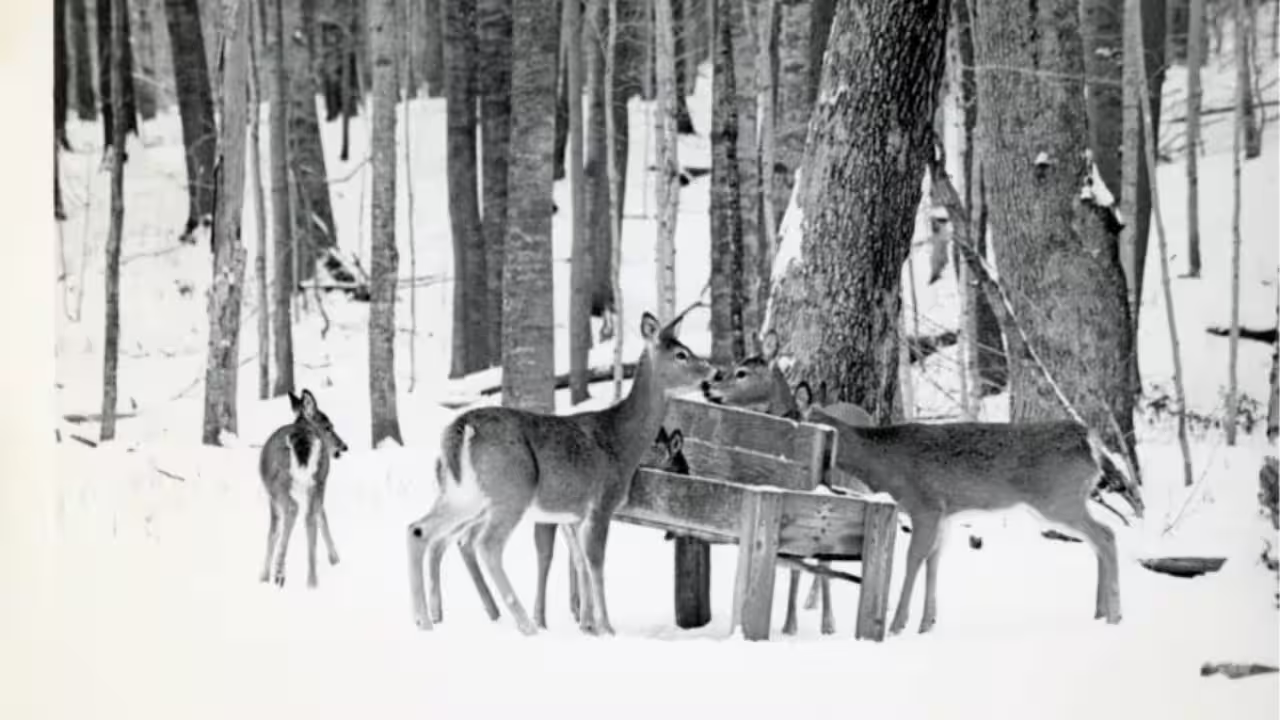
North Manitou Island was never home to large game until a wealthy Michigan businessman decided it should be. In the mid-1920s, William R. Angell, the driving force behind the Manitou Island Association, set out to turn the 15,000-acre island into a private hunting and fishing retreat for himself and his associates. His answer was to bring white-tailed deer to a landscape that had never supported them, nine animals shipped over from the mainland with no natural predators waiting on the other side. What began as a modest experiment in stocking a sportsman's playground would, within a few decades, grow into one of the largest deer herds ever recorded on an island of its size, reaching an estimated 2,000 by the early 1980s and forcing a reckoning between private ambition and the land's own limits. That story starts with Angell himself, and the choices he made in 1926.How William R. Angell brought nine white-tailed deer to North Manitou IslandIn the mid-1920s, businessman William R. Angell set in motion one of the most consequential wildlife experiments in the history of North Manitou Island. Angell, the principal owner behind the Manitou Island Association, wanted to turn the 15,000-acre island into an exclusive retreat where he and his associates could hunt and fish away from the mainland crowds. White-tailed deer were central to that ambition, and in 1926 he had a small founding herd brought over to establish the population from scratch.As per The Leelanau Historical Society, a slightly fuller account of the same event, recording that the white-tailed fawns were sourced from the Munising State Forest and arrived nine strong, eight does and a single buck, chosen in the hope that their bloodline would eventually produce impressive racks for hunters to pursue. Whichever figure is taken as the precise starting point, both accounts agree that the white-tailed deer were an entirely artificial addition to an island that had never supported large game before.How deer became the main attraction for wealthy sportsmenAngell's motive for introducing deer was never purely sentimental. He and his fellow landowners in the Manitou Island Association were building a business, and a stocked hunting ground was the product they wished to sell. Raccoons had already been released in 1924 for the same purpose, but it was the deer that would come to define the island's reputation among wealthy sportsmen throughout the following decades.The early years were not without difficulty. Farm dogs on the island reportedly killed three of the original fawns when they tried to herd the newcomers as though they were cattle, mistaking their unfamiliar behaviour for something that needed correcting. Once that initial disruption passed, however, the surviving deer found ideal conditions on North Manitou. With no natural predators and abundant vegetation to browse, the small founding group began to multiply at a pace that would soon outstrip the island's capacity to support them.How nine deer grew to 700 on North Manitou IslandUnchecked breeding transformed Angell's modest founding stock into a genuine management problem within little more than a decade. By 1937, the population had swollen to an estimated 700 animals, prompting the Manitou Island Association to organise the island's first official deer hunt with assistance from the State of Michigan, alongside a winter supplemental feeding programme to keep the herd alive through the harsher months. By the 1950s that figure had climbed to around 1,000, and naturalists and state officials returned periodically over the following decades to count the herd and assess its condition.The growth did not stop there. According to the National Park Service, "By counts in the early 1980s, there were about 2,000 deer on the island," a scale that had visibly reshaped the landscape itself. The deer stripped the island of almost every plant they found palatable, leaving a distinctive browse line five to six feet above the ground and allowing unpalatable species such as American beech to flourish unchecked in their place, a stark contrast to the lush understorey still found on neighbouring South Manitou Island.Why North Manitou Island became a private hunting retreatFor much of the twentieth century, the herd Angell had founded served a narrow and well-heeled clientele. Hunters were generally guests of the island's principal owners or corporate clients drawn from firms such as Continental Motors and Shakespeare Rod and Reel, along with government contractors and, during the 1950s and 1960s, associates of the Detroit mafia. Each guest was guaranteed a deer, driven out to a guide-selected spot in the morning and returned to the lodge for lunch before an evening of cards and conversation. Guides ensured a steady supply for the table by shooting animals from moving vehicles when demand outpaced what visiting hunters managed to bag themselves.That arrangement could not survive the island's transfer into public ownership. Negotiations between the Manitou Island Association and the US Justice Department over incorporating the island into the Sleeping Bear Dunes National Lakeshore began in 1977 and dragged on for seven contentious years, and when the Association withdrew its staff in the autumn of 1978, the supplemental feeding programme that had sustained Angell's herd through the winters came to an abrupt end. Hundreds of deer and turkeys starved over the two winters that followed, a grim coda to a herd that had begun, half a century earlier, as a handful of fawns brought ashore for the pleasure of a wealthy few.Catch the latest World News and Live updates. Download the TOI app.
Topics in this story
- Manitou Island Association
- private hunting retreat North Manitou Island
- Sleeping Bear Dunes National Lakeshore
- North Manitou Island deer herd
- Michigan wildlife management
- white-tailed deer introduction
- deer population growth Michigan
- wildlife conservation issues
- history of North Manitou Island
- William R. Angell
- World news
- World news today
Gathered from external sources. Rights to this text belong to whoever originally published it.